Venus and Jupiter

Visible in the Western sky this week, for those of us in North  America, will be an especially stunning conjunction of the planets Venus and Jupiter.  The two planets will come within 3 degrees of each other just after twilight and remain close till almost 11 p.m.  On March 25th, NASA will host a live chat about the conjunction of the planets, but I suppose I prefer to think of the scene from the first book of Virgil’s Aeneid, when Venus comes to her father to express the trouble in her heart.  As the poet writes,

Then Sire of gods and men upon her smiled
with mild expression calming sky and squalls,
and kissing her, he said,  “Fear not, my child.”

Olli subridens hominum sator atque deorum,
voltu, quo caelum tempestatesque serenat,
oscula libavit natae, dehinc talia fatur:
‘Parce metu, Cytherea.’

Posted in Astronomical, Classics, Poetry | Leave a comment

Protected: The Coyote and the Cliff

This content is password-protected. To view it, please enter the password below.

Posted in Cartoons, Classics, Poetry | Enter your password to view comments.

Protected: The Dance of the Graces

This content is password-protected. To view it, please enter the password below.

Posted in Uncategorized | Enter your password to view comments.

Canis Major

It was cold but clear on Sunday night as I took out the trash and, as has become traditional, the dog rushed out with me for one last run around in the woods. She disappears into the dark but can be heard barking at the deer one last time before bed.  With the leaves off the trees, the stars are more easily seen in the winter, and I was glad for that on Sunday, because I was able to just catch sight of Canis Major, who trails behind Orion.

Canis Major


The great Overdog
That heavenly beast
With a star in one eye
Gives a leap in the east.

He dances upright
All the way to the west
And never once drops
On his forefeet to rest.

I’m a poor underdog,
But to-night I will bark
With the great Overdog
That romps through the dark.

–Robert Frost (1925)

Posted in Astronomical, Dogs, Family, Poetry, Sewanee | Leave a comment

Liesegang Bands Not Fossils

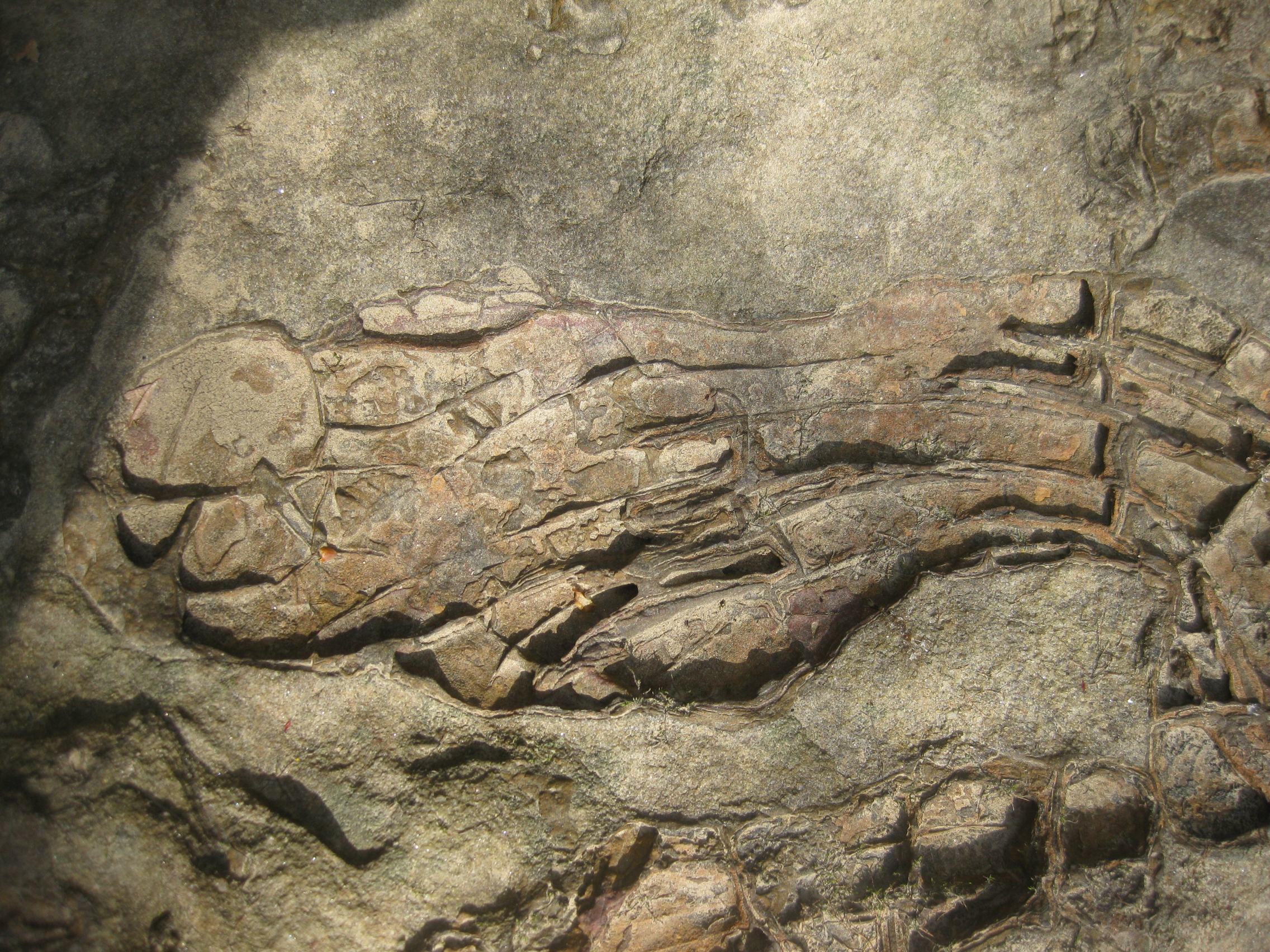
We were out hiking one day last spring when I decided to rest on a large boulder while the boys played in a nearby stream.  As I got ready to sit down, I noticed some formations in the rock, pictured below.  I was certain that I had come across some fossils, but in fact they were Liesegang bands, which form when iron in the water diffuses through a porous rocks, like the sandstone boulder I was about to sit on.  In this instance, the ferrous oxide has been deposited along the fractures in the stone to give it a sort of honeycomb appearance.  The last picture was set as my desktop image for a few months.

Posted in Sewanee, The South | 1 Comment

Protected: Adventures in Etymology! Cacafuego

This content is password-protected. To view it, please enter the password below.

Posted in Classics, England, Language & Etymology, Nautical | Enter your password to view comments.

Some Jars in Tennessee

In the woods behind my house there is a bunch of junk.  Railroad ties, rusty oil drums, the top of a washing machine with an attached wringer, et cetera, all of it old, haphazardly deposited, and overgrown with moss.  My neighbor Barbara grew up on this street and she tells me that, back in the day, all that was here was a dirt road.  There wasn’t any regular trash pick-up, so it made sense with stuff you didn’t want anymore just to haul it out to some spot far away from the house and leave it there.

So, yes, there is lots of old crap in the woods but you could also say that there’s an unexplored archeological site there, too.  Sometimes, when I am taking the dog for a walk out back, I stop and pick things up.  The kids have taken to doing the same.  Inevitably it is the dirty but not yet broken old glass bottles and jars that attract our attention.  And just as inevitably, I end up reciting some stanzas of Wallace Stevens in the meantime, though the boys have refrained from doing the same so far.

The stanza comes from Stevens’ poem, “Anecdote of the Jar,” reproduced below, which some of you may know.  Published in 1919, the poem is a classic of modernism, and is defiantly at odds with traditional literary aesthetics.  In a sort of ironic commentary on Keats’ “Ode on a Grecian Urn” (written in 1819), Stevens here questions the Romantic assertion that “beauty is truth, truth beauty.”   Maybe a jar placed in the “slovenly wilderness” of Tennessee is every bit as good as the “Attic shape” found in “Tempe or the dales of Arcady.”

Now, I love the Classics without a doubt, but I really despise cultural snobbery.  Much as I admire “Ode on a Grecian Urn,” sometimes I find it just a little too breathlessly pedantic.  The nice thing, though, is I don’t have to choose.  Hurray for you, “thou still unravish’d bride of quietness,” but hurray, too, for Wallace Stevens.  Hurray for modern ideals of American beauty.  And hurray for jars in the woods of Tennessee!

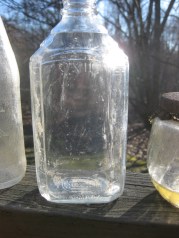
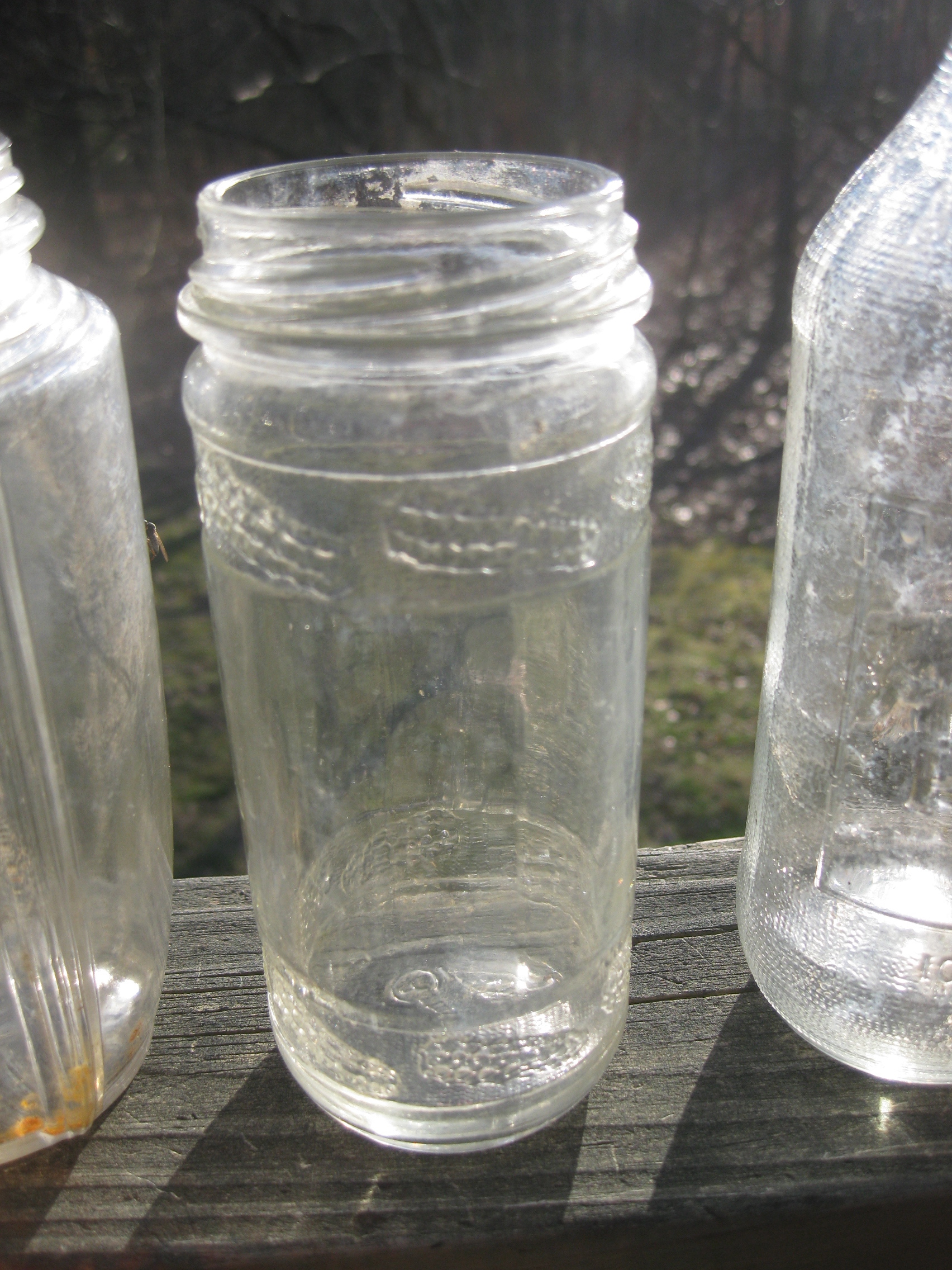
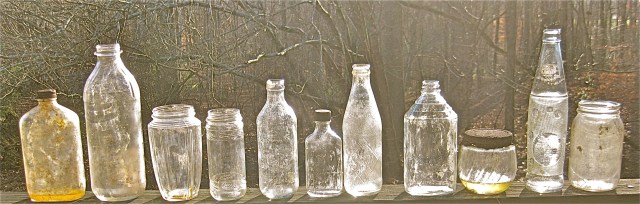
Let me share a few pictures of glass bottles and jars that the boys and I have found in the woods in the past few weeks.  I am not making any special claims about the uniqueness of their design or the rareness of their types.  All I’m saying is that there they were, ready to be picked up, small reminders of the days when the wilderness behind the house seemed the right place to cast away the excess things of this world.  My bottles and jars are, each in their own way I think, “foster-children of Silence and slow Time.”

Anecdote of the Jar

I placed a jar in Tennessee,
And round it was, upon a hill.
It made the slovenly wilderness
Surround that hill.

The wilderness rose up to it,
And sprawled around, no longer wild.
The jar was round upon the ground
And tall and of a port in air.

It took dominion every where.
The jar was gray and bare.
It did not give of bird or bush,
Like nothing else in Tennessee.

— Wallace Stevens (1919)

Posted in Poetry, Sewanee, The South | Leave a comment

Testa dell’Efebo

Last fall, Humanities magazine published an essay I wrote about the relationship between a poem by Tennessee Williams and a statuette the playwright had once owned, now here in Sewanee.  Both are pasted below.

Testa dell’ Efebo

Of Flora did his luster spring
and gushing waters bathed him so
that trembling shells were struck and held
until his turning let them go

Then gold he was when summer was;
unchangeable this turning seemed
and the repose of sculpture told
how thinly gold his shoulders gleamed.

A cloud of birds awoke in him
when Virgo murmured half awake.
Then higher lifted birds and clouds
to break in fire as glasses break

A lunatic with tranquil eyes
he must have been when he had dimmed
and that town burned wherein was turned
this slender copper cast of him.

By Tennessee Williams, from In the Winter of Cities, copyright ©1956, 1964 by The University of the South. Renewed 1984, 1992 The University of the South.

In case you’re interested to hear TW himself reading the poem, go to this podcast from KWLS: “Testa dell’Efebo” starts at 12:31.

Posted in Poetry, Sewanee | Tagged | Leave a comment

“Redheads Mean Trouble”

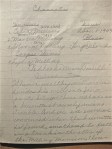
Sometime back in the 90’s, my wife found this old notebook that had belonged to my mother as a schoolgirl.  In it are several chapters of a murder-mystery she had written called “Redheads Mean Trouble.” I’m not sure how old she was at the time but I would guess she was perhaps twelve.  As can see, though, her vocabulary was excellent, as was her penmanship.  I’ve posted the introduction and list of characters below, with transcript following.  Perhaps I will post more of it in the future.

Characters

Heiresses

  1. Celia Milling (Med. Sized)(Murderer)
  2. Marcia Milling (Tall)
  3. Gloria Milling (Small)

Corpse Heiress

4.  Lydia Milling

Time

About 1949

Place

Long Island

“Redheads Mean Trouble”

Introduction

When a wealthy millionaire divides his will into four parts between three redheads and a brunette it surely means trouble. And we are evermore convinced when the brunette is found, smothered to death in a trunk in the attic of the Milling Mansion, therefore one redhead must be a murderer.  Each one has a motive yet each one has a alibi which adds more excitement to our mystery. All these clues and women help Paul Lane solve an interesting and hair-raising murder by Margaret Donahue.

Posted in Family | Leave a comment

Blockheading and Boxing Enough

The teaching of Latin a century or two ago was predicated on its very difficulty, the mastering of which offered a “mental discipline” that usually required an accompanying physical component.  Champions of classical education in the eighteenth and nineteenth century seem to have considered intimidation in the learning of Latin as not an incidental but rather an essential part of the subject. In The Life of Johnson (1791), for instance, Boswell writes, “Mr. Langton one day asked him [Johnson] how he had acquired so accurate a knowledge of Latin, in which, I believe, he was exceeded by no man of his time; he said, ‘My master whipt me very well.  Without that, Sir, I should have done nothing.’”

This is amusingly put, as so much of Doctor Johnson’s life is, but that such treatment could also be traumatic seems evident enough from an anecdote recorded in John Adams’ diary in 1769 that was recounted by his friend Benjamin Gridley, later a minor figure in the American Revolution.

“When 
I was a school Boy, at Master Lovells, Mr. Gridley my Uncle used to make me call at his Office, sometimes, to repeat my Lesson to him. I called there  one Day for that Purpose. —Well, Ben! What have you to say, Ben? Says he. —I am come to say my Lesson sir to you, says I. —Ay? Ben? What Book have  you there? Under your Arm? – Virgil sir. —Ay! Ben? Is that the Poet, Virgil?
—Yes sir. —So I opened my Book and began: Arma, Virumque Cāno, Trojae, qui primus ab oris. —“Arma Virumque Cāno!” , You blockhead. — does 
John Lovell teach you to read so? — read again. — So I began again. Arma Virumque Cāno —“Cāno” you villain, “Canō” — and gave me a tremendous 
Box on the Ear.—Arma Virumque Canō, You blockhead, is the true reading.  Thinks I, what is this—I have Blockheading and boxing enough at Master Lovells, I wont have it repeated hear, and in a great Passion I threw the Virgil at his Head, hit him in the Face, and bruised his Lip, and ran away.”

To my mind, one can make out in this childhood anecdote some dim foreshadowing of the spirit that would give us the American Revolution in a just a few decades’ time.  Master Lovell’s School, where Gridley had had “Blockheading and boxing enough” was, by the way, my alma mater, the Boston Latin School.  In 1906, Charles William Eliot, a Latin School alumnus and later President of Harvard, deplored the fact that at “the best public school of the city of Boston, and the oldest school in Massachusetts, the control used was physical force, the application of  torture — that is the long and short of it.”  At the helm of Harvard, Eliot would do more than any other American educator to dismantle the old classical curricululm by introducing the free elective system, and it is safe to say that the study of Classics in America has never recovered from Eliot’s reforms.  The Latin School masters had evidently boxed one ear too many.

Posted in Boston, Classics, Education | 1 Comment