Pictures at an Exhibition, or, “The Value-added Potential of Liberal Education”

For the Sewanee Faculty Retreat on August 20, 2010, the dean asked me to give a response to a remark in Louis Menand’s The Marketplace of Ideas, our assigned reading, about “the value-added potential of liberal education” (p. 56).

I’m sure that the prospect of listening to somebody ruminate on the “value-added potential of liberal education” fills you with as much alarm as it does me.  I presume that we are not talking about the intrinsic value of learning about useless things like Latin and Greek, the subjects that I teach, but some value beyond the intrinsic, something extrinsic, transcendent, metaphysical.  We are beginning to enter the territory of the Noble Gases (to include my friends in the sciences).  In fact, I have been wondering whether I ought to have asked Harold at Sewanee Auto if I could borrow the “100% Pure Gas” sign from his front-window for the morning, but I suppose that would not have done much for my carbon footprint.

So instead let me talk about another trip I took last week that didn’t do much for my carbon footprint either, to Washington, D.C., to visit a friend of mine who is a curator at the Smithsonian.  We spent a lot of time tooling around in the several museums that ring the Mall, and I must say that looking at museums with a professional is an instructive experience, and a useful analogy for considering the idea of the liberal arts  curriculum.  Both the college and the museum are engaged, after all, in the connected tasks of preservation and explication of knowledge.  It’s a tricky business, this knowledge-preserving and explicating, and the different museums in D.C. reflect the variety of ways in which it might be done.

There is the very high-brow tone of the contemporary art museum, the Hirschorn, for instance, in which it is supposed that visitors don’t need a term like “expressionism” defined because they wouldn’t have entered the museum in the first place if they did.  And then there are the more populist venues, in which an ignorance of the material is taken for granted and the interpretive capacity is presumed to extend no further than “I like it, but I can’t say why.”  It seems to that the variety of approaches to museum exhibition is analogous to the ways in we think about about the aims of coursework in the majors, which would be more like that of the Hirschorn, and that in general education, which would be less so.  An example of the latter would probably be the show now up of Norman Rockwell originals from the collections of Stephen Spielberg and George Lucas, concerning which my friend and I had a vigorous debate:  was he being a snot-nosed elitist or was I being a mouth-breathing philistine?  We “agreed to disagree,” you will be pleased to know.

One thing my friend and I did not disagree about was the National Gallery’s 1659 self-portrait of Rembrandt.  This is a truly compelling work, and we spent several long minutes silently scrutinizing the deft brushwork.

I found myself wondering, what does the look on his face mean?  He seems pensive, yet also calm.  What do you call that kind of emotion?  Is it a specifically seventeenth-century Dutch emotion?  Is it an emotion I would recognize in myself?  These were some questions that came to my mind, but it seems to me that what we’re here to discuss today is another question which stands apart from these, and dealing with a college career and not an afternoon at the museum.  Which is the fact that, unless you intend to be an art historian, the close study of Rembrandt’s brushwork will probably never get you a job.  So, is it still worth doing, and if so, why?

In terms of added as opposed to intrinsic value, one answer might be Yes, it is worth doing because the close study of any topic trains the mind in the habit of analysis, making one a better thinker and a consequently a more marketable one.  This sort of justification for the liberal arts once was categorized as “mental discipline,” and more recently as “critical thinking,” and even more recently as “core competency.”  At the heart of this idea is the concept of the “transferable skill.”  A demonstrated ability to pick apart a sonnet, a sonata, or a small rodent (to include my friends in the sciences) is useful in picking apart the problems of the non-academic workplace.  According to this way of thinking, in school students become habituated to the idea of method, and learn both how to ask fruitful questions and how to go about answering them.  If nothing else, they learn how much labor is involved in getting to a satisfactory response, how to work hard to do well.  As the woman who ran the Human Resources department at the bank I once worked for told me, “If you can impress a college professor about his or her own area of expertise, you can certainly do the work here.”

Another, older response to the question of why we bother with the liberal arts does not focus on developing skill sets in this way, but instead considers the acquisition of cultural and scientific knowledge unashamedly as a matter of pedigree.  This is an obviously elitist idea of education, but at one time, it was the primary reason one sought an education at all. To speak and write with polish, grace, balance, proportion, etc., about the natural world or the world of the arts—these were the credentials of the aristocracy.  Absent such credentials, one would be unlikely to have found a place or a position among the upper class.  Such an idea today is often snidely dismissed as “cocktail party talk,” and yet it is just such talk at cocktail parties that comprises the all-important networking by which gainful employment is often found.  And you know, I’ve yet to meet the person who wished they sounded less educated in social situations.

And then there is the “added value” of values themselves, the belief that liberal education has as one of its primary goals the formation of character.  There was a time when humanists like Irving Babbitt felt strongly about such things, but it’s hard now to think of a phrase like “instilling virtue” without also thinking of the phrase “ramming your agenda down my throat.”  What makes this particular idea so controversial, of course, is its obvious political bias, from the left or right, and what makes it ring hollow is the sad fact that there has been many a liberally-educated person who went on to do horrendous things.  Classical allusions came readily to Cortez’ mind, for instance, as he massacred the Aztecs.

Yet, I think it is the case for most of us that we hope something we teach will make some unusual claim on our students, and that it will not just make them smarter but also make them wiser.  And there are students, too, who hope for that Eureka moment of self-discovery in college, and do not go away disappointed.  I can recall myself being a sophmore at Tufts and reading the bittersweet Satires of Juvenal and thinking, You know, this guy makes a lot of sense.  I found Juvenal an especially helpful guide when working in the bank.  Perhaps it is worth noting that I still own my copy of Juvenal, but the bank I worked for then went under in 2008.

So those of some reasons, writ large, of why the study of impractical things like the Satires of Juvenal or the brushwork on a Rembrandt might be of added value in a liberal education:  it may make you more skillful and hard-working, it may make you more cultured and clubbable, it may make you more self-aware and wise.  It’s not necessary to choose which of these senses of liberal education best describes the work we do here at Sewanee.  We can find traces of all of them inside the classroom and out as it is, and if they seem to sit a little inconsistently beside each other at times, well, so be it.

But I think there is at least one last idea to ruminate on in our general education curriculum particularly.  It’s in the majors, by contrast, that students delve more deeply and earn the right perhaps to leave here cum laude, “with praise.”  But in the earlier years when they’re usually enrolled in 100-level classes that students have the bewildering experience of education which Alexander Pope likens to mountain-climbing in his Essay on Criticism;  getting to the summit, one looks out only to realize that “Hills peep o’er Hills, and Alps on Alps arise!”   It seems to me that this may be the best preparation for the world as it will actually be encountered, as a place with so much that’s knowable, and so little possibility that we might learn it all, or even very much of it.

So let me end by altering the terms of my initial analogy: the world our students enter is like the museums that ring the Mall in Washington, some of which have spaceships, some of which have tomahawks, some of which have stuffed rodents, some of which have art that is explained in a way that is way over your head, some of which have art that is an insult to your intelligence.  All of which is to say that the world is a baffling place with Alps on Alps that our mountain can honestly do only so much to prepare them for.  It’s no small thing if our students leave us with some passages of Juvenal in mind, or the image of a 17th-century Dutch master whose expression radiates a sense of calm self-possession though his world was just as bewildering as our own.  Out there in their own worlds, our students may find such things genuinely useful, even intrinsically valuable.
Posted in Education, Sewanee | 8 Comments

Ann Burns, Confederate Captive

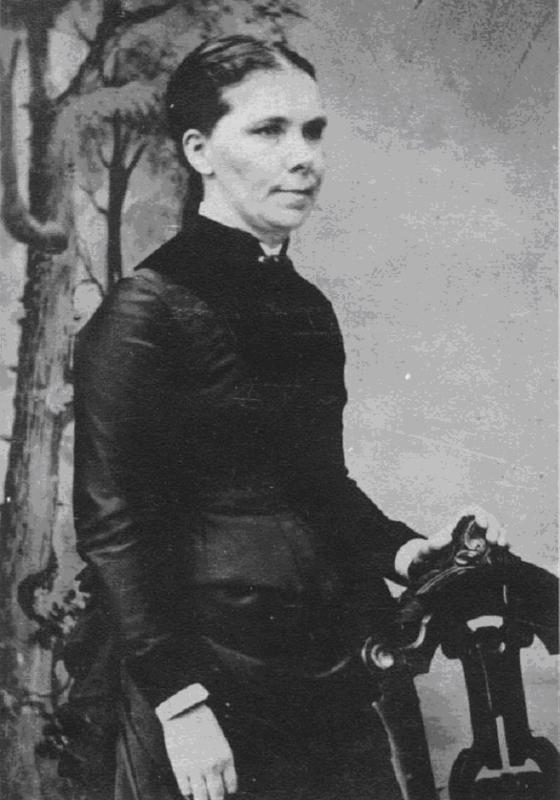
My cousin Theresa recently brought an intriguing story to my attention about my ancestor, Ann Burns (later Byron).  I had already known that she was at one time Ralph Walso Emerson’s cook and had been an important member of the Irish Catholic community in Concord, Mass.  What I had not known was that, during her passage from Ireland to America, she had been briefly the captive of a Confederate privateer!

In the early summer of 1863, a Confederate naval officer named Lt. Charles W. “Savvy” Read was conducting an audacious raiding mission in the waters south of Nova Scotia.  Before he was apprehended, Read would seize or destroy twenty-two U.S. vessels.  Not for nothing was he latter dubbed “the Seawolf of the Confederacy.”  Among the ships Read captured at this time was the Shatemuc, a clipper ship making its maiden voyage across the Atlantic with hundreds of Irish immigrants, among whom was my grandmother’s grandmother, Ann Burns, then eighteen years old.

According to an article published later in the naval magazine, The Rudder, Read’s ship, CSS Tacony, had had a close encounter with a Federal gunboat on the evening of June 23, 1863, about 150 miles east of Portsmouth, NH.  As the article goes on,

“Next morning, in 43° 10′ N., 67° 43′ W., the weather still being thick, with occasional lifting of the fog, a ship was sighted, and on coming up was boarded. She proved to be the Shatemuc, Liverpool for Boston, with 350 immigrants and cargo. Lieutenant Read took charge of her, and remained aboard all day, the Tacony standing by. The Shatemuc carried iron plates (probably for gunboats), and Lieutenant Read for this reason wished to destroy her, if he could secure vessels to take her passengers. None appearing, he bonded the ship for $150,000, and toward night left her.”

Later that day, Read captured a schooner named the Archer, to which he decided to shift command, and set fire to the Tacony.  Hence, while the Union navy continued to search for the rebel ship on the open sea, Read was able to slip past them to enter Portland Harbor.  Nobody there suspected that the fishing vessel was in fact now a Confederate raider, and Read took advantage of the situation to steal a US cutter called the Caleb Cushing.  By the time the authorities had figured out what was going on, the Cushing and Archer were well on their way out to sea.

A swift fleet of Union ships soon gave chase and the incident that followed has been called “The Battle of Portland Harbor,” one of the northernmost encounters of the Civil War.  “Savvy” Read was captured and brought back to Maine, but was soon transferred for safekeeping to Fort Warren, on George’s Island in Boston Harbor.  Perhaps it is worth pointing out that, only a few short days beforehand, the Shatemuc had arrived in Boston with its hundreds of Irish immigrants, Ann Burns one among them.

Postscript. According to the passenger manifest record in the Massachusetts Secretary of State’s office, Ann Burns arrived to Boston on July 23, 1863.

Postscript, March 2026. So, two other things on Ann Burns.

Emerson writes to Francis Channing Barlow, December 26, 1863 (The Letters of Ralph Waldo Emerson, ed. Ralph L. Rusk (Columbia U Press, 1939) Vol. 5, p. 343, see link here) that he had forgotten Christmas day was coming, and with it the holiday for the help. His guests and family would need to fend for themselves, because the Irish cook– simply called “Ireland”– would not be on call. As he writes,

“I had learned first from Edith, who made the discovery, only two days before, that Friday was to be Christmas, & I was properly mortified at the contretemps. Had we all persisted in our day, we should have had a philosophic hour, — my wife laid up in blankets, for a few days past, & Ellen & Edward sole cooks, — indispensable Ireland deserting range & pantry on the holiday.”

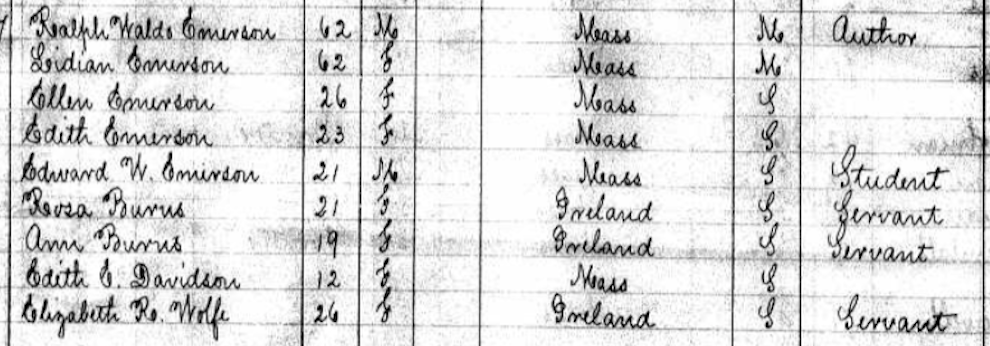
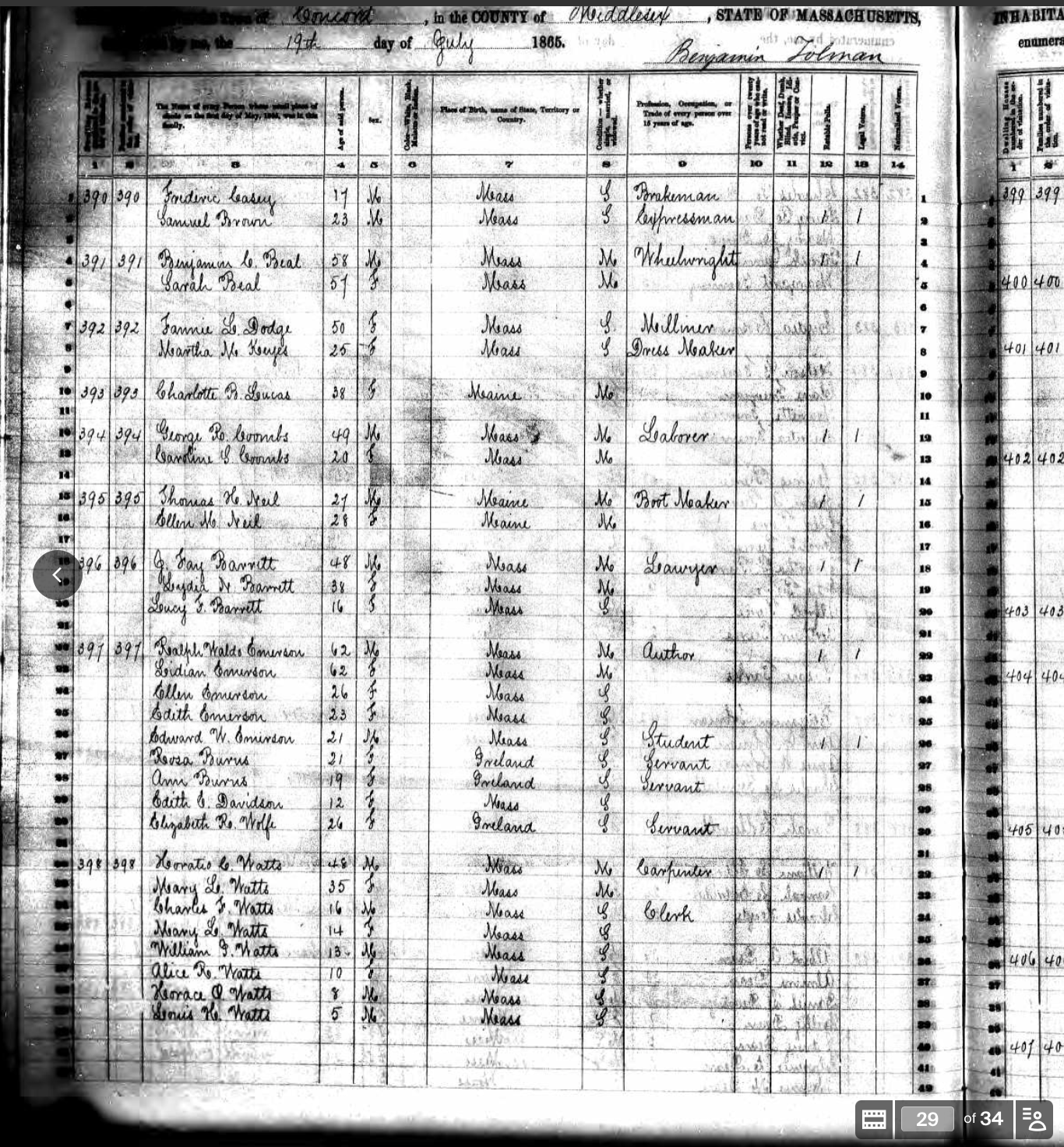
The postscript is that Ann Burns appears in the 1865 Concord census as living in Emerson’ household.

Posted in Boston, England, Family, Ireland, Nautical, New England, The South | 3 Comments

All Things Uncomely and Broken

For the title of my blog, I decided to use the first line of W.B. Yeats’ 1892 poem, The Lover Tells Of The Rose In His Heart, quoted in full below.  It’s long been a favorite of mine. When we were with my father in County Galway about twenty years ago, my wife and I bought a lovely print of this poem, rendered in an appealing Irish uncial with illuminated lettering.  It is my hope to upload an image of it soon.  It’s featured above.

While I have always admired Yeats’ lyricism, I cannot say I share his sentiment in this poem, or at least not entirely.  Sure, there is something distressing about what is aesthetically unappealing.  Who doesn’t like a rose-garden better than, say, a strip mall?  The poet’s desire to have a world fashioned perfectly for his love is deeply moving.  But, then again, the yearning to have everything “re-made” strikes me as a tad fascist, and the phrase “like a casket of gold” is sort of morbid.

So, if I have problems with the poem, why name my blog for it?  Mostly, I guess, because of the way the words sound.  But in addition, it is because I imagine this blog will be made up of observations mostly disjointed in nature, not seamless and coherent.  In The Valley of Fear, Conan Doyle has Sherlock Holmes dismiss a theory because it fails to account for “the nasty, angular, uncompromising bits which won’t slip into their places.”  That almost became the name of the blog—“Nasty, Angular, Uncompromising Bits”—but I don’t have a nice print of that quotation all done up in fancy calligraphy.

The Lover Tells Of The Rose In His Heart

All things uncomely and broken, all things worn out and old,
The cry of a child by the roadway, the creak of a lumbering cart,
The heavy steps of the ploughman, splashing the wintry mould,
Are wronging your image that blossoms a rose in the deeps of my heart.

The wrong of unshapely things is a wrong too great to be told;
I hunger to build them anew and sit on a green knoll apart,
With the earth and the sky and the water, re-made, like a casket of gold
For my dreams of your image that blossoms a rose in the deeps of my heart.

Posted in Ireland, Uncategorized | 6 Comments

The Least of My Brothers

JANUARY 2, 2012. Mark Byron McDonough, age 42, of Leominster. Son of the late Margaret B. (Donahue) and James M. McDonough. Survived by his guardian, Gene Buchman and family, with whom he lived for many years, and by foster brother Patrick O’Connor. Also survived by siblings Christopher M., Sheila M., James F. and Michael P. McDonough. A funeral service will be held at Boucher Funeral Home, 110 Nichols St., Gardner, Mass., on January 13, at 11:00 A.M. Interment at St. Joseph’s Cemetery in West Roxbury, Mass. will follow.

When I e-mailed my siblings last week that Mark had died, my brother Michael wrote back, “I almost feel like it isn’t even our business,” and I certainly understood what he meant. Mark was the fourth in our Irish-Catholic family of five children, but when he was young, he had been given up for guardianship to a man named Gene Buchman. It was an unusual situation, different from the way other families were. Because it was hard to understand or to explain, we stopped trying to understand or explain it. Mark had disappeared from the family, and little by little, he disappeared from our idea of the family. If we thought about him, we didn’t really speak about him. He had gone from being a brother to a memory to some sort of palpable void. That’s just the way it was.

There were times, of course, when Mark had very much been a part of our family. I have never been entirely sure of his diagnosis, but he seems to have been autistic, with some retardation and evidence of bipolar disorder. He was certainly obsessive-compulsive, and there were a wide range of ritualistic behaviors he would engage in, sometimes to great amusement. When my mother would strike a match to light a cigarette, for instance, he would make her say “G.I. Joe” over and over again before she could blow it out. If she failed to obey his directions precisely, he would scream and take off all his clothes, usually in public. Mark’s obsession with G.I. Joe was almost total, and for years he carried around a detached G.I. Joe head, complete with fuzzy 70s “life-like” hair, as though it were a religious totem. One day, however he lost it, and though we searched high and low, G.I. Joe could not be found anywhere. Mark was inconsolable. Years later, my father would hire an Irish cousin named Noel to do some renovations in the house. My siblings and I all treasure the moment when Noel emerged from the long-disused kitchen bathroom, where he’d just removed the drainpipe from the sink. He was holding up G.I. Joe’s head, and  asked, in his thick Irish brogue, “Who’s the little man?” It really did seem to us like the recovery of a legendary item, the Golden Fleece or a fragment of the True Cross. But it was, for us, much more important than that: it was a shard of an almost-unremembered past, dredged suddenly up into the present.

So, there were certainly some surreal and humorous moments that came from Mark’s company. But it is important to remember too, that he was a destructive child, and his capacity for damage was greater than my parents’ capacity to stop it. My mother had had, for instance, a large collection of LPs that she had bought over time, starting as a shop-girl in Filene’s in the 50s, which included albums by Elvis, the Kingston Trio, and the Beatles. Mark smashed every one of those records. It’s hard to remember, in our iTunes age, how difficult music used to be to come by, how you could not simply do an internet search and download a song you once remember liking. If you had a record, and it got warped or scratched or broken, and was no longer on sale, well, that was that. The albums were not so much material possessions as they were emblems and expressions of her youth, and I think, as such, they were hard for her to lose. While all this was happening, the bedroom my father shared with Mark was missing most of its wallpaper, since, whenever he was put into his room for time-out, Mark would dig his fingernails into the walls and rip some of it down. The room remained that way, scratched-up drywall with scraps of wallpaper stuck to it, until I went off to college. Even after Mark left, my parents did not ever really sleep in the same bedroom again.

My brothers and sister will have stories of their own, but I can recall one Christmas morning getting from my grandmother a brand-new Radio Shack pocket calculator. Some of you are too young to remember what a big deal the calculator was when it first came out. Here was a gadget every bit as cool as an 8-track tape-player or a digital watch, but with a futuristic functionality that connected it to things like MIT and Star Trek. I was ecstatic about this new toy, but, in the way of pre-teens everywhere, I left it lying around, and by the afternoon, Mark had predictably demolished it. I was furious, and made a point of seeking him out and booting his ass as hard as I could. For weeks afterward, you will be pleased to know, Mark would kick me whenever he saw me, which I can’t deny I had coming.

Mark’s impulsive behavior was not limited to our home, and he could be a real terror to West Roxbury, the neighborhood in which we grew up. In some ways, there was a cute “Dennis the Menace” quality to his antics, teasing local dogs and rolling other families’ Jack-o-lanterns down the street. To see him sitting naked on top of one of the local cars, peeing and laughing at the top of his lungs, struck me as a boy as an act of high hilarity. The neighbors did not see it that way, however. Autism was little understood or tolerated in those days, and they figured they had better supplement the permissive parenting Mark was surely getting at home with something a little more traditionally physical. At least that was what my mother thought, and she made her accusations openly. Relations deteriorated quickly, and at one point, one of the neighbors yelled a nasty name at her as she drove down the street. She responded to this by jamming on her brakes, marching over to him, and slapping him on the face in front of everyone.

Before long, an all-out war raged between us and, it seemed, every one who lived around us. Some of the teenagers who hung out on the corner near our house have grown up, I’m told, to be not such bad men, but they were very bad kids. For years, our house was routinely egged on Halloween. One year, it was spray-painted with the words “You Suck.” Another year, a cross was burnt on the lawn. It was all very threatening. The sense of insecurity in our own house certainly exacerbated the sense of disunity as a family. None of this was Mark’s fault, of course, but none of it would have happened except for Mark.

These were the circumstances in which my parents made their decision to let Mark go, or at least I imagine so. We never talked about it. We did not see Mark again after 1979 or so. For reasons of her own, my mother did not make a point of keeping Mark a regular part of our lives after he’d come under Gene’s care. If I had to guess, I would say that she felt a sense of failure in realizing that she was incapable of raising one of her own children, and in needing to admit that this incapability had had devastating effects on the rest of her family. As many of you will know, she died in 1987 after years of depression. The cause of her death was a drug overdose. She was forty-eight, the same age I am now. After my mother’s death, my father endured his grief as best he could, and spent some part of the next two decades reflecting on the problems of his own broken childhood. He turned his attention to family in Ireland and visited them a number of times. And of course, he spent most of his days traipsing around Castle Island in South Boston, his childhood home. I cannot recall ever discussing Mark with him during those years.

Photo taken by Gene Buchman

Sometime in the ‘90s, curiosity compelled me to look Mark up, and Michael, my wife, and I went to see him in the group home where he lived in Framingham. Gene was generous enough to take us out there, though he was understandably aggravated that we had not made an effort sooner. It was a good visit, but we did not follow up on it, which I am sure also aggravated Gene. The sad truth is that too much time had passed for me to reach out to Mark in any real way. My parents had decided all of this for us, with finality, years before. Mark was “the least of my brothers,” but it would have taken a stronger and better man than I am to break through all the very real barriers that separated us. I think my my failure to remain in touch with Mark after seeing him again is understandable, though it is nothing to be especially proud of, either.

It has been heartening to think, as I never have before, that my parents’ decision had been the best thing for Mark. The love and understanding Gene was able to give Mark in the years he lived with him were all that he deserved, far from the callous environment of West Roxbury. The people over the years who have cared for Mark in various group homes, and especially those associated with the Institute of Professional Practice, were able to help him develop into a better functioning member of society, and to help him direct his humor and energy to productive channels. For all of these things, my family and I are deeply grateful. To be able to feel a sense of gratitude in the midst of tragedy, to be able to feel something so positive in our hearts where for years there had been just a guilty void, is no small thing at all.

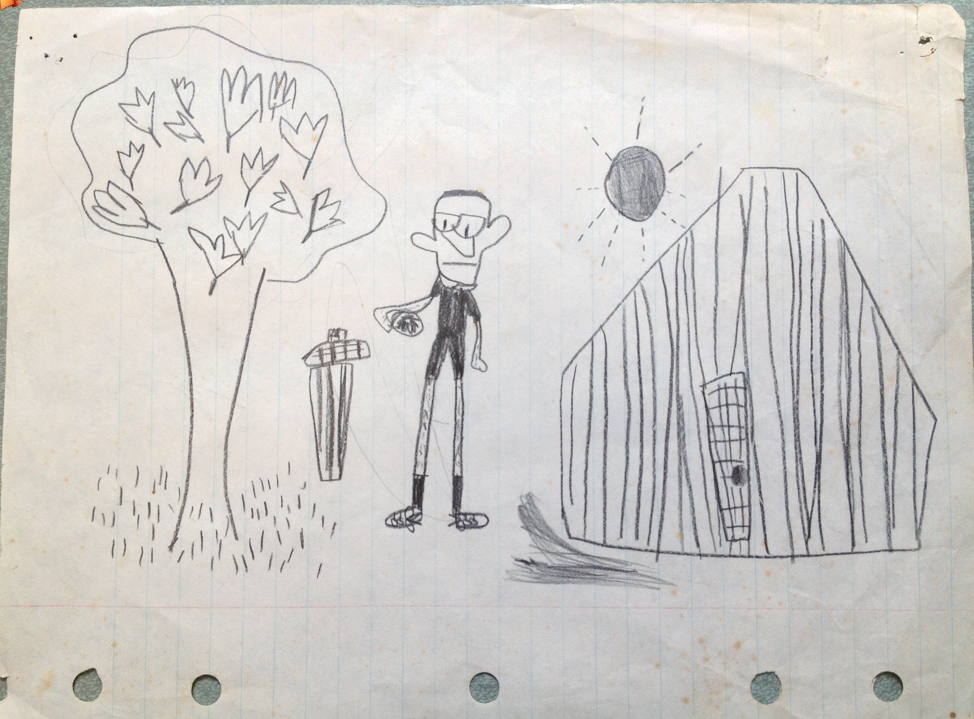
When I think of Mark, it will be his drawings that come to my mind. He drew incessantly as a boy, and quite well. His figures were recognizably cartoon-like, and the settings always distinct and easy to make out. He had a fine eye for detail, whether it was in the dotted lines that represented sunrays or the careful arrangements of leaves in a tree. There is one elaborate picture I recall in particular. It is obviously my family’s kitchen, except that everything is in disarray. The table is askew, the dishes are in the air, and the phone is flying off the hook. The people in the scene, whom I don’t recognize, have their heads tilted back and are laughing uproariously. In the corner, written in large, perfectly-formed script are the uppercase letters B, A, and D. I’m still not sure what to make of the contrast between the absolute frenzy of what is depicted in our kitchen and the exaggerated control in the lettering of the label “Bad.” Was it a description of his mental landscape, and a recognition of how others thought of it? Was it a portrait of our family as he saw it? Maybe it was a joke? All I know is that there is a complexity to the picture, something that does not immediately yield to ready understanding, but not because it is poorly-composed or badly-drawn. It is a piece from a young mind working itself out. All young people have to do that, of course. It’s just that Mark’s task was an awful lot harder.

Atque in perpetuum, frater, ave atque vale

Screen Shot 2015-12-16 at 4.13.34 PM

Posted in Bible, Boston, Cartoons, Cemeteries & Funerals, Dogs, Family, Ireland, Music, Trees & Flowers | Leave a comment