Major Archibald Butt

Major Archibald Butt has a funny name, it cannot be denied— Major Butt! Har har har— but by all accounts, he was a kind and even noble soul who died a hero’s death when the Titanic sank in the North Atlantic one hundred years ago today.  A graduate of Sewanee’s class of 1885, he was apparently the picture of Southern chivalry at the time of the ship’s sinking.  It was reported shortly afterward that, when one man tried to make his way into a lifeboat, Butt pulled him back and said, “Sorry. Women will be attended to first or I’ll break every damned bone in your body.”  His reputation among Titanic buffs has grown apace over the years.

After graduating from Sewanee, Butt joined the army and ended up serving as chief military aide to Presidents Theodore Roosevelt and William Howard Taft.  It was at the Major’s suggestion, in fact, that Taft came in 1911 to Sewanee to deliver a wide-ranging speech from a make-shift podium erected in front of All Saint’s Chapel.  The image above is from a set of stained-glass windows on University history in the chapel vestibule, only a few feet from where the President and his aide stood that day.  I will admit to experiencing a slight vicarious thrill when I look at it, as though somehow the vivid colors of the window associate me in some way with the particulars of their story.

I have seen a black-and-white photograph of that event, which I hope sometime to scan and upload.  In it, Taft is speaking, and he is ebullient in the way of all politicians.  Behind the President, Butt is harder to make out.  Before them is a sea of umbrellas.  Here and there you can make out undergraduate faces straining to hear Taft’s speech in the rain.  It has occurred to me that many of these young men will go on in the next few years to fight in the First World War and not return.  The Sewanee Memorial Cross which looks out from a bluff into the valley below was erected in honor of their collective sacrifice.

But all of that is in those young men’s futures.  In Archie Butt’s future, of course, is the Titanic and the iceberg.  His name, one posthumous tribute observed, “once synonymous of laughter and jest, now symbolic of heroism, was repeated while eyes blurred and voices became queerly strained.”  Also aboard the Titantic on that fateful voyage was Francis Millet, the artist twenty years Butt’s senior with whom he shared a house in Washington.  He may have been Butt’s lover, although this is only speculation.  In Washington, not far from the White House, is the Butt-Millet Memorial Fountain, erected privately, “with the sanction of Congress” as the inscription says, to commemorate their friendship and tragic deaths.
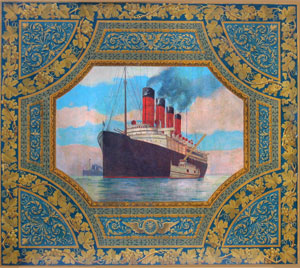
Whatever the nature of their attachment, it is clear that Butt and Millet were close.  Millet was himself also a significant figure in his day, and many of his paintings and large-scale murals still are to be found in American buildings.  The image to the left is from a series in the Federal Courthouse in Cleveland, originally created for the Post Office, that depict scenes of postal delivery.  Its title is  “Foreign Mail Transfer, New York Harbor,” and was completed in 1911.  The paint on it was hardly dry when Millet boarded the Titanic, together with Butt, headed for New York but never to arrive.

In thinking about such weighty events, I am often inclined to draw a literary connection, as some of you may know.  There was, in the days that followed the loss of the ship, an outpouring of  poetry about the Titanic’s larger meaning, most of it execrable.  Thomas Hardy’s “Convergence of the Twain,” on the other hand, is a profound (and not atypical) meditation on the operation of Fate.  It is worth reading in full, but one stanza in particular stands out for me:

And as the smart ship grew
In stature, grace, and hue,
In shadowy silent distance grew the Iceberg too.

It is a hundred years later.  Global warming has loosed more ice from its Arctic network, though travel is more fraught with fear of disaster of human rather than natural origin.  If yours was a gay relationship with Francis Millet, Major Butt, you would find the political discourse on the subject more open and yet more vexed now than it had been in your day.  Earlier this year, an Italian liner ran aground, and you would be amazed to know her captain was among the first to abandon ship.  But perhaps it would please you to know that, at Commencement each spring, Sewanee students and professors walk over the spot where you stood faithfully alongside President Taft so long ago.  A century from now, I wonder, who of us will be remembered as you are now, courageous in the face of unspeakable horror?

Posted in Military, Nautical, Poetry, Sewanee | 2 Comments

Argus’ Tale

Sometimes when I’m teaching Homer’s Odyssey, I ask students to write a short story about a passage they’ve read but from the perspective of a character other than Odysseus.  I decided to try my own hand at the assignment.  It’s based on an episode from Book 17, when Odysseus, now back home in Ithaca, comes to his palace disguised as an old beggar.  A grim fact of Odysseus’ return has been the failure of almost everybody to recognize him without being told; only his old dog, Argus, knows him for who he is (a translation of the original passage is below my story). It’s a classic tale of canine loyalty, but my idea was to complicate it a little.

Argus’ Tale

There was a time … well, I think there was a time, because I can’t remember all that well any more.  But there was a time when I had an excellent nose.  I could track anything– stags, birds, you name it, I’d get the smell and I was after it.  And I’d catch it, too!  I would.  You laugh, but I would, because I was fast.  Look at him go, the hunters would say when I tore after some boar or other, and my master would smile and say, Oh yeah, he’s fast alright.  That’s what he’d say.

Those days are over, though.  My nose isn’t what it was, and my legs are, well, let’s say that I just don’t get around that much anymore.  And my master has been gone for a long time, too.

I usually lie here, outside the palace.  There are always a lot of people going in and out of the palace, and they always have some small treat for me.  It works out well.  I lie here and, when I see them, I struggle to my feet and give the old tail a wag, and  they give things to eat.  They seem to have a lot left over every night. … There was a time when the servants would bring me the juiciest pieces of the prey I had hunted down.  I was the king’s dog, and I ate better than most of the people in the house.  Why shouldn’t I have?  I’d caught it, hadn’t I?

Well, that was a long time ago.  I don’t know, lying here’s a lot easier than running after things.  I was fast once, you know … maybe I already told you?  I can’t recall.

Did I mention that I used to have a really good nose?  Oh, I could tell you who everyone was even if I’d only sniffed them once.  My master had some many friends who would come, and I knew right away who was who.  Their clothes might smell of salt, and I knew they had come straight off from the sea.  And maybe their sandals were made of leather from a kind of cow that you don’t find around here.  I could smell all of that, and I’d know.

I can’t smell anything now, though.  And it hardly matters.  The men going in and coming out of the palace, I can’t even tell how many of them there are, maybe a hundred, maybe more.  When they pass by, I make a big show out of getting up, and I wag my tail and that’s usually enough to get a little snack.

Anyway, here comes one.  Just try to stand up here.  Okay.  I don’t think I recognize this one.  Or maybe I do?  Wish I still had the nose–it would be useful to know if I knew him sometime ago.  Seems friendly.  Let’s hope he’s got something for me to eat.


From Odyssey, Book 17

 The translation of Odyssey 17 below is from an on-line translation by Ian Johnson:

And so these two men [Odysseus and Eumaeus]                               [290]
talked to each other about these things.  Then a dog
lying there raised its head and pricked up its ears.
It was Argus, brave Odysseus’ hunting dog,
whom he himself had raised many years ago.
But before he could enjoy being with his dog,
he left for sacred Troy.  In earlier days, young men
would take the dog to hunt wild goats, deer, and rabbits,                 
  380
but now, with his master gone, he lay neglected
in the piles of dung left there by mules and cattle,
heaped up before the doors until Odysseus’ servants
took it as manure for some large field.  Argus lay there,      
                       [300]
covered in fleas.  Then, when he saw Odysseus,
who was coming closer, Argus wagged his tail
and dropped his ears.  But he no longer had the strength
to approach his master.  Odysseus looked away
and brushed aside a tear
—he did so casually 
to hide it from Eumaeus.  Then he questioned him:                     
      390

Eumaeus, it’s strange this dog is lying here,
in the dung.  He has a handsome body.
I’m not sure if his speed once matched his looks
or if he’s like those table dogs men have,
ones their masters raise and keep for show.”                  
                  [310]

Then, swineherd Eumaeus, you answered him and said:

“Yes, this dog belongs to a man who died
somewhere far away.  If he had the form
and acted as he did when Odysseus
left him and went to Troy, you’d quickly see                   
          400
his speed and strength, and then you’d be amazed.
No wild animal he chased escaped him
in deep thick woods, and he could track a scent.
He’s in a bad way now.  His master’s dead
in some foreign land, and careless women
don’t look after him.  For when their masters               
                    [320]
no longer exercise their power, then slaves
have no desire to do their proper work.
Far-seeing Zeus takes half the value of a man
the day he’s taken and becomes a slave.”                   
               410

This said, Eumaeus went inside the stately palace,
going straight into the hall to join the noble suitors.
But once he’d seen Odysseus after nineteen years,
the dark finality of death at once seized Argus.

Posted in Classics, Dogs, Education, Poetry | Leave a comment

Studying the Free Market at Harvard

It was September 1979 and the school guidance counselor wanted to set up an interview for me and my friend Mike with some guys starting up a concession business at Harvard Stadium.  Hot dogs, popcorn, that sort of thing.  Would we be interested?  We looked at each other.  “What’s it pay?” Mike asked.  Mike was type of guy who liked to know up-front about money.  This was a trait I would come to admire in him over the next few months.  The guidance counselor hadn’t thought to ask about the pay.  We decided to check it out anyway.

It made sense that we had been sought out for the Harvard job.  Mike and I had both worked as vendors at Fenway Park for the past two summers, so we knew about selling food and handling cash at large sporting events.  We were both sophomores at Latin—Boston Latin School, founded in 1635, the oldest public school in the nation, alma mater to Benjamin Franklin, Ralph Waldo Emerson, and countless other cultural luminaries.  I suspect that our connection to Latin meant more than our experience at Fenway to our would-be Harvard employers.  To have Latin School boys peddling their wares at ye olde Harvard Stadium seemed traditional somehow.  Classy, even.

Mike and I showed up in Cambridge a week later, an hour before kick-off, as we’d been instructed.  The guys running this operation, it was clear, were new to concessions.  We were the only vendors they’d hired, and there were no cooks or tray-setters. It was just the two of us and the two of them.  We helped them get the dogs cooked, the popcorn popped, the cokes chilled, and all of it loaded into trays, but it was a pretty last-minute job.  They had hats, I think, but that was about all they had for us by way of uniform.  Just before the game started, they began to run us through the price-list they’d worked up.

“Okay, boys,” the first guy said. “The hot dogs are fifty cents.”

“Do you have buttons?” Mike asked.

“What kind of buttons?” the guy responded.

At Fenway, you had to wear a big button indicating the price of the thing you were selling.  In a large and loud crowd, it made it easier when people asked, How much?  Instead of yelling, you just pointed to the button.

The Harvard guys didn’t have any buttons.  Mike said out of the corner of his mouth, “McDonough, dogs are a buck now.”  We went through the rest of the list with the guys, and after each one, Mike would say, “McDonough,” and he would double the price.  By the end of the drill, he was just giving me a knowing look.

Harvard Stadium was an easier place to sell concessions than Fenway, where the bosses were constantly patrolling the park to make sure people were working.  These guys were too busy in the booth outside trying to keep up with cooking and pouring drinks.  They had no idea how much we were charging in the stadium.  When we were done selling one tray, we would return, give them the amount they were expecting, and help them load up the next tray.  Then off we’d go through a side-entrance to the stadium, waved through by the security guards, who were all very friendly.

In fact, everybody was friendly.  The people who came out to see Harvard play on Sunday afternoons, I discovered, were nowhere near as unruly as Red Sox fans were.  They never complained about our overpriced hot-dogs or Cokes.  I started to feel a little bad about ripping them off, but Mike’s heart was hard.  “Ah, fuck ‘em,” he’d say. “Nobody’s forcing them to buy anything.”

A few weeks later, Mike took me aside just as we were going back to re-load our trays.  “You know what this guy just told me?” he asked, nodding his head toward the security guard.  “These are all general admission seats.”  So what?  “So what?!  It means that all you gotta do is show your stub to the guy and he lets you in.  There’s no assigned seat.  Nobody’s gonna yell at you for where you’re sitting.”

He showed me a ticket stub he had in his hand, and indeed, it did say General Admission.  When I pointed out that we weren’t here to watch the game, he rolled his eyes.  “McDonough, McDonough, McDonough,” he sighed in exasperation.  “Come with me.”

We walked past our hapless bosses at the concession booth, over to the vicinity of the ticket office.  Mike accosted someone standing in line.  Tickets were eight bucks, but Mike offered to sell him the stub for four.  In a matter of seconds, the deal was done, and Mike was four dollars richer.

As we made our way back into the stadium, I asked him where he had gotten the stub. “I traded a dog to somebody for it,” he said, smiling.  “Not bad, huh?  Eight hundred percent mark-up.”  We had been studying economics at school, but it had not occurred to me that our lessons might have some practical application.

By the time Mike had stumbled on his stubs-for-dogs racket, there was only one game left in the season, so we never really had a chance to test the boundaries of this unfettered free market.  And although the prospects for profit were bright, neither of us went back to the Stadium the next year.  By that time, we were juniors, which meant we could work night-games at Fenway selling beer.  “There’s better money selling beer to drunks,” Mike told me.  I was certain that he knew what he was talking about.

Posted in Boston, Uncategorized | 1 Comment

Protected: Strip-Searches, Ancient and Modern

This content is password-protected. To view it, please enter the password below.

Posted in Classics, Emblems, Numismatics, Uncategorized | Enter your password to view comments.

Protected: Baguette and Oosik

This content is password-protected. To view it, please enter the password below.

Posted in Cartoons, Language & Etymology | Enter your password to view comments.

Protected: Robert E. Lee on eBay (After Juvenal)

This content is password-protected. To view it, please enter the password below.

Posted in Classics, Poetry, Sports & Games, The South, Uncategorized | Enter your password to view comments.

Protected: “If You Could Read My Mind, Love”

This content is password-protected. To view it, please enter the password below.

Posted in Music, Uncategorized | Enter your password to view comments.

Poised Midway Between Dark and Light

The spring equinox arrived just after 1 this morning, a little early because of Leap Year.  The uncommon warmth of the winter had nothing to do with it, I see in the newspaper, and yet it seems a little hopeful.  The celebration of the vernal equinox has ancient roots, particularly among the Persians, and is still called Nowruz in Iran.  Among the ruins of Persepolis, by the staircase of Darius I’s palace, there is a relief of a bull fighting a lion. Whether this represents a celestial combat of the sun and earth is, as of now, a matter of scholarly debate, but I for one hope that’s what’s depicted.  The idea of the earth-bull at long last gaining an equal footing with the shadow-lion is appealing.  It is all the more appealing now, since I see in the same newspaper that we are debating the nature of the struggle we will engage in with Iran as it acquires nuclear weapons.  A delicate balance?  Or a longer period of darkness?  The Persian ruins augur uncertainly.

Posted in Astronomical, Classics, Uncategorized | Leave a comment

Horseshit versus Bullshit

What is the difference between bullshit and horseshit?  I just listened to Ira Glass confront Mike Daisey, who had given a deliberately erroneous account of Apple’s factory conditions in China on This American Life, so I guess the topic is on my mind.  According to Wikipedia, “The term ‘horseshit’ is a near synonym [for bullshit].”  A much-approved-of definition on Urban Dictionary concurs: “Horseshit is really the same as bullshit, but less cliched and therefore slightly more provocative.”  With all due respect to these authoritative sources, I think there is room to make a genuine distinction.

Before doing so, though, it is worth recalling the description of bullshit as given by philosopher Harry Frankfurt: “When an honest man speaks, he says only what he believes to be true; and for the liar, it is correspondingly indispensable that he considers his statements to be false. For the bullshitter, however, all these bets are off: he is neither on the side of the true nor on the side of the false. His eye is not on the facts at all, as the eyes of the honest man and of the liar are, except insofar as they may be pertinent to his interest in getting away with what he says. He does not care whether the things he says describe reality correctly. He just picks them out, or makes them up, to suit his purpose.”

By and large, I accept Frankfurt’s terms here:  bullshit is not at heart about truth or falsehood, so much as it about the speaker’s wishing to appear to know something at a given moment that his audience does not happen to know.  Whether this something can be verified or not later is of no concern with respect to bullshit.  It is all about appearance. Horseshit, by contrast, is more insidious and more pathetic than bullshit.  A former colleague of mine, a Jesuit priest as it happens, once maintained that there was a real and palpable distinction between the two.  “Bullshit,” he would say (and here I am quoting as best I can from memory), “is not true, but it’s something you say to others in hopes that they’ll believe it.  Horseshit is not true, but at the moment you are saying it, you are willing to believe that it is.”

I agree that the terms “horseshit” and “bullshit” are used interchangeably, even synonymously at times.  But there are times when “horseshit” is precisely the mot propre, and “bullshit” would be off.  For instance, in an interview with Paris Review in 1958, author James Jones said “I am at the moment trying to write a novel [The Thin Red Line], a combat novel, which, in addition to being a work which tells the truth about warfare as I saw it, would free all these young men from the horseshit which has been engrained in them by my generation. I don’t think that combat has ever been written about truthfully; it has always been described in terms of bravery and cowardice. I won’t even accept these words as terms of human reference any more.”  This strikes me as a very fine illustration of the word.

It may be that we are beginning to tread into the territory outlined by Plato in the Euthryphro here.  But rather than do that, let me conclude by saying that what is dangerous about bullshit is how it degrades our regard for truth.  What is even more dangerous about horseshit, though, is the fact that we sometimes voluntarily act on that disregard.  The one is to have the car headlights off at night; the other is to have the lights off and then to start up the engine and drive.

Posted in Uncategorized | 7 Comments

Protected: The Ides of March Coin

This content is password-protected. To view it, please enter the password below.

Posted in Classics, Emblems, Numismatics, Poetry, Slavery | Enter your password to view comments.