Leda in the News

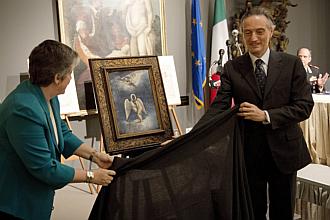
In connection with a recent auction at Sotheby’s, there’s a piece on the arte10 website today about the colored steel panels of Leda and the Swan that pop artist Roy Lichtenstein made for the bathroom in gazillionaire Gunter Sachs’s penthouse in 1968.  It’s a lot more decorous than the depiction of the myth by Derrick Santini that London police took exception to last month, claiming it “condoned bestiality, which [is] an arrestable offence.”  You can look it up and decide for yourself.  Also in April, a stolen Renaissance oil painting of the same subject by Lelio Orsi was returned by U.S. Homeland Security to Italy.  It had previously sold at auction for $1.6 million but I have to say that I like Lichtenstein’s Leda better than this one, too.

Posted in Classics, Mythology | Leave a comment

The Hills of Sewanee

The Hills of Sewanee

Sewanee Hills of dear delight,
Prompting my dreams that used to be,
I know you are waiting me still to-night
By the Unika Range of Tennessee.

The blinking stars in endless space,
The broad moonlight and silvery gleams,
To-night caress your wind-swept face,
And fold you in a thousand dreams.

Your far outlines, less seen than felt,
Which wind with hill propensities,
In moonlight dreams I see you melt
Away in vague immensities.

And, far away, I still can feel
Your mystery that ever speaks
Of vanished things, as shadows steal
Across your breast and rugged peaks.

O, dear blue hills, that lie apart,
And wait so patiently down there,
Your peace takes hold upon my heart
And makes its burden less to bear.

— George Marion McClellan (1860-1934)
From The Path of Dreams, Louisville: John P. Morton Co., 1916
Reprinted in The Book of American Negro Poetry, ed. James Weldon Johnson. New York: Harcourt Brace, 1922.

I will admit that I have never heard of this poem before, much less read it. This astounds me.  McClellan’s reference to “The blinking stars in endless space, / The broad moonlight and silvery gleams,” touches closely on an observation of my own made recently and yet, I swear, I only saw the poem two days ago.

Who was George Marion McClellan (pictured above)?  Here’s what the Poetry Foundation website has to say about him:

Born in Belfast, Tennessee, the minister, teacher, writer, and poet George Marion McClellan received a BA and an MA from Fisk University and a bachelor of divinity from Hartford Theological Seminary. He married Mariah Augusta Rabb in 1888 and served as a minister in a Nashville, Tennessee, Congregational church from 1892 to 1894.

After his time as a minister, McClellan pursued a career as a teacher and principal at schools in Louisville and Los Angeles. A difficult period in his personal life followed the death of one of his sons and was further complicated by financial difficulty, marital conflict, and a sense of alienation fostered by a society divided sharply along racial lines.

McClellan’s poetry, composed from the 1880s onward, shows a sensitive ear to meter and rhyme and addresses religion, nature, and romantic love while only occasionally revealing an emotional struggle against racial discrimination. He is perhaps best remembered for his blank-verse epic, “The Legend of Tannhauser and Elizabeth.”

McClellan published two collections of poetry: Poems (1895), which was retitled Songs of a Southerner in 1896, and The Path of Dreams (1916). A favorable review of his work, comparing his skill to that of Paul Laurence Dunbar, appeared in the New York Times after his poetry was included in a 1901 exhibit at the Pan-American Exposition.

African-American poetry of this period is surely no forté of mine, but if anybody knows more about McClellan, I’d be interested to hear.

Postscript, September 2017. Still no real reaction to this post. A little further digging: At the end of the introduction of his first collection of privately-printed poems (a section called “Race Literature”), McClellan writes,

Aside from the history of our emancipation and the hardships of our enslavement, of what subjects have we to sing to make a literature peculiarly native to us? To produce a Negro literature, we must have time to produce song-material, as well as singers. In this little attempt of mine I have not tried to sing Negro songs purely, but songs of beautiful landscapes, wherever I have seen them, and felt song-inspired by them, or of touches of human loves and feelings, as I have felt them. McClellan, George Marion. Poems (Nashville: A.M.E. Church Sunday School Union, 1895) 10

The poem to the Hills of Sewanee is evidently among those he was song-inspired to write.

Posted in Astronomical, Poetry, Race, Sewanee, Tennessee, The South, Time | 1 Comment

Venus, Vulcan, Mars, and Joe

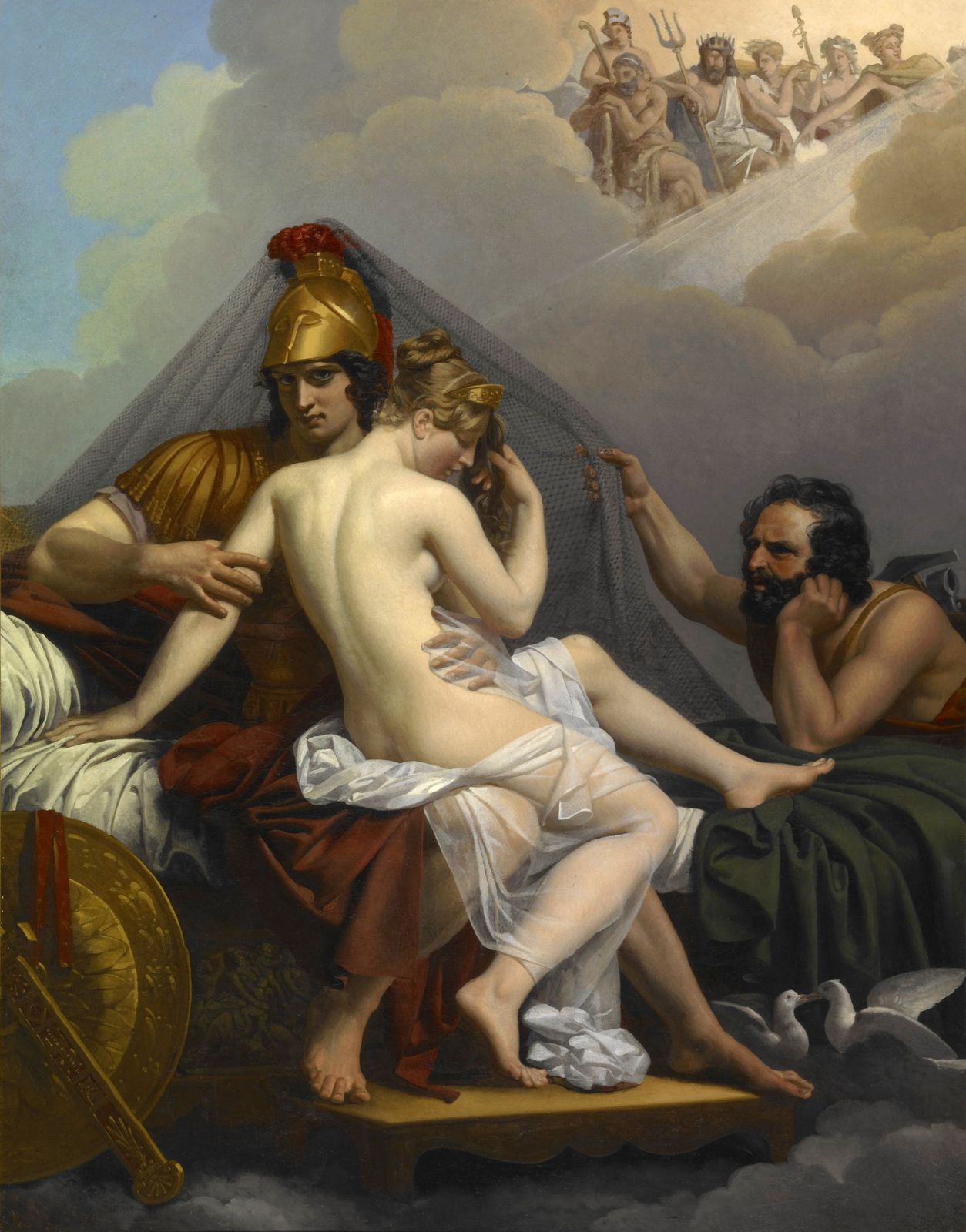
Aphrodite was married to Hephaestus, but carried on a long-standing affair with Ares.  Neither god was happy, of course, with the idea of the goddess being with the other. What are we to make of it?  On the one hand, there is great sympathy for the husband, and Homer, in Odyssey Book 8, has him triumph over the adulterous couple.  And yet, as Dryden wrote memorably, “None but the brave deserve the fair.”

It is an archetypal arrangement for the ages, to my mind.  The question is not what makes the best sense for Venus, but rather, what can she see in the guy who isn’t me?  As Joe Jackson asked, is she really going out with him?

Posted in Classics | 3 Comments

Currency & Current Events

“If Greece leaves the euro, the most likely interim currency is the existing euro overprinted with a Greek delta symbol (for ‘drachma’), or possibly with a corner clipped.”  So speculated yesterday’s Independent.  The intentional defacing, or rather “re-facing,” of currency is not new.  In ancient Greece, states would often “overstrike” the coinage of another so as to make a claim on it.

The reasons for overstriking were numerous.  It might be intended to restrict export of the currency and so keep it in the local economy.  It might also help to raise revenue in a cash-strapped state, or to devalue a currency for the purpose of improving rates of exchange.  And, of course, overstriking also could make a powerful political statement.

To the side is a fifth-century Athenian tetradrachm found in Egypt. (You will recognize the owl on the reverse as the model for the reverse of the Greek-issued one-euro coin above)  What’s interesting is the symbol on Athena’s cheek on the heads-side of the coin.  It is a “countermark” of the hieroglyph nefer, meaning “good” or “beautiful.”   In the period preceding the establishment of Ptolemaic rule in Egypt, Athenian tetradrachms and their imitations were the only recognized form of money.  The Egyptian authorities had “recoined” this tetradrachm to validate it as legal tender in their state.  Such coins go for great amounts at auction now.

It could take weeks for the Greek government to produce a new drachma if they, in fact, exit the Eurozone in the chaotic fashion that is apparently in the offing.  The provisional coin of the realm, then, will probably be some sort of “drachmatized” Euro.  While these would lose at least half their value at the moment of official overstriking, future collectors no doubt would pay a lot for them.

Posted in Birds, Classics, Emblems, Numismatics | 1 Comment

Sappho’s Supermoon

A few days ago, I posted a piece about a Homeric passage that the recent supermoon reminded me of.  But I’ve just realized that there is a description by Sappho, in a short poem not entirely complete, that I like even better.  The original text is below, with a translation of my own after it.

Sappho, Poem 34

Ἄστερες μὲν ἀμφὶ κάλαν σελάνναν
ἂψ ἀπυκρύπτοισι φάεννον εἶδος,
ὄπποτα πλήθοισα μάλιστα λάμπῃ
γᾶν … ἀργυρία …

Stars near the moon hide
when she causes earth to glow
in lovely silver. …

Yeah, it’s a haiku, I know, so that’s a little cheesy.  But Greek lyric poetry strikes me as having the same sort of oblique quality that can be found in a good haiku.  I fooled a little with the photo (the original of which I found here), but I like the moonlit ruin, since it picks up on the content as well as the fragmentary nature of the poem.

Posted in Astronomical, Classics, Poetry | 2 Comments

Vos Salutamus

My chief duty on graduation weekend in Sewanee is to coach the salutatorian on the Latin address.  The Commencement ceremony on Sunday begins with greetings in turn to the Chancellor and the Episcopal bishops whose dioceses own the university, the Vice-Chancellor and other administrators, the graduating class and lower-class students, parents, siblings, friends, and guests, all of it delivered in rather ornate formulaic language, and all of it in Latin. I’ve pasted the text with a translation below, in case you’re interested.

The person who has to say all of this is the salutatorian, and he or she will usually have no idea about this little ordeal until just about 72 hours beforehand.  The faculty turn in their grades for seniors on the Wednesday before graduation and the registrar’s office then heroically crunches all the numbers.  Final grade-point averages are calculated, and those at the bottom of the class sweat it out to see if they will be marching while those at the very top wait to find out who will be #1 and #2.  Once the grades are all calculated, the valedictorian is informed, and off they go to write up an address for delivery at Commencement.  The salutatorian, poor thing, is told to go see me.

Now and then, a student who has had some Latin will become salutatorian, of course, but many times the salutatory is the first time they will have encountered the old dead language.  My heart goes out to these people, and I have often wondered how I might feel in an analogous situation.  What if, during one of the busiest weekends of my life, I were told that I had to give a page-long tribute in public in Mandarin Chinese?  The fortunate thing, however, is that it isn’t me who has to do this, but somebody who is really, really smart.  The salutatorian is invariably a person with a GPA over 4.0, which means they routinely have been given A+s.

After yesterday’s Baccalaureate ceremony, I met with this year’s salutatorian, Brian Fennessy, in All Saints chapel to go over the address.  In addition to what must be said, there is also what one associate dean has called “the choreography,” since there is a fair bit of moving around.  The opening remarks are delivered to the chancellor and the bishops at the high altar, with the rest of it spoken down by the front of the choir stalls.  The videographer accompanies us as we rehearse it, so he will know where Brian is going as the address unfolds.

But at the heart of the thing is the language itself.  I have often been asked about the pronunciation of the Latin used at Sewanee.  It’s a church-affiliated institution, but we do not use “Church Latin” here.  I love the way Church Latin and all its rolling Italianate sound.  Of course, the choir customarily sings in Church Latin, with Gloria given to God “in ex-Chell-sis.”  But the Latin used at Sewanee has always been pronounced with a Classical Accent.  That means the C’s sound like K’s, and the V’s sound like W’s.  And for poor Brian, who has studied French here, that means some radical readjustment.  The first words of the address are a mouthful, no doubt about it.  Cancellarie Reverendissime, “Most reverend Chancellor.”  Kank-ell-Ar-ee-ay Re (short e!)-We (another short e!) -rend-iss-im-ay.

[Actually, it’s even worse.  The final syllables should be pronounced as short e’s as well, but since everyone has heard “Et tu Brutay,” good luck with that. Also, these are generally Southerners we’re talking about, who lengthen every vowel they encounter.]

[[And if you’re really looking to confuse someone, try to explain why this vocative isn’t a simple -i instead of -ie, as it ought to be, if Wheelock’s Latin Grammar is to be trusted, which in this case, it isn’t]]

Yikes.  How will Brian do today? Well, based on our practice today, I know he will do splendidly.  Give an address in Latin?  It’s a challenge, sure, but I have yet to meet the salutatorian who didn’t thrive on just such challenges.  Vos salutamus, salutatorians, past, present, and future.  We salute you.

[Update, May 23: How did Brian do?  As predicted, splendidly. It’s always a pleasure to watch a bright person confront and resolve a problem!  And look like he was enjoying it, to boot!]

SEWANEE LATIN SALUTATORY

Cancellarie reverendissime, huius universitatis princeps et pastor ecclesiae sanctae Domini nostri, te salutamus.

Patres in Deo, huius universitatis fideles custodes, vos salutamus.

Pro-Cancellarie nobilissime, societatis academicae nostrae dux fidelis et diligens, te salutamus.

Praeposite dignissime et decani illustres et sacerdos universitatis et professores sapientes, qui nos in quaestum veritatis amoremque rationis duxistis, vos salutamus.

Salvete hospites grati et condiscipuli fortunati.

Salvete discipuli inferiores.  Videte ut mores huius universitatis fideliter conservetis.

Salvete matres patresque amati, fratres, sorores et amici fideles.

Pro nobis omnibus qui in gradus eruditionis hodie admittamur, vos omnes in hac sollemni convocatione saluto, et vos spero semper habituros esse felicitatem et prosperitatem.

ECCE QUAM BONUM ET IUCUNDUM EST HABITARE FRATRES IN UNUM!

Most reverend Chancellor, head of this university and shepherd of Our Lord’s holy church, we salute you.

Fathers in God, faithful custodians of this university, we salute you.

Most noble Vice-Chancellor, faithful and diligent leader of our academic institution, we salute you.

Most worthy Provost, illustrious Deans, University Chaplain, and wise professors who lead us in the search for truth and the love of reason, we salute you.

Greetings, dear guests and fortunate fellow-students.

Greetings, lower-class students. See to it that you faithfully preserve the character of this university.

Greetings, beloved mothers and fathers, brothers, sisters and loyal friends.

On behalf of all who today are entering upon this step of learning, I salute all of you in this solemn convocation, and I hope that you will ever have happiness and well-being.

BEHOLD HOW GOOD AND JOYFUL IT IS WHEN BROTHERS LIVE TOGETHER IN UNITY!

Posted in Education, Uncategorized | 1 Comment

O Swallow, Swallow

My friend David Haskell asked his students on their Ornithology final, “If you could come back as a bird, which species would you choose and why?”   As I responded in the Comments section of his blog, my choice would be Hirundo Rustica, the barn swallow.  I’ve long admired their sleek appearance and graceful flight, and I’m not alone in that.  The Spring Fresco at Thera dates back to 1500 BC:

A close-up of the swallows– aren’t they sweet?

I didn’t know this until just now when searching, but the Spring Fresco features in the Disney movie Hercules, on the wall in the home where  the hero grew up.  Who knew the animators were so learned?

Posted in Birds, Cartoons, Classics | 1 Comment

Night-piece

Behind Gailor Hall (May 5, 2012, 10 p.m.)

Tonight’s “supermoon” puts me in mind of a passage from the Iliad.  A long day’s battle has been raging outside the walls of Troy, but by the end of Book Eight, the Trojans have taken the field and determinedly set up camp.  They sit around their fires, and Homer gives us what has been called “the most beautiful night-piece that can be found in Poetry.”  As Robert Fagles translates,

                                  And so [the warriors’] spirits soared
as they took positions down the passageways of battle
all night long, and the watchfires blazed among them.
Hundreds strong, as stars in the night sky glittering
round the moon’s brilliance blaze in all their glory
when the air falls to a sudden, windless calm …
all the lookout peaks stand out and the jutting cliffs
and the steep ravines and down from the high heavens bursts
the boundless bright air and all the stars shine
clear and the shepherd’s heart exults­—so many fires burned
between the ships and the Xanthus’ whirling rapids
set by the men of Troy, bright against their walls.
A thousand fires were burning there on the plain
And beside each fire sat fifty fighting men
poised in the leaping blaze, and champing oats
and glistening barley, stationed by their chariots,
stallions waited for Dawn to mount her glowing throne.

The analogy between the stars and the watch-fires strikes me as especially inventive, since it encompasses not only the brilliance but also the numberlessness of each, all of it spread out in prospect before us.  I have had this experience myself.  From Morgan’s Steep in Sewanee, you can look out on a clear night and see a great many stars in the sky seeming to mirror the street-lamps of Franklin County beneath.  It’s always a heartening sight.

The passage’s pièce de résistance, of course, is the moon illuminating the lands below it, the refulgent lamp of night, as Alexander Pope had put it in his own translation, that O’er heaven’s pure azure spreads her sacred light.  Such light, Homer observes, delights the herdsmen, who otherwise would have to stand guard in the dark.  It is hard not to recall here the shepherds abiding in the field, keeping watch over their flock by night in the Nativity story (to whom another sort of light would appear).  We forget in our modern age how the husbandry that was done nocturnally not even so long ago would be made so much easier by a moon-lit sky. The warrior’s work, too, was far different in the pre-electric age, and only the stallions champing their oats might still feel at home in Homer’s world.

What I have never seen from Morgan’s Steep, of course, is the very thing Homer describes.  In fact, nobody has ever seen a full moon with stars visible all around it.  Does this make the simile a failure?  Certainly Wordsworth thought so, and he shook his head about a poet who felt that “the visible universe was of so little consequence … that it was scarcely necessary for him to cast his eyes upon it.”  Even so, Pope had defended Homer’s impulse a century before.  “A Poet is not obliged to speak with the exactness of Philosophy, but with the Liberty of Poetry,” he observed, speaking of this very passage from the Iliad.

Pope’s invocation of poetic license here seems about right.  Sometime later Robert Frost would write in “Birches,” But I was going to say when Truth broke in / With all her matter-of-fact, then asking in plaintive parenthesis, (Now am I free to be poetical?). Homer hardly needs our permission to be poetical, I suppose.  Still, on a night like tonight, with its rare supermoon, it is easy to imagine the landscape he’s talking about, one in which stars and watch-fires or maybe street-lamps are so numerous that they seem to come together into a single whole, burning with such intensity that even those in the lonesome darkness (soldiers, field-workers, or perhaps just professors grading finals) find some comfort in the serviceable light.

Posted in Astronomical, Bible, Classics, Military, Poetry, Sewanee | 3 Comments

Angry Bird

Usually the phoebe’s nest is a chirpy little bundle on the drainpipe out back, but this spring it is silent, and for this we blame the towhee.  We’re not sure when he arrived, but he has been a constant presence on the deck now for a week.  The mornings begin with his trill– to-whee! to-whee!— and then a bapping at the windows, as he shadow-boxes with himself for dominance.  The other birds seem to give him wide berth.  We think the cardinals are rolling their eyes about all of this, but perhaps they are more forgiving than we give them credit for.  The mornings have been bright and warm, and certainly encourage the kinder interpretation.

Posted in Birds, Sewanee, Uncategorized | Leave a comment

By the Rude Bridge

Those are my boys, standing by the Old North Bridge in Concord, grimly determined to face down the Redcoats, and wondering when we can get some ice cream.  The picture was taken a few years ago when we were spending the summer in Boston.  In the background you can see Daniel Chester French’s statue of the Minuteman, on the base of which is inscribed Ralph Waldo Emerson’s famous lines:

By the rude bridge that arched the flood,
Their flag to April’s breeze unfurled,
Here once the embattled farmers stood,
And fired the shot heard round the world.

The battle of Concord took place two hundred and thirty seven years ago today.  As it happens, one of my ancestors, James Joseph Byron, was the caretaker of the Old North Bridge and the battleground in the late nineteenth century.  Like my great-great-grandmother, Ann Burns, whom I have discussed before, he was an Irish immigrant and had settled in Concord.  She had been the cook for Emerson, though whether it was through his good graces that James Byron became custodian of the historic site I could not say.  (That’s him late in life below, in a photo lifted from a genealogy written by my late cousin, Bobby Byron.)

When I had had my sons pose at the bridge for the photo at the top, I knew the Battle of Concord as a matter of American history only.  I was not aware that it was also a part of our family history as well.  I’m not sure the boys would have been too impressed, however, had I known to tell them.

Later that day, we had gone to watch a demonstration of a live musket firing.  There was an elderly man in period dress who spoke in great detail about things like the route the British may have taken and the proper way to load a musket.  When I think of him now, it seems to me that his lecture was probably much like one old James Byron might have given.  I wonder if, long ago, little boys listening to him tugged on their father’s hand and asked, “Is he ever gonna shoot that thing, daddy?”

Posted in Boston, Family, Ireland, Military, Poetry, Statues & Monuments | Leave a comment