
-
Recent Posts
Recent Comments
Uncomely and Broken on Pope Leo on cinema: “an… David Cronin on Pope Leo on cinema: “an… Uncomely and Broken on Ishi and the Algorithm Dennis Davenport on Ishi and the Algorithm Uncomely and Broken on Theodore Parker’s Grave,… Archives
- April 2026
- March 2026
- November 2025
- December 2024
- April 2024
- October 2021
- February 2021
- September 2020
- July 2020
- June 2020
- May 2020
- April 2020
- March 2020
- January 2020
- August 2019
- July 2019
- June 2019
- May 2019
- April 2019
- March 2019
- February 2019
- January 2019
- December 2018
- November 2018
- October 2018
- July 2018
- June 2018
- May 2018
- April 2018
- March 2018
- February 2018
- November 2017
- October 2017
- September 2017
- August 2017
- April 2017
- February 2017
- October 2016
- September 2016
- May 2016
- April 2016
- March 2016
- February 2016
- January 2016
- November 2015
- October 2015
- September 2015
- August 2015
- July 2015
- June 2015
- April 2015
- March 2015
- February 2015
- January 2015
- December 2014
- November 2014
- October 2014
- September 2014
- August 2014
- July 2014
- June 2014
- May 2014
- April 2014
- March 2014
- February 2014
- January 2014
- December 2013
- November 2013
- October 2013
- September 2013
- August 2013
- July 2013
- June 2013
- April 2013
- March 2013
- February 2013
- January 2013
- December 2012
- November 2012
- October 2012
- September 2012
- August 2012
- July 2012
- June 2012
- May 2012
- April 2012
- March 2012
- February 2012
- January 2012
Categories
- AI
- Animals
- Astronomical
- Bible
- Birds
- Books
- Boston
- Cartoons
- Cemeteries & Funerals
- Classics
- Coal
- Dogs
- Drama
- Education
- Emblems
- England
- Family
- Film
- Florence
- Ireland
- Italy
- Language & Etymology
- Military
- Music
- Mythology
- Nautical
- New England
- Numismatics
- Oxford
- Poetry
- Pontius Pilate
- Race
- Rivers
- Rome
- Saints
- Scotland
- Sewanee
- Slavery
- Sports & Games
- Statues & Monuments
- Tennessee
- The South
- Time
- Trees & Flowers
- Uncategorized
Meta
Swithin and Sewanee
This morning, ironically enough, it is not raining in Oxford. It is St. Swithin’s Day, July 15th, and according to an English proverb,
Saint Swithun’s day, if thou dost rain,
For forty days it will remain
Saint Swithun’s day, if thou be fair,
For forty days ’twill rain no more.
As you may know, Britain has been experiencing its rainiest summer ever, and everyone is exasperated about it. In yesterday’s Times, one columnist lamented, “Worst of all there is no one to blame; no minister to haul on to Newsnight to explain why the front destined for Scandinavia has been stuck for weeks; no calls for a Weatherson Inquiry.” The fact that back in Tennessee it has been hotter than blazes has assuaged my own wet and chilly feelings only a little.
 So far, the saint is doing right by us, but there’s plenty of time left in the day for him to screw this up. Swithin was a bishop of Winchester, only an hour or so’s drive from Oxford, and is venerated there particularly in the famous cathedral. Closer to home, there’s a girl’s school called St. Swithin’s in Oxfordshire and a quad named for him at Magdalen College, which I have
 not now seen. Interestingly enough, the image I know best of this saint is in All Saints’ Chapel back in Sewanee (pictured to the left). He’s holding a bridge, his traditional iconographic attribute, to represent the bridge he ordered built over the River Itchen and where he performed a miracle. Why this entitles him to represent “Civil Engineering,” as the window states, is beyond me, but then, Sewanee hasn’t had a department of civil engineering for a long time, if ever, so it’s probably just as well.
Truthfully, I think Sewanee’s program in Environmental Studies ought to adopt the St. Swithin’s window in All Saints. There is a great tradition of rationalizing weather-lore, and everything I’ve read about the inherent wisdom of the Swithin’s Day proverb discusses the jet stream’s position in early summer. This year, the jet stream has not moved north to leave Britain relatively dry but is instead squatting damply in the south. Why is the jet stream behaving this way? Probably for the same reason it’s so damned hot in Sewanee this summer: changes in global climate. The fact is, there is somebody to blame, as the Times columnist wanted, and it is all of us. If skeptics won’t listen to scientists about these matters, perhaps they’ll listen to St. Swithin, and maybe his bridge can be re-interpreted as a symbol of dialogue. That would be miraculous, even more so than this morning’s sunshine.
Protected: Liddell & Scott, A Little About Both
Posted in Classics, Emblems, Oxford, Statues & Monuments
Enter your password to view comments.
Like a Fawn

My son and I saw two deer on the Sewanee bike-path this morning, and it reminded me of a Horatian ode. We were barreling along when a doe crossed far ahead of us. As we got closer, a younger deer suddenly appeared and, seeing us, scrambled after its mother. We laughed and pedaled on, but a few Latin lines began to buzz around in my head.
Now I love Horace, as do most classicists, and one of my married colleagues has even referred to him as “the other man in her life.” As it happens, though, I don’t teach him all that often, and when I do, it’s usually the “greatest hits” in translation. But the poem that came to mind on the bike-path–Ode 1.23, Vitas Hinuleo– is an old friend, so to speak, one I recall studying in high school. In fact, my senior year, I won a medal for my translation of it.
I no longer have the medal, and I can barely remember my version of it. A few of my lines were coming back to me on the bike, though, and making me wince. At any rate, Horace’s poem is below, with a translation following, and after that, some cursory discussion.
Horace, Odes 1.23
Vitas hinuleo me similis, Chloe,
Quaerenti pavidam montibus aviis
Matrem non sine vano
Aurarum et silvae metu.
Nam seu mobilibus veris inhorruit
Adventus foliis, seu virides rubum
Dimovere lacertae,
Et corde et genibus tremit.
Atqui non ego te tigris ut aspera
Gaetulusve leo frangere persequor:
Tandem desine matrem
Tempestiva sequi viro.
Like a Fawn
Like a fawn you avoid me, shy Chloe, a young one
alongside her mother, astray in the hills,
whom the rustle of leaves or the sight of a lizard
in the first flush of spring is enough to give chills.
Both your knees and your heart are for some reason trembling.
You presume me a predator, falsely, and hide
as though from a lion, and run to your mother,
yet you’re ready for love and should come from her side.
One of the things I have always liked about Horace is the way he creates these interesting personae in even his shortest poems. The speaker here has his eye on Chloe and is filled with unconvincing reassurances about his intentions. He likens her to a young deer seeking a mother’s protection, and only half-heartedly denies his own comparison to a beast of prey. In the Latin, Atqui non ego te tigris ut aspera / Gaetulusve leo frangere persequor more literally means “And I, not like a tiger or Gaetulian lion, chase to break you.” Yikes. Even the simple natural images of the wind in the leaves and skinks in the shrubs are suspect. Springtime simply seems spooky in Chloe’s world.
I feel fairly certain that none of this was brought out in my high school Latin class, and if it had been, I am equally certain I was incapable of understanding it. But beneath Horace’s charming imagery, this courtship poem has an unmistakable predatory quality. I was glad to have a reason to re-visit the poem. “Animals are good to think with,” as Claude Lévi-Strauss once said.
Posted in Boston, Poetry, Sewanee
8 Comments
“Naked We Stand on the Naked Ground”
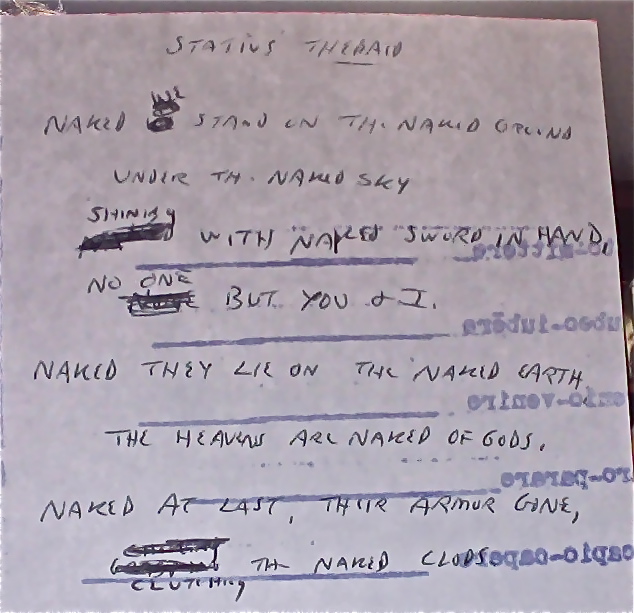
I have been cleaning out my office and found this item among some papers I had inherited when I became chair. It is poem about Statius’ Thebaid by my former colleague and well-loved Sewanee Classics professor, Bill Bonds. It is scrawled on the torn-off corner of an old mimeographed quiz.
Naked we stand on the naked ground
Under the naked sky.
Shining with naked sword in hand,
No one but you and I.Naked they lie on the naked earth;
The heavens are naked of gods.
Naked at last, their armor gone
Clutching the naked clods.
If you don’t know the Thebaid, let me just say it is a rhetorically sophisticated and completely bleak epic from the time of the tyrannical emperor Domitian. Bill spelled out his thoughts more fully in a scholarly article (“Two Combats in the Thebaid,” Transactions of the American Philological Association, Vol. 115 [1985], pp. 225-235). In fact, I found Bill’s poem among his notes for this article. If you knew Bill, you will understand why this brilliant and unsentimental work appealed to him.
Posted in Classics, Military, Poetry, Sewanee
6 Comments
Protected: Concerning Flowers and Soldiers
Posted in Classics, Emblems, Military, Mythology, Statues & Monuments, Trees & Flowers
Enter your password to view comments.


