
Sewanee Purple (April 16, 1918) 3

Sewanee Purple (April 16, 1918) 3
An update, April 2023: Willis Wilkinson Memminger, who played Antigone in the production, was the grandson of Christopher Memminger, the Confederate Secretary of the Treasury. Here he is on the CSA $5 bill, via Wikipedia:

Various Notices on the Sewanee Production of Antigone of 1894
“Loftier than this devotion to the legitimate, semi-legitimate, and wholly illegitimate drama, is the success on the stage of the students of the Greek department, who, under the direction of Vice Chancellor Wiggins, have won an enviable reputation by their presentations of the masterpieces of ancient tragedy and comedy. Every summer they put a Greek play on the boards, now a comedy of Aristophanes, that makes the audience hold its sides with laughter; now a solemn and moving tragedy of Sophocles or Euripides that brings tears to the eyes of seasoned veterans. The performance of the “Antigone” last summer elicited great enthusiasm, not only at Sewanee, where it was presented before a large and distinguished audience, but also at Nashville, where two brilliant performances were given in the opera house. So great is the interest aroused by this successful reproduction of the spirit of old Greek life as exhibited in the Greek drama, that the Greek play may be said to be the leading feature of a Sewanee commencement—a function which lasts several days, a performance at which there is no vacant seat, and a marvel of staging considering the primitive surroundings of the University.”
American University Magazine 2.1 (May 1895) pp. 29-30
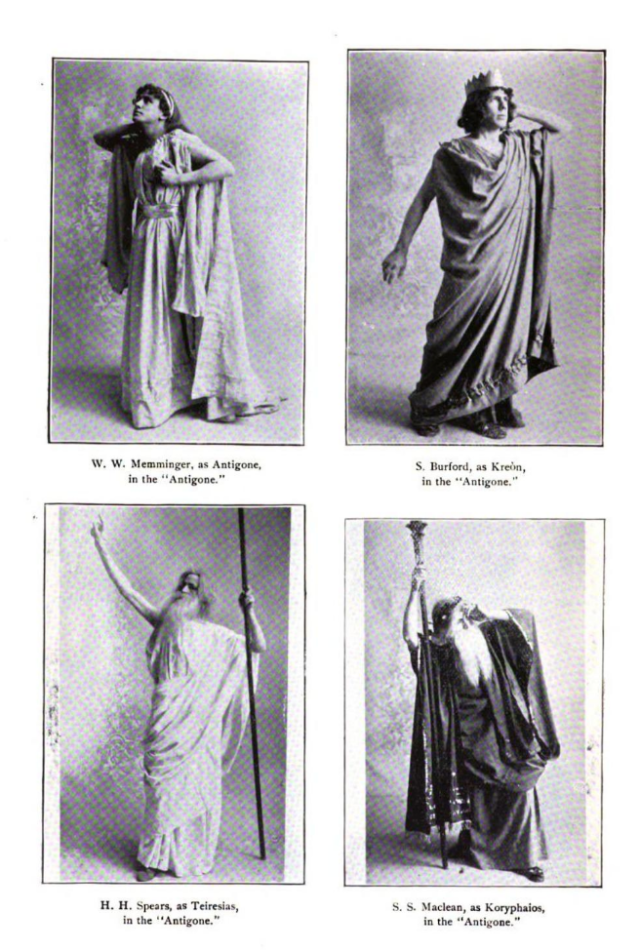

Sewanee Purple (November 3, 1894) 1, 4


That some of Abbo’s Alley was laid out during WWII by German POWs is something I’ve often heard, but seen little documentary evidence. Below is what I’ve found.
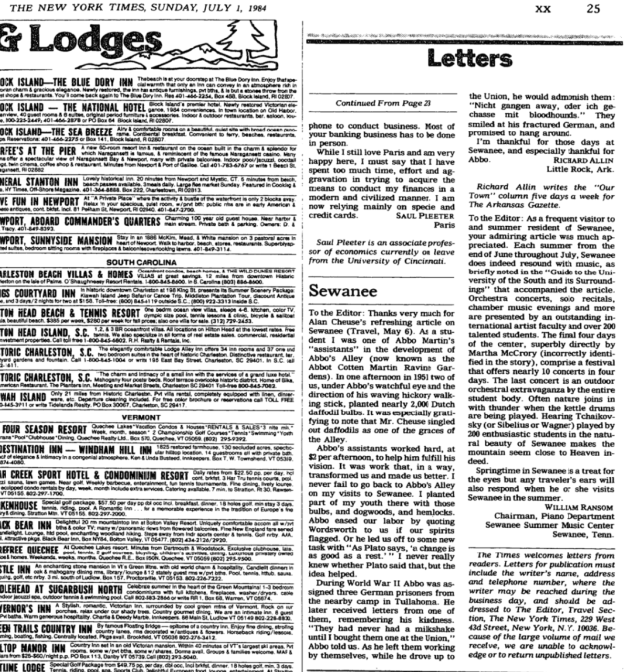
New York Times July 1, 1984, Section 10, Page 25:
To the Editor:
Thanks very much for Alan Cheuse’s refreshing article on Sewanee (Travel, May 6). As a student I was one of Abbo Martin’s ”assistants” in the development of Abbo’s Alley (now known as the Abbot Cotten Martin Ravine Gardens). In one afternoon in 1951 two of us, under Abbo’s watchful eye and the direction of his waving hickory walking stick, planted nearly 2,000 Dutch daffodil bulbs. It was especially gratifying to note that Mr. Cheuse singled out daffodils as one of the graces of the Alley.
Abbo’s assistants worked hard, at $2 per afternoon, to help him fulfill his vision. It was work that, in a way, transformed us and made us better. I never fail to go back to Abbo’s Alley on my visits to Sewanee. I planted part of my youth there with those bulbs, and dogwoods, and hemlocks. Abbo eased our labor by quoting Wordsworth to us if our spirits flagged. Or he led us off to some new task with ”As Plato says, ‘a change is as good as a rest.’ ” I never really knew whether Plato said that, but the idea helped.
During World War II Abbo was assigned three German prisoners from the nearby camp in Tullahoma. He later received letters from one of them, remembering his kindness. ”They had never had a milkshake until I bought them one at the Union,” Abbo told us. As he left them working by themselves, while he drove up to the Union, he would admonish them: ”Nicht gangen away, oder ich gechasse mit bloodhounds.” They smiled at his fractured German, and promised to hang around.
I’m thankful for those days at Sewanee, and especially thankful for Abbo.
RICHARD ALLIN
Little Rock, Ark.
Richard Allin writes the ”Our Town” column five days a week for The Arkansas Gazette.
***
No doubt the poem Abbo recited was “I Wandered Lonely as a Cloud”:
I wandered lonely as a cloudThat floats on high o’er vales and hills,When all at once I saw a crowd,A host, of golden daffodils;Beside the lake, beneath the trees,Fluttering and dancing in the breeze.Continuous as the stars that shineAnd twinkle on the milky way,They stretched in never-ending lineAlong the margin of a bay:Ten thousand saw I at a glance,Tossing their heads in sprightly dance.The waves beside them danced; but theyOut-did the sparkling waves in glee:A poet could not but be gay,In such a jocund company:I gazed—and gazed—but little thoughtWhat wealth the show to me had brought:For oft, when on my couch I lieIn vacant or in pensive mood,They flash upon that inward eyeWhich is the bliss of solitude;And then my heart with pleasure fills,And dances with the daffodils.
***
From “Abbo’s Scrapbook,” a feature in the Sewanee Purple (March 23, 1955) 2

From Theodor Mommsen (trans. William P. Dickson) History of Rome, Vol. 4 (London 1867), Book 5, Chapter 7, pp. 286-87 (link here)
Mind you, an edition of this work won a goddam Nobel Prize for Literature in 1902
In the mighty vortex of the world’s history, which inexorably crushes all peoples that are not as hard and as flexible as steel, such a nation could not permanently maintain itself ; with reason the Celts of the continent suffered the same fate at the hands of the Romans, as their kinsmen in Ireland suffer down to our own day at the hands of the Saxons — the fate of becoming merged as a leaven of future development in a politically superior nationality. On the eve of parting from this remarkable nation we may be allowed to call attention to the fact, that in the accounts of the ancients as to the Celts on the Loire and Seine we find almost every one of the characteristic traits which we are accustomed to recognize as marking the Irish. Every feature reappears : the laziness in the culture of the fields ; the delight in tippling and brawling ; the ostentation… ; the language full of comparisons and hyperboles, of allusions and quaint turns; the droll humour … ; the hearty delight in singing and reciting the deeds of past ages, and the most decided talent for rhetoric and poetry ; the curiosity … and the extravagant credulity which acted on such accounts, for which reason in the better regulated cantons travellers were prohibited on pain of severe punishment from communicating unauthenticated reports to others than the public magistrates ; the childlike piety, which sees in the priest a father and asks him for his advice in all things; the unsurpassed fervour of national feeling, and the closeness with which those who are fellow-countrymen cling together almost like one family in opposition to the stranger; the inclination to rise in revolt under the first chance leader that presents himself and to form bands, but at the same time the utter incapacity to preserve a self-reliant courage equally remote from presumption and from pusillanimity, to perceive the right time for waiting and for striking, to attain or even barely to tolerate any organization, any sort of fixed military or political discipline. It is, and remains, at all times and places the same indolent and poetical, irresolute and fervid, inquisitive, credulous, amiable, clever, but — in a political point of view — thoroughly useless nation ; and therefore its fate has been always and everywhere the same.


These images are take from the recently-recovered Fauquier Book of Hours, on which my friend and colleague Greg Clark is an expert, as discussed in the video below. The scene illustrated is from Psalm 6, the opening of which is here (you can listen to Monteverdi’s setting as you read!)
1 Domine ne in furore tuo arguas me neque in ira tua corripias me
O Lord, rebuke me not in thy indignation, nor chastise me in thy wrath.
2 Miserere mei Domine quoniam infirmus sum sana me Domine quoniam conturbata sunt ossa mea.
Have mercy on me, O Lord, for I am weak: heal me, O Lord, for my bones are troubled.
This is just a page on which I intend to stick things I find out about Tim’s Ford lake.
Other links:

From the NASA wesbite:
Apollo 14 launched in the late afternoon of January 31, 1971 on what was to be our third trip to the lunar surface. Five days later Alan Shepard and Edgar Mitchell walked on the Moon while Stuart Roosa, a former U.S. Forest Service smoke jumper, orbited above in the command module. Packed in small containers in Roosa’s personal kit were hundreds of tree seeds, part of a joint NASA/USFS project. Upon return to Earth, the seeds were germinated by the Forest Service. Known as the “Moon Trees”, the resulting seedlings were planted throughout the United States (often as part of the nation’s bicentennial in 1976) and the world. They stand as a tribute to astronaut Roosa and the Apollo program.
One such “moon tree” is in Sewanee, and was the subject of a poem by a friend of mine, 30+ years ago.
Moon Tree
It really happened, you know,
hundreds of seedlings to the moon and back in ’71.
Was it just to say they did,
a boondoggle,
the ultimate road trip,
a journey for the sake of the ride?
Or were they altered,
inexplicably changed in some fundamental way?
I’ve seen one of those moon trees.
You’d never know where it had been
unless someone told you.
A sycamore, it stands tall like all the ones around it,
no discernible difference.
Its branches stretch no higher than the others nearby.
Its leaves move from green to yellow before
discarding another year.
Its roots are securely earthbound.
Perhaps, though, when night falls and we sleep,
something internal and unseen awakens.
Just maybe there is a hidden monitoring
of the waxing and waning,
A deep knowing,
an undetected communing,
an unprecedented exhilaration of recognition
on nights when the full silver orb shines-
a yearning for a place visited and never forgotten.
Or perhaps the shift is perceptible only in
the darkest moments,
when the deep, black velvet curtain closes and
no light or comfort can be detected.
Then there may be a lonesome keening,
an inconsolable grief,
a loss lost on those who slumber.
If not, it would mean nothing to be a moon tree.
–Anne-Barton Robison Carter, circa 1986
July 22, 2019: I asked A-B to tell me her thoughts on this poem she wrote so many years ago. Here’s what she had to say.
Ahh, my connection to Sewanee is entirely one of place. It was the domain that lured me there and then held me. It is still what calls me back. I believe I received an excellent education and certainly made lifelong friends. I do not believe the school itself to be any less flawed than any other institution and probably no more so either. Like any human construction it bears all the honorable intentions and also the less worthy.
The land itself, however, is remarkable and has so much to say. My years there, and my visits since, taught me to listen to more than humans and to be open to learning from all sources. Like Wendell Berry, I discovered the value of place. I wrote a lot poems simply for myself to try and capture those lessons.
The moon tree caught my imagination, particularly, because it had travelled further than any of us can really imagine yet was so rooted in such an unassuming place drawing so little notice. I think in a weird way, it helped me realize that a remarkable identity could be similarly held and did not rely on the accolades of others to create and sustain it.
How’s that for a Monday morning?
The paradox for the anthropologist imagining time travel and anachronism leads to a certain insight about present-day blindness
Claude Levi-Strauss, Tristes Tropiques, trans. John Russell (New York: Criterion, 1961) 44-45
I should have liked to live in the age of real travel, when the spectacle on offer had not yet been blemished, contaminated, and confounded; then I could have seen Lahore not as I saw it, but as it appeared to Bernier, Tavernier, Manucci … There’s no end, of course, to such conjectures. When was the right moment to see India? At what period would the study of the Brazilian savage have yielded the purest satisfaction and the savage himself been at his peak? Would it have been better to have arrived at Rio in the eighteenth century, with Bougainville, or in the sixteenth, with Lery and Thevet? With every decade that we travelled further back in time, I could have saved another costume, witnessed another festivity, and come to understand another system of belief. But I’m too familiar with the texts not to know that this back ward movement would also deprive me of much information, many curious facts and objects, that would enrich my meditations. The paradox is irresoluble: the less one culture communicates with another, the less likely they are to be corrupted, one by the other; but, on the other hand, the less likely it is, in such conditions, that the respective emissaries of these cultures will be able to seize the richness and significance of their diversity. The alternative is inescapable: either I am a traveller in ancient times, and faced with a prodigious spectacle which would be almost entirely unintelligible to me and might, indeed, provoke me to mockery or disgust; or I am a traveller of our own day, hastening in search of a vanished reality. In either case I am the loser -and more heavily than one might suppose; for today, as I go groaning among the shadows, I miss, inevitably, the spectacle that is now taking shape. My eyes, or perhaps my degree of humanity, do not equip me to witness that spectacle; and in the centuries to come, when another traveller revisits this same place, he too may groan aloud at the disappearance of much that I should have set down, but cannot. I am the victim of a double infirmity: what I see is an affliction to me; and what I do not see, a reproach.
 | Uncomely and Broken on Pope Leo on cinema: “an… |
 | David Cronin on Pope Leo on cinema: “an… |
| Uncomely and Broken on Ishi and the Algorithm |
 | Dennis Davenport on Ishi and the Algorithm |
| Uncomely and Broken on Theodore Parker’s Grave,… |

