Welcome to my blog, which I have been running for most of the last decade. It’s a fairly low-tech venue, and one I am familiar with, so I have been thinking that it might be the right format for the future teaching of our class.
Let me ask you to listen to this voice memo above, in .m4a format, and tell me whether or not listening to a recording like this is going to be OK for you as a way for me to run class. Shoot me a quick email to say either “My internet connection isn’t going to work for this” or “This will be just fine.”
Also– and this means a lot to me –let me know how you are doing during these very strange days.
Welcome to my blog, which I have been running for most of the last decade. It’s a fairly low-tech venue, and one I am familiar with, so I have been thinking that it might be the right format for the future teaching of our class.
So, can I ask you to listen to this voice memo above, in .m4a format, which outlines my plans for the rest of the term? The text of the recording is below, and you can scroll along as I read, if you want to.
What I’d really like to know is whether or not listening to a recording like this is going to work for you. So PLEASE, let me know by shooting me a quick email to say either “My internet connection isn’t going to work for this” or “This will be just fine.” Also, and this means a lot to me, let me know how you are doing!
Yours,
CMcD
Photo Credit Stephen Alvarez
My friends,
Greetings from Sewanee! It is a warm spring evening here, a bit overcast. You can hear maybe the birds behind me, and maybe the trucks on the highway too, and perhaps even the train-whistle from Cowan a few miles away.
Events has fallen out in such a way that we cannot finish up our class together as we had originally planned, and instead we will have to proceed remotely as of March 31. As I have mentioned to you in a previous e-mail, I have never taught or taken an online class, and so we will need to work together to make this work.
But before I begin, let me offer one observation: I know how awful this has all been for you, being violently wrenched away from college like this. It’s been awful for all of us who teach and work here as well. Nobody at Sewanee would have done this if it hadn’t absolutely had to happen this way. I know you know that. I think we all understand that, intellectually. But that doesn’t mean that emotionally any of us is OK with it. . You may want to seek out somebody to talk with about it. If you are upset, or angry, or depressed about it, that is an appropriate way to feel.
This is my current thinking on how to move ahead. Most of you left campus intending to return, so I assume you do not have your books with you. I also assume that, because you will be at home and not in Sewanee with its study spaces, you will not necessarily have a quiet room and a reliable Wifi connection. Based on these two assumptions, I will be using readily-accessible texts on the internet, and will also try to keep my instruction to the bare minimum of bandwidth. As all of you have access to it, we will use Blackboard for written assignments and feedback.
We were due, as you know, to have an exam immediately upon return from Spring Break. Some of you have been studying, I imagine, but probably most of you have been somewhat distracted by the news. I will admit that I have not figured out how exactly to carry out this exam, but one thing is clear– it’s going to have to be different than what we would have done on campus!
OK. So, what will we read for the rest of the semester? Having read some of the greatest hits of Pliny’s Letters and some of the Passion of Saint Perpetua, it had been my plan to begin reading more of Tacitus. Like I say, though I know you probably don’t have the book of selections by Steven Rutledge. Rather than have you order a new copy, or ask the hard-working people in duPont to make a PDF of it, I’ve decided to use a pretty good online version of Tacitus’s work, the Agricola, which is available from Dickinson College. It’s a pretty good resources, I think. Besides the Latin, there is vocab and notes. It’s designed for students at your level, so it should be pretty user-friendly.
There’s a link here. I’ll give you this link again in my next post, together with a PDF of a a translation. I’ll also discuss in fuller detail what the Agricola is about, and why it makes sense for us, at this particular moment, for us to be reading it together.
One last thing. Because there will some things I post that will not be, strictly speaking, out of copyright, I will be putting future posts on this blog behind a password. That password is the word written on the whiteboard in the picture of me below.
OK, that’s it for now. I hope you are all staying safe and healthy.
“Can we get Shenanigan’s?” Daniel asked me. Kelly’s out of town, and I had plans to make chili. I flinched a little. Shelter in place. Stay at home. These are the mantras of the day. “I just feel like,” he said, “it won’t be possible to get a burger anywhere pretty soon.” Today, a few states have shut down restaurants and bars. But Tennessee isn’t one of the states, and Shenanigan’s isn’t one of the restaurants. Not yet. So we called in our order and drove over. While we paid, they said probably they’d be going to delivery only pretty soon. It’s Monday night, and I know I shouldn’t, but I ordered a beer. “I feel like we’re living in a sci-fi movie,” said Daniel. “One of the depressing ones.” I sipped my beer. By the weekend, who knows whether even this will be possible.
“People of the same trade seldom meet together, even for merriment and diversion, but the conversation ends in a conspiracy against the public, or in some contrivance to raise prices.”–Adam Smith, The Wealth of Nations
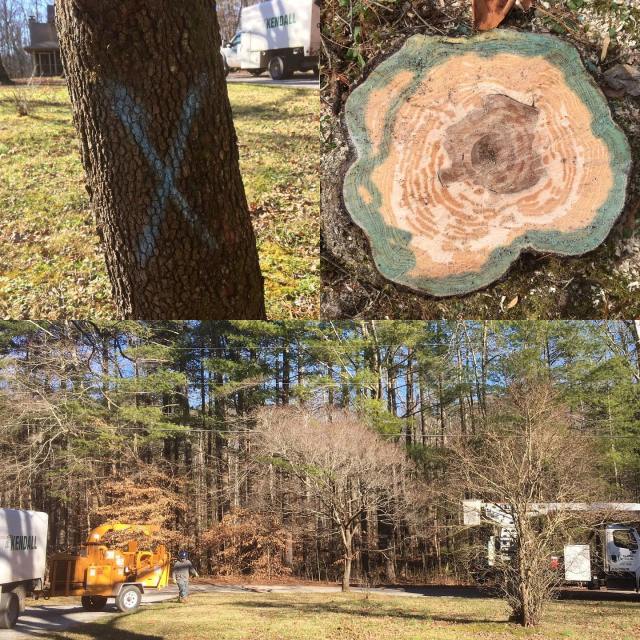
A sad tale. In order to bring in fiber optic cable, quite a few trees in town have needed to be removed, including our beloved dogwood by the roadside. In its time, the dogwood had held up Christmas lights in its branches, as well as a See Rock City birdhouse.
The blue X appeared several weeks ago and today was the unfortunate day. A green door hanger indicating that some of our trees would be trimmed or removed came a few weeks earlier. I almost threw it away, thinking it was an ad. But in fact, it was a notice, like a call from a doctor with bad news.
The trucks showed up last week. I had heard a loud sound outside, like an airplane flying too low, but it was in fact the sounds of buzzsaws and the chipper. Then they pulled up in front of our house, but it was late so they decided to come back the following day.
“It’s like watching a pet get put down,” Kelly said. As it happened, we were away when the cutting and chipping took place the next morning. When we came back, there was a pretty little stump, all that’s left of our pretty little tree.
Some other folks in town wrote on Facebook that they had not realized their trees would be cut down until they arrived home to see them gone. I don’t like what happened, but I can’t say I didn’t have advance notice. That doesn’t make it any easier, of course. I guess losing our trees are the price we pay for progress?
Postscript. My friend Bob Benson’s letter to the Sewanee Mountain Messenger from October:
This is the Bethel Church in Victoria, Tennessee, located off Old Highway 28.
The image above is taken from this Flickr page, which lists this comment from Tim Holloway in 2013:
A man named John Frater built this church for the community of coal miners and farmers. Because coal mining was such a huge industry in the area, an English company bought up mines in the area, and the church bell was donated by Queen Victoria of England. Because of her generosity, the community was renamed Victoria in her honor.
The bell of this church, the one reportedly donated by Queen Victoria, is in the Whitwell Coal Miner’s Museum, I believe.
Is it true? There is indeed a strong connection between this area and England. From the Tennessee Encyclopedia entry on Marion County:
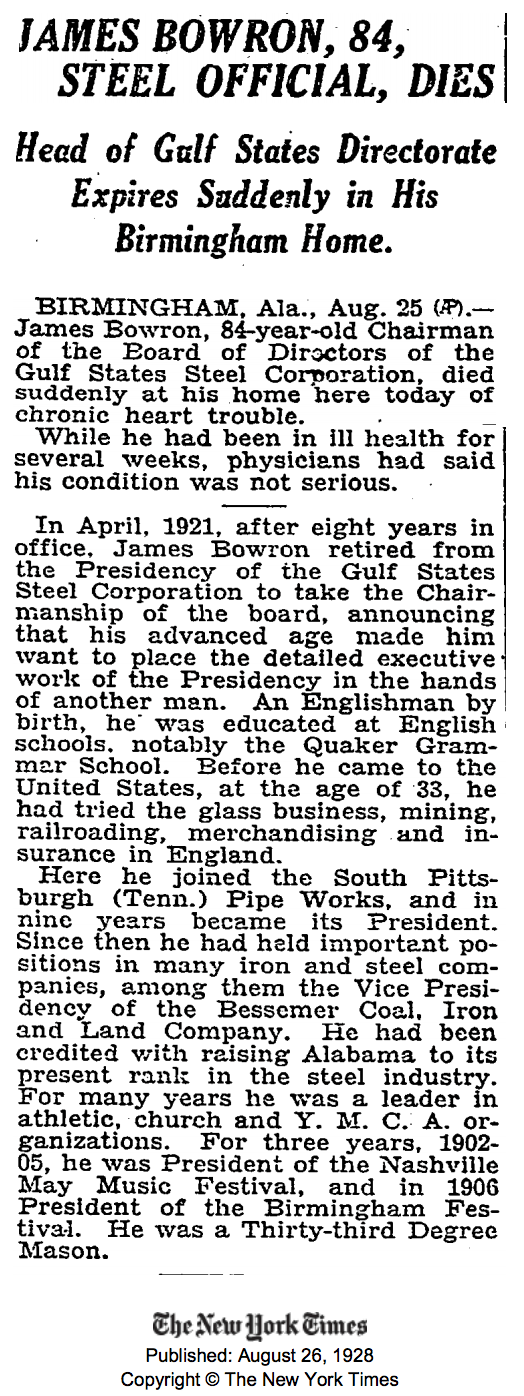
In 1877 James Bowron and associates from England brought sufficient capital into the valley to develop the iron and coal industries. Coal mines opened in Whitwell; coke ovens operated in Victoria; iron ore came from Inman; and smelters dominated South Pittsburg. “
His papers are held at the University of Alabama: “A substantial collection of papers and materials relating to James Bowron, one of the 19th century iron and mining pioneers in the Deep South. It includes Bowron’s 1632-page, unpublished autobiography, as well as his daily journals, letters, and pictures.”
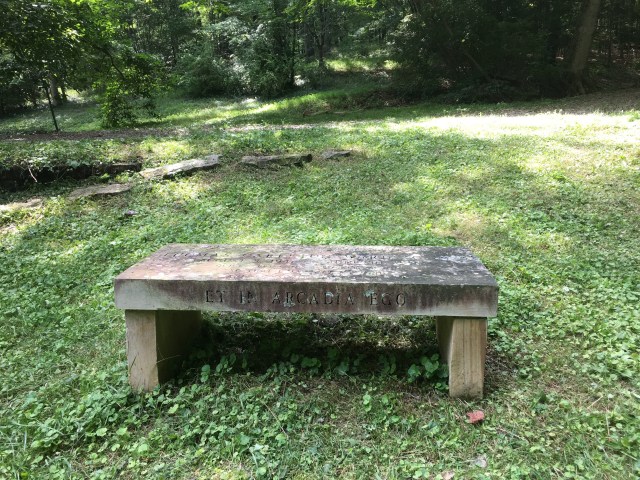
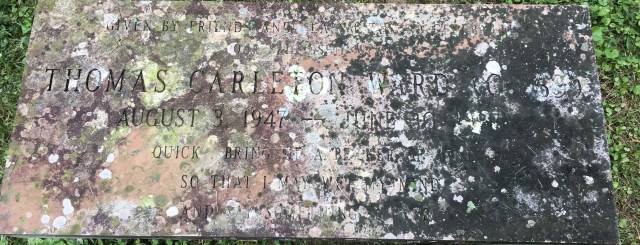
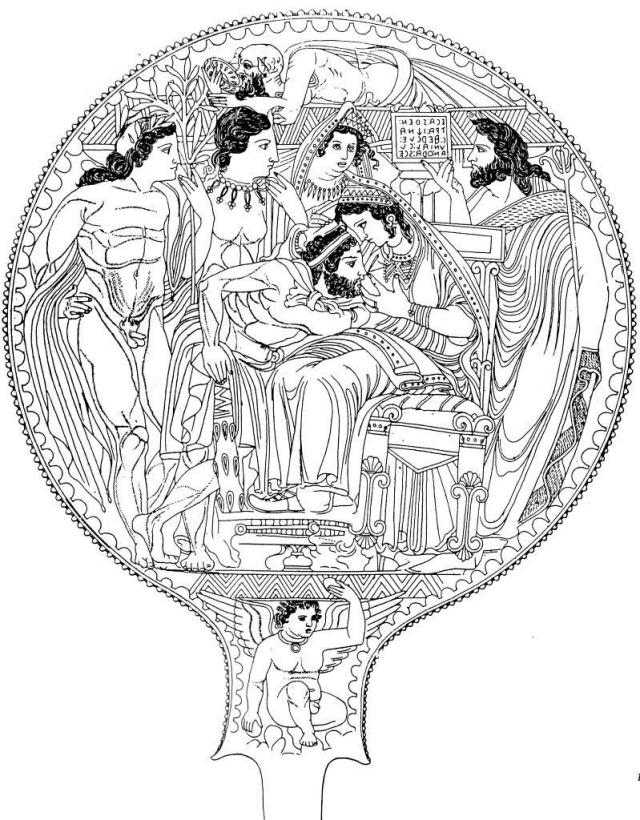
TC was a great wit with a very dry sense of humor, thus the Aristophanes quotation on the bench he often recited. One of his favorite comments to make was “e pluribus unum” said very slowly and with a sigh as he peered over the top of his horn rimmed glasses whenever he witnessed someone doing something particularly distasteful or particularly stupid. Discussions of Mississippi politicians often ended with “e pluribus unum.” There is no question that Honey Boo Boo would merit an “e pluribus unum” comment. When he called me, he always began the conversation with, “MM, TC, quelle surprise.” Clearly, I have more to tell about TC than about his bench. I will have to tell TC’s mama, my great aunt, that the bench has an admirer. She will be pleased.




 A sad tale. In order to bring in fiber optic cable, quite a few trees in town have needed to be removed, including our beloved dogwood by the roadside. In its time, the dogwood had held up Christmas lights in its branches, as well as a See Rock City birdhouse.