Domine ne in furore tuo arguas

Screen Shot 2019-07-31 at 1.24.24 PM.png

Screen Shot 2019-07-31 at 11.54.21 AM.png

These images are take from the recently-recovered Fauquier Book of Hours, on which my friend and colleague Greg Clark is an expert, as discussed in the video below. The scene illustrated is from Psalm 6, the opening of which is here (you can listen to Monteverdi’s setting as you read!)

Psalm 6

1 Domine ne in furore tuo arguas me neque in ira tua corripias me

O Lord, rebuke me not in thy indignation, nor chastise me in thy wrath.

2 Miserere mei Domine quoniam infirmus sum sana me Domine quoniam conturbata sunt ossa mea.

Have mercy on me, O Lord, for I am weak: heal me, O Lord, for my bones are troubled.


Posted in Bible, Poetry, Sewanee, Uncategorized | Leave a comment

Tim’s Ford notes

This is just a page on which I intend to stick things I find out about Tim’s Ford lake.

Other links:


Posted in Nautical, Rivers, Tennessee, Uncategorized | Leave a comment

Sewanee’s Moon Tree: A Poem & A Reflection

67178393_10100146890482538_321301126114705408_n

From the NASA wesbite:

Apollo 14 launched in the late afternoon of January 31, 1971 on what was to be our third trip to the lunar surface. Five days later Alan Shepard and Edgar Mitchell walked on the Moon while Stuart Roosa, a former U.S. Forest Service smoke jumper, orbited above in the command module. Packed in small containers in Roosa’s personal kit were hundreds of tree seeds, part of a joint NASA/USFS project. Upon return to Earth, the seeds were germinated by the Forest Service. Known as the “Moon Trees”, the resulting seedlings were planted throughout the United States (often as part of the nation’s bicentennial in 1976) and the world. They stand as a tribute to astronaut Roosa and the Apollo program.

One such “moon tree” is in Sewanee, and was the subject of a poem by a friend of mine, 30+ years ago.

Moon Tree

It really happened, you know,
hundreds of seedlings to the moon and back in ’71.
Was it just to say they did,
a boondoggle,
the ultimate road trip,
a journey for the sake of the ride?
Or were they altered,
inexplicably changed in some fundamental way?

I’ve seen one of those moon trees.
You’d never know where it had been
unless someone told you.
A sycamore, it stands tall like all the ones around it,
no discernible difference.
Its branches stretch no higher than the others nearby.
Its leaves move from green to yellow before
discarding another year.
Its roots are securely earthbound.

Perhaps, though, when night falls and we sleep,
something internal and unseen awakens.
Just maybe there is a hidden monitoring
of the waxing and waning,
A deep knowing,
an undetected communing,
an unprecedented exhilaration of recognition
on nights when the full silver orb shines-
a yearning for a place visited and never forgotten.

Or perhaps the shift is perceptible only in
the darkest moments,
when the deep, black velvet curtain closes and
no light or comfort can be detected.
Then there may be a lonesome keening,
an inconsolable grief,
a loss lost on those who slumber.

If not, it would mean nothing to be a moon tree.

–Anne-Barton Robison Carter, circa 1986

July 22, 2019: I asked A-B to tell me her thoughts on this poem she wrote so many years ago. Here’s what she had to say.

Ahh, my connection to Sewanee is entirely one of place. It was the domain that lured me there and then held me. It is still what calls me back. I believe I received an excellent education and certainly made lifelong friends. I do not believe the school itself to be any less flawed than any other institution and probably no more so either. Like any human construction it bears all the honorable intentions and also the less worthy.

The land itself, however, is remarkable and has so much to say. My years there, and my visits since, taught me to listen to more than humans and to be open to learning from all sources. Like Wendell Berry, I discovered the value of place. I wrote a lot poems simply for myself to try and capture those lessons.

The moon tree caught my imagination, particularly, because it had travelled further than any of us can really imagine yet was so rooted in such an unassuming place drawing so little notice. I think in a weird way, it helped me realize that a remarkable identity could be similarly held and did not rely on the accolades of others to create and sustain it.

How’s that for a Monday morning?

Posted in Astronomical, Poetry, Sewanee, Time, Trees & Flowers | Leave a comment

Protected: Modern origins of the manly-man Roman fore-arm handshake

This content is password-protected. To view it, please enter the password below.

Posted in Classics, Drama, Uncategorized | Enter your password to view comments.

Protected: “The Hitler Gang”

This content is password-protected. To view it, please enter the password below.

Posted in Military, Uncategorized | Enter your password to view comments.

what I see is an affliction to me; and what I do not see, a reproach

The paradox for the anthropologist imagining time travel and anachronism leads to a certain insight about present-day blindness

Claude Levi-Strauss, Tristes Tropiques, trans. John Russell (New York: Criterion, 1961) 44-45

I should have liked to live in the age of real travel, when the spectacle on offer had not yet been blemished, contaminated, and confounded; then I could have seen Lahore not as I saw it, but as it appeared to Bernier, Tavernier, Manucci … There’s no end, of course, to such conjectures. When was the right moment to see India? At what period would the study of the Brazilian savage have yielded the purest satisfaction and the savage himself been at his peak? Would it have been better to have arrived at Rio in the eighteenth century, with Bougainville, or in the sixteenth, with Lery and Thevet? With every decade that we travelled further back in time, I could have saved another costume, witnessed another festivity, and come to understand another system of belief. But I’m too familiar with the texts not to know that this back ward movement would also deprive me of much information, many curious facts and objects, that would enrich my meditations. The paradox is irresoluble: the less one culture communicates with another, the less likely they are to be corrupted, one by the other; but, on the other hand, the less likely it is, in such conditions, that the respective emissaries of these cultures will be able to seize the richness and significance of their diversity. The alternative is inescapable: either I am a traveller in ancient times, and faced with a prodigious spectacle which would be almost entirely unintelligible to me and might, indeed, provoke me to mockery or disgust; or I am a traveller of our own day, hastening in search of a vanished reality. In either case I am the loser -and more heavily than one might suppose; for today, as I go groaning among the shadows, I miss, inevitably, the spectacle that is now taking shape. My eyes, or perhaps my degree of humanity, do not equip me to witness that spectacle; and in the centuries to come, when another traveller revisits this same place, he too may groan aloud at the disappearance of much that I should have set down, but cannot. I am the victim of a double infirmity: what I see is an affliction to me; and what I do not see, a reproach.

Posted in Uncategorized | Leave a comment

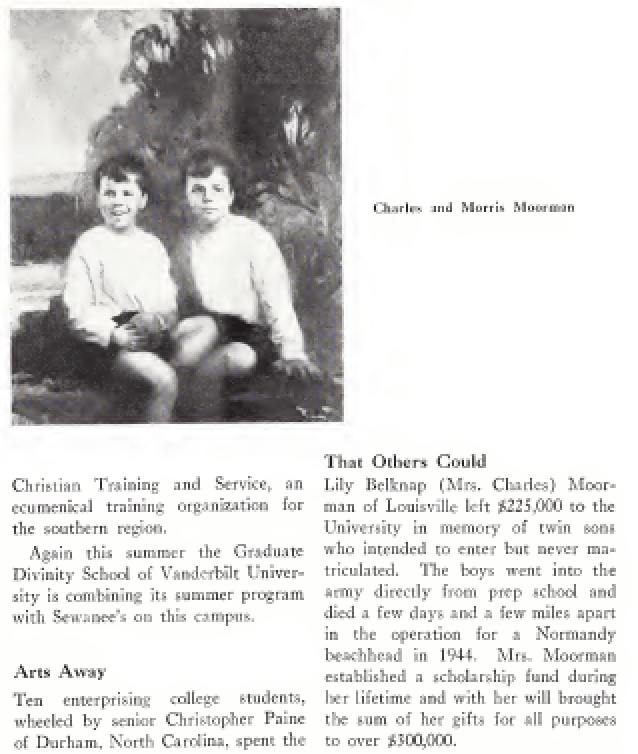
Moorman twins & Normandy

If you have been over to the University Counsel’s office in Walsh-Ellett Hall in Sewanee, you have seen probably the portrait of the Moorman twins from the early 1930s. (I’ll load an image of it when I get back over there next). I wonder if you know, as I didn’t until recently, their tragic connection with D-Day? According to the Sewanee Magazine (March 1973) p. 5:

Lily Belknap (Mrs. Charles) Moorman of Louisville left $225,000 to the University in memory of twin sons who intended to enter but never matriculated. The boys went into the army directly from prep school and died a few days and a few miles apart in the operation for a Normandy beachhead in 1944.

Screen Shot 2019-06-06 at 7.13.43 AM.png

Posted in Cemeteries & Funerals, England, Military, Sewanee, Tennessee, Time | Leave a comment

Battle Fatigues?

Screen Shot 2019-05-30 at 12.04.07 PM.png

Posted in Uncategorized | Leave a comment

Order of the Adjectives

Adjectives in English absolutely have to be in this order: opinion-size-age-shape-colour-origin-material-purpose Noun. So you can have a lovely little old rectangular green French silver whittling knife. But if you mess with that word order in the slightest you’ll sound like a maniac.”

So Mark Forsyth wrote for the BBC a few years ago. I just wanted to hold on to this insight, as I’d like to test it out for Latin when I have more time this summer.

But thus far, it seems right to me for English: right now, I’m looking at a little orange paperback Greek textbook on my desk, as well as an old broken porcelain coffee mug.


Posted in England, Language & Etymology | 1 Comment

In Search of Elijah Smith: Glastonbury

If you’ve been following my inquiries (here and here) into the mysterious inscription in my old edition of Cicero, you know that I’ve pinpointed Glastonbury, CT, as the place where all the principals lived. I was at Yale with some students this week for a screening and presentation on “Mine 21,” and decided I would drive over to Glastonbury to see if there were any further clues particularly about Elijah Smith, the black sheep of the story. Sure, the weather was bad, but Winter Storm Scott was no match for my insatiable curiosity and a decent enough Chevy Impala rental.

The Glastonbury Historical Society museum and archives are located in what was the old town hall. It’s a quaint red-brick building in a town of quaint old buildings. “Only Marblehead has more eighteenth-century structures,” the director, Jim Bennett, tells me with a slight twinge of envy. He’s been good enough to come out in the snow to meet me this morning. When I explain what I’m looking for, he starts to pull out books and folder from the various shelves and cabinets.

While Jim is looking into the numerous Hale and Welles files, I take a look around the museum. “We’re giving it a long overdue paint job,” Jim explains, “so pardon our appearance.” A few display cases are covered in heavy plastic, and some others are pushed together to make space for ladders and such. But the general feel of the place, the very evident pride of the locals in their long history, is evident throughout.

As I have found, Hales and Welleses are thick on the ground in Glastonbury, both in the archives and in the town’s many old houses as well. Below is the Gideon Hale house, where the Gideon of my inscription live and raised his large family over two centuries ago. Because of the snow, I decided to forego a trip to the graveyard, and instead got back into the car to drive north where my brother- and sister-in-law were bringing my son to meet me for lunch.

The person I had really come to find out more about, the hapless Elijah Smith who once owned the 1750 copy of Cicero now in my possession, was not much in evidence. There is a Smith brook I had to pass over as I drove from the museum to the Hale house, and I believe it is likely to have crossed Elijah’s family property in the eighteenth century. But as for the old debt-welsher himself, nary a peep. “He hath absconded himself,” indeed, and my search will have to take me elsewhere.

Posted in Cemeteries & Funerals, Classics, Education, Family, New England, Rivers, Uncategorized | Leave a comment