



-
Recent Posts
Recent Comments
Archives
- March 2026
- November 2025
- December 2024
- April 2024
- October 2021
- February 2021
- September 2020
- July 2020
- June 2020
- May 2020
- April 2020
- March 2020
- January 2020
- August 2019
- July 2019
- June 2019
- May 2019
- April 2019
- March 2019
- February 2019
- January 2019
- December 2018
- November 2018
- October 2018
- July 2018
- June 2018
- May 2018
- April 2018
- March 2018
- February 2018
- November 2017
- October 2017
- September 2017
- August 2017
- April 2017
- February 2017
- October 2016
- September 2016
- May 2016
- April 2016
- March 2016
- February 2016
- January 2016
- November 2015
- October 2015
- September 2015
- August 2015
- July 2015
- June 2015
- April 2015
- March 2015
- February 2015
- January 2015
- December 2014
- November 2014
- October 2014
- September 2014
- August 2014
- July 2014
- June 2014
- May 2014
- April 2014
- March 2014
- February 2014
- January 2014
- December 2013
- November 2013
- October 2013
- September 2013
- August 2013
- July 2013
- June 2013
- April 2013
- March 2013
- February 2013
- January 2013
- December 2012
- November 2012
- October 2012
- September 2012
- August 2012
- July 2012
- June 2012
- May 2012
- April 2012
- March 2012
- February 2012
- January 2012
Categories
- AI
- Animals
- Astronomical
- Bible
- Birds
- Books
- Boston
- Cartoons
- Cemeteries & Funerals
- Classics
- Coal
- Dogs
- Drama
- Education
- Emblems
- England
- Family
- Film
- Florence
- Ireland
- Italy
- Language & Etymology
- Military
- Music
- Mythology
- Nautical
- New England
- Numismatics
- Oxford
- Poetry
- Pontius Pilate
- Race
- Rivers
- Rome
- Saints
- Scotland
- Sewanee
- Slavery
- Sports & Games
- Statues & Monuments
- Tennessee
- The South
- Time
- Trees & Flowers
- Uncategorized
Meta
Canis Major
It was cold but clear on Sunday night as I took out the trash and, as has become traditional, the dog rushed out with me for one last run around in the woods. She disappears into the dark but can be heard barking at the deer one last time before bed. With the leaves off the trees, the stars are more easily seen in the winter, and I was glad for that on Sunday, because I was able to just catch sight of Canis Major, who trails behind Orion.
Canis Major
The great Overdog
That heavenly beast
With a star in one eye
Gives a leap in the east.
He dances upright
All the way to the west
And never once drops
On his forefeet to rest.
I’m a poor underdog,
But to-night I will bark
With the great Overdog
That romps through the dark.
–Robert Frost (1925)
Posted in Astronomical, Dogs, Family, Poetry, Sewanee
Leave a comment
Liesegang Bands Not Fossils
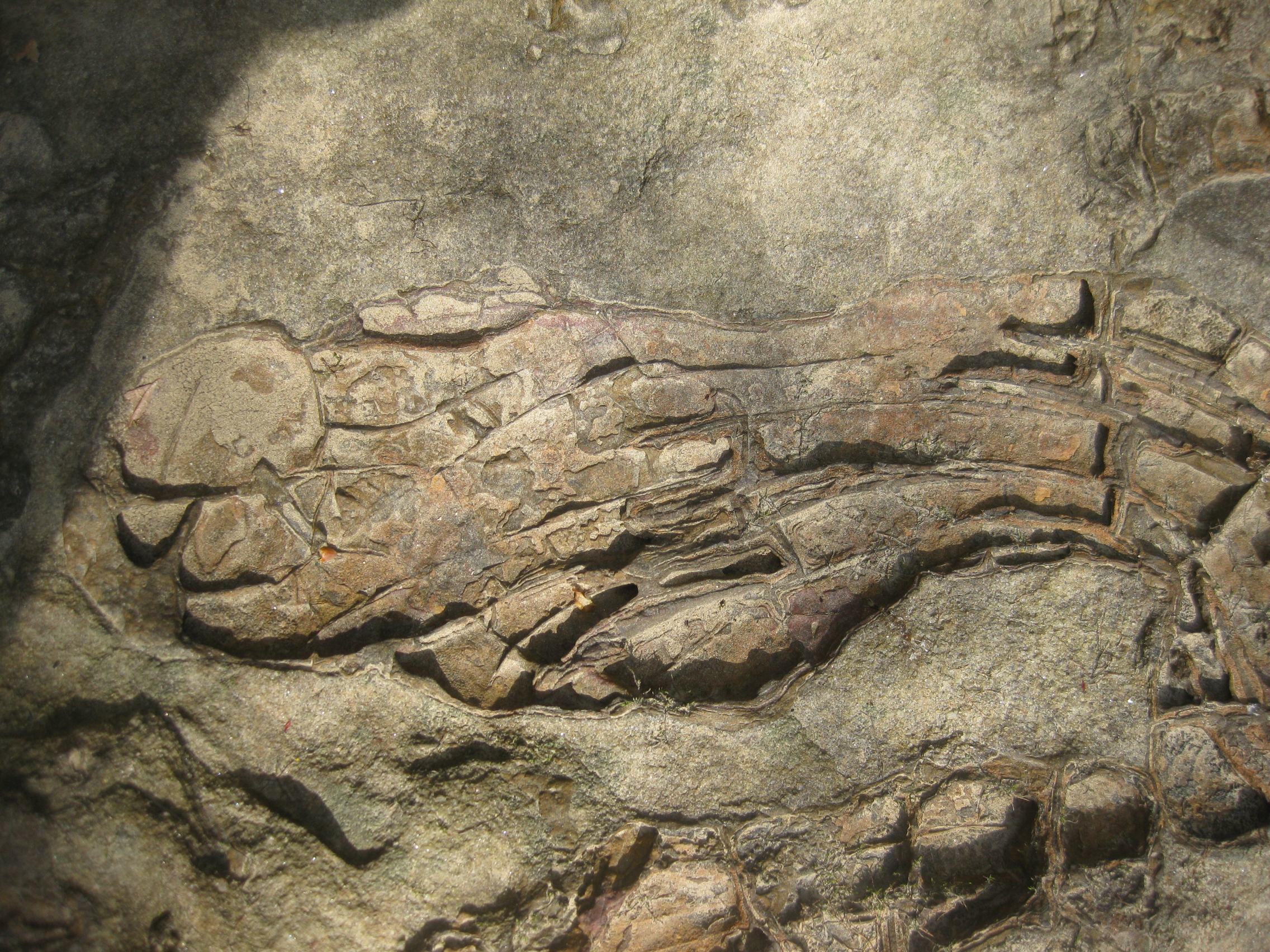
We were out hiking one day last spring when I decided to rest on a large boulder while the boys played in a nearby stream. As I got ready to sit down, I noticed some formations in the rock, pictured below. I was certain that I had come across some fossils, but in fact they were Liesegang bands, which form when iron in the water diffuses through a porous rocks, like the sandstone boulder I was about to sit on. In this instance, the ferrous oxide has been deposited along the fractures in the stone to give it a sort of honeycomb appearance. The last picture was set as my desktop image for a few months.
Protected: Adventures in Etymology! Cacafuego
Posted in Classics, England, Language & Etymology, Nautical
Enter your password to view comments.
Some Jars in Tennessee

In the woods behind my house there is a bunch of junk. Railroad ties, rusty oil drums, the top of a washing machine with an attached wringer, et cetera, all of it old, haphazardly deposited, and overgrown with moss. My neighbor Barbara grew up on this street and she tells me that, back in the day, all that was here was a dirt road. There wasn’t any regular trash pick-up, so it made sense with stuff you didn’t want anymore just to haul it out to some spot far away from the house and leave it there.
So, yes, there is lots of old crap in the woods but you could also say that there’s an unexplored archeological site there, too. Sometimes, when I am taking the dog for a walk out back, I stop and pick things up. The kids have taken to doing the same. Inevitably it is the dirty but not yet broken old glass bottles and jars that attract our attention. And just as inevitably, I end up reciting some stanzas of Wallace Stevens in the meantime, though the boys have refrained from doing the same so far.
The stanza comes from Stevens’ poem, “Anecdote of the Jar,” reproduced below, which some of you may know. Published in 1919, the poem is a classic of modernism, and is defiantly at odds with traditional literary aesthetics. In a sort of ironic commentary on Keats’ “Ode on a Grecian Urn” (written in 1819), Stevens here questions the Romantic assertion that “beauty is truth, truth beauty.” Maybe a jar placed in the “slovenly wilderness” of Tennessee is every bit as good as the “Attic shape” found in “Tempe or the dales of Arcady.”
Now, I love the Classics without a doubt, but I really despise cultural snobbery. Much as I admire “Ode on a Grecian Urn,” sometimes I find it just a little too breathlessly pedantic. The nice thing, though, is I don’t have to choose. Hurray for you, “thou still unravish’d bride of quietness,” but hurray, too, for Wallace Stevens. Hurray for modern ideals of American beauty. And hurray for jars in the woods of Tennessee!
Let me share a few pictures of glass bottles and jars that the boys and I have found in the woods in the past few weeks. I am not making any special claims about the uniqueness of their design or the rareness of their types. All I’m saying is that there they were, ready to be picked up, small reminders of the days when the wilderness behind the house seemed the right place to cast away the excess things of this world. My bottles and jars are, each in their own way I think, “foster-children of Silence and slow Time.”



Anecdote of the Jar
I placed a jar in Tennessee,
And round it was, upon a hill.
It made the slovenly wilderness
Surround that hill.
The wilderness rose up to it,
And sprawled around, no longer wild.
The jar was round upon the ground
And tall and of a port in air.
It took dominion every where.
The jar was gray and bare.
It did not give of bird or bush,
Like nothing else in Tennessee.
— Wallace Stevens (1919)
Posted in Poetry, Sewanee, The South
Leave a comment
Testa dell’Efebo
Last fall, Humanities magazine published an essay I wrote about the relationship between a poem by Tennessee Williams and a statuette the playwright had once owned, now here in Sewanee. Both are pasted below.
Testa dell’ Efebo
Of Flora did his luster spring
and gushing waters bathed him so
that trembling shells were struck and held
until his turning let them go
Then gold he was when summer was;
unchangeable this turning seemed
and the repose of sculpture told
how thinly gold his shoulders gleamed.
A cloud of birds awoke in him
when Virgo murmured half awake.
Then higher lifted birds and clouds
to break in fire as glasses break
A lunatic with tranquil eyes
he must have been when he had dimmed
and that town burned wherein was turned
this slender copper cast of him.

—By Tennessee Williams, from In the Winter of Cities, copyright ©1956, 1964 by The University of the South. Renewed 1984, 1992 The University of the South.
In case you’re interested to hear TW himself reading the poem, go to this podcast from KWLS: “Testa dell’Efebo” starts at 12:31.
“Redheads Mean Trouble”
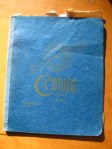
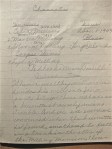
Sometime back in the 90’s, my wife found this old notebook that had belonged to my mother as a schoolgirl. In it are several chapters of a murder-mystery she had written called “Redheads Mean Trouble.” I’m not sure how old she was at the time but I would guess she was perhaps twelve. As can see, though, her vocabulary was excellent, as was her penmanship. I’ve posted the introduction and list of characters below, with transcript following. Perhaps I will post more of it in the future.
Characters
Heiresses
- Celia Milling (Med. Sized)(Murderer)
- Marcia Milling (Tall)
- Gloria Milling (Small)
Corpse Heiress
4. Lydia Milling
Time
About 1949
Place
Long Island
“Redheads Mean Trouble”
Introduction
When a wealthy millionaire divides his will into four parts between three redheads and a brunette it surely means trouble. And we are evermore convinced when the brunette is found, smothered to death in a trunk in the attic of the Milling Mansion, therefore one redhead must be a murderer. Each one has a motive yet each one has a alibi which adds more excitement to our mystery. All these clues and women help Paul Lane solve an interesting and hair-raising murder by Margaret Donahue.
Posted in Family
Leave a comment
Blockheading and Boxing Enough
The teaching of Latin a century or two ago was predicated on its very difficulty, the mastering of which offered a “mental discipline” that usually required an accompanying physical component. Champions of classical education in the eighteenth and nineteenth century seem to have considered intimidation in the learning of Latin as not an incidental but rather an essential part of the subject. In The Life of Johnson (1791), for instance, Boswell writes, “Mr. Langton one day asked him [Johnson] how he had acquired so accurate a knowledge of Latin, in which, I believe, he was exceeded by no man of his time; he said, ‘My master whipt me very well. Without that, Sir, I should have done nothing.’”
This is amusingly put, as so much of Doctor Johnson’s life is, but that such treatment could also be traumatic seems evident enough from an anecdote recorded in John Adams’ diary in 1769 that was recounted by his friend Benjamin Gridley, later a minor figure in the American Revolution.
“When I was a school Boy, at Master Lovells, Mr. Gridley my Uncle used to make me call at his Office, sometimes, to repeat my Lesson to him. I called there one Day for that Purpose. —Well, Ben! What have you to say, Ben? Says he. —I am come to say my Lesson sir to you, says I. —Ay? Ben? What Book have you there? Under your Arm? – Virgil sir. —Ay! Ben? Is that the Poet, Virgil? —Yes sir. —So I opened my Book and began: Arma, Virumque Cāno, Trojae, qui primus ab oris. —“Arma Virumque Cāno!” , You blockhead. — does John Lovell teach you to read so? — read again. — So I began again. Arma Virumque Cāno —“Cāno” you villain, “Canō” — and gave me a tremendous Box on the Ear.—Arma Virumque Canō, You blockhead, is the true reading. Thinks I, what is this—I have Blockheading and boxing enough at Master Lovells, I wont have it repeated hear, and in a great Passion I threw the Virgil at his Head, hit him in the Face, and bruised his Lip, and ran away.”
To my mind, one can make out in this childhood anecdote some dim foreshadowing of the spirit that would give us the American Revolution in a just a few decades’ time. Master Lovell’s School, where Gridley had had “Blockheading and boxing enough” was, by the way, my alma mater, the Boston Latin School. In 1906, Charles William Eliot, a Latin School alumnus and later President of Harvard, deplored the fact that at “the best public school of the city of Boston, and the oldest school in Massachusetts, the control used was physical force, the application of torture — that is the long and short of it.” At the helm of Harvard, Eliot would do more than any other American educator to dismantle the old classical curricululm by introducing the free elective system, and it is safe to say that the study of Classics in America has never recovered from Eliot’s reforms. The Latin School masters had evidently boxed one ear too many.
Pictures at an Exhibition, or, “The Value-added Potential of Liberal Education”
For the Sewanee Faculty Retreat on August 20, 2010, the dean asked me to give a response to a remark in Louis Menand’s The Marketplace of Ideas, our assigned reading, about “the value-added potential of liberal education” (p. 56).
I’m sure that the prospect of listening to somebody ruminate on the “value-added potential of liberal education” fills you with as much alarm as it does me. I presume that we are not talking about the intrinsic value of learning about useless things like Latin and Greek, the subjects that I teach, but some value beyond the intrinsic, something extrinsic, transcendent, metaphysical. We are beginning to enter the territory of the Noble Gases (to include my friends in the sciences). In fact, I have been wondering whether I ought to have asked Harold at Sewanee Auto if I could borrow the “100% Pure Gas” sign from his front-window for the morning, but I suppose that would not have done much for my carbon footprint.
So instead let me talk about another trip I took last week that didn’t do much for my carbon footprint either, to Washington, D.C., to visit a friend of mine who is a curator at the Smithsonian. We spent a lot of time tooling around in the several museums that ring the Mall, and I must say that looking at museums with a professional is an instructive experience, and a useful analogy for considering the idea of the liberal arts curriculum. Both the college and the museum are engaged, after all, in the connected tasks of preservation and explication of knowledge. It’s a tricky business, this knowledge-preserving and explicating, and the different museums in D.C. reflect the variety of ways in which it might be done.
There is the very high-brow tone of the contemporary art museum, the Hirschorn, for instance, in which it is supposed that visitors don’t need a term like “expressionism” defined because they wouldn’t have entered the museum in the first place if they did. And then there are the more populist venues, in which an ignorance of the material is taken for granted and the interpretive capacity is presumed to extend no further than “I like it, but I can’t say why.” It seems to that the variety of approaches to museum exhibition is analogous to the ways in we think about about the aims of coursework in the majors, which would be more like that of the Hirschorn, and that in general education, which would be less so. An example of the latter would probably be the show now up of Norman Rockwell originals from the collections of Stephen Spielberg and George Lucas, concerning which my friend and I had a vigorous debate: was he being a snot-nosed elitist or was I being a mouth-breathing philistine? We “agreed to disagree,” you will be pleased to know.
One thing my friend and I did not disagree about was the National Gallery’s 1659 self-portrait of Rembrandt. This is a truly compelling work, and we spent several long minutes silently scrutinizing the deft brushwork.
I found myself wondering, what does the look on his face mean? He seems pensive, yet also calm. What do you call that kind of emotion? Is it a specifically seventeenth-century Dutch emotion? Is it an emotion I would recognize in myself? These were some questions that came to my mind, but it seems to me that what we’re here to discuss today is another question which stands apart from these, and dealing with a college career and not an afternoon at the museum. Which is the fact that, unless you intend to be an art historian, the close study of Rembrandt’s brushwork will probably never get you a job. So, is it still worth doing, and if so, why?
In terms of added as opposed to intrinsic value, one answer might be Yes, it is worth doing because the close study of any topic trains the mind in the habit of analysis, making one a better thinker and a consequently a more marketable one. This sort of justification for the liberal arts once was categorized as “mental discipline,” and more recently as “critical thinking,” and even more recently as “core competency.” At the heart of this idea is the concept of the “transferable skill.” A demonstrated ability to pick apart a sonnet, a sonata, or a small rodent (to include my friends in the sciences) is useful in picking apart the problems of the non-academic workplace. According to this way of thinking, in school students become habituated to the idea of method, and learn both how to ask fruitful questions and how to go about answering them. If nothing else, they learn how much labor is involved in getting to a satisfactory response, how to work hard to do well. As the woman who ran the Human Resources department at the bank I once worked for told me, “If you can impress a college professor about his or her own area of expertise, you can certainly do the work here.”
Another, older response to the question of why we bother with the liberal arts does not focus on developing skill sets in this way, but instead considers the acquisition of cultural and scientific knowledge unashamedly as a matter of pedigree. This is an obviously elitist idea of education, but at one time, it was the primary reason one sought an education at all. To speak and write with polish, grace, balance, proportion, etc., about the natural world or the world of the arts—these were the credentials of the aristocracy. Absent such credentials, one would be unlikely to have found a place or a position among the upper class. Such an idea today is often snidely dismissed as “cocktail party talk,” and yet it is just such talk at cocktail parties that comprises the all-important networking by which gainful employment is often found. And you know, I’ve yet to meet the person who wished they sounded less educated in social situations.
And then there is the “added value” of values themselves, the belief that liberal education has as one of its primary goals the formation of character. There was a time when humanists like Irving Babbitt felt strongly about such things, but it’s hard now to think of a phrase like “instilling virtue” without also thinking of the phrase “ramming your agenda down my throat.” What makes this particular idea so controversial, of course, is its obvious political bias, from the left or right, and what makes it ring hollow is the sad fact that there has been many a liberally-educated person who went on to do horrendous things. Classical allusions came readily to Cortez’ mind, for instance, as he massacred the Aztecs.
Yet, I think it is the case for most of us that we hope something we teach will make some unusual claim on our students, and that it will not just make them smarter but also make them wiser. And there are students, too, who hope for that Eureka moment of self-discovery in college, and do not go away disappointed. I can recall myself being a sophmore at Tufts and reading the bittersweet Satires of Juvenal and thinking, You know, this guy makes a lot of sense. I found Juvenal an especially helpful guide when working in the bank. Perhaps it is worth noting that I still own my copy of Juvenal, but the bank I worked for then went under in 2008.
So those of some reasons, writ large, of why the study of impractical things like the Satires of Juvenal or the brushwork on a Rembrandt might be of added value in a liberal education: it may make you more skillful and hard-working, it may make you more cultured and clubbable, it may make you more self-aware and wise. It’s not necessary to choose which of these senses of liberal education best describes the work we do here at Sewanee. We can find traces of all of them inside the classroom and out as it is, and if they seem to sit a little inconsistently beside each other at times, well, so be it.
But I think there is at least one last idea to ruminate on in our general education curriculum particularly. It’s in the majors, by contrast, that students delve more deeply and earn the right perhaps to leave here cum laude, “with praise.” But in the earlier years when they’re usually enrolled in 100-level classes that students have the bewildering experience of education which Alexander Pope likens to mountain-climbing in his Essay on Criticism; getting to the summit, one looks out only to realize that “Hills peep o’er Hills, and Alps on Alps arise!” It seems to me that this may be the best preparation for the world as it will actually be encountered, as a place with so much that’s knowable, and so little possibility that we might learn it all, or even very much of it.
So let me end by altering the terms of my initial analogy: the world our students enter is like the museums that ring the Mall in Washington, some of which have spaceships, some of which have tomahawks, some of which have stuffed rodents, some of which have art that is explained in a way that is way over your head, some of which have art that is an insult to your intelligence. All of which is to say that the world is a baffling place with Alps on Alps that our mountain can honestly do only so much to prepare them for. It’s no small thing if our students leave us with some passages of Juvenal in mind, or the image of a 17th-century Dutch master whose expression radiates a sense of calm self-possession though his world was just as bewildering as our own. Out there in their own worlds, our students may find such things genuinely useful, even intrinsically valuable.
Posted in Education, Sewanee
8 Comments
Ann Burns, Confederate Captive
 My cousin Theresa recently brought an intriguing story to my attention about my ancestor, Ann Burns (later Byron). I had already known that she was at one time Ralph Walso Emerson’s cook and had been an important member of the Irish Catholic community in Concord, Mass. What I had not known was that, during her passage from Ireland to America, she had been briefly the captive of a Confederate privateer!
In the early summer of 1863, a Confederate naval officer named Lt. Charles W. “Savvy” Read was conducting an audacious raiding mission in the waters south of Nova Scotia. Before he was apprehended, Read would seize or destroy twenty-two U.S. vessels. Not for nothing was he latter dubbed “the Seawolf of the Confederacy.” Among the ships Read captured at this time was the Shatemuc, a clipper ship making its maiden voyage across the Atlantic with hundreds of Irish immigrants, among whom was my grandmother’s grandmother, Ann Burns, then eighteen years old.
According to an article published later in the naval magazine, The Rudder, Read’s ship, CSS Tacony, had had a close encounter with a Federal gunboat on the evening of June 23, 1863, about 150 miles east of Portsmouth, NH. As the article goes on,
“Next morning, in 43° 10′ N., 67° 43′ W., the weather still being thick, with occasional lifting of the fog, a ship was sighted, and on coming up was boarded. She proved to be the Shatemuc, Liverpool for Boston, with 350 immigrants and cargo. Lieutenant Read took charge of her, and remained aboard all day, the Tacony standing by. The Shatemuc carried iron plates (probably for gunboats), and Lieutenant Read for this reason wished to destroy her, if he could secure vessels to take her passengers. None appearing, he bonded the ship for $150,000, and toward night left her.”
Later that day, Read captured a schooner named the Archer, to which he decided to shift command, and set fire to the Tacony. Hence, while the Union navy continued to search for the rebel ship on the open sea, Read was able to slip past them to enter Portland Harbor. Nobody there suspected that the fishing vessel was in fact now a Confederate raider, and Read took advantage of the situation to steal a US cutter called the Caleb Cushing. By the time the authorities had figured out what was going on, the Cushing and Archer were well on their way out to sea.
A swift fleet of Union ships soon gave chase and the incident that followed has been called “The Battle of Portland Harbor,” one of the northernmost encounters of the Civil War. “Savvy” Read was captured and brought back to Maine, but was soon transferred for safekeeping to Fort Warren, on George’s Island in Boston Harbor. Perhaps it is worth pointing out that, only a few short days beforehand, the Shatemuc had arrived in Boston with its hundreds of Irish immigrants, Ann Burns one among them.
Postscript. According to the passenger manifest record in the Massachusetts Secretary of State’s office, Ann Burns arrived to Boston on July 23, 1863.
Postscript, March 2026. So, two other things on Ann Burns.
Emerson writes to Francis Channing Barlow, December 26, 1863 (The Letters of Ralph Waldo Emerson, ed. Ralph L. Rusk (Columbia U Press, 1939) Vol. 5, p. 343, see link here) that he had forgotten Christmas day was coming, and with it the holiday for the help. His guests and family would need to fend for themselves, because the Irish cook– simply called “Ireland”– would not be on call. As he writes,
“I had learned first from Edith, who made the discovery, only two days before, that Friday was to be Christmas, & I was properly mortified at the contretemps. Had we all persisted in our day, we should have had a philosophic hour, — my wife laid up in blankets, for a few days past, & Ellen & Edward sole cooks, — indispensable Ireland deserting range & pantry on the holiday.”
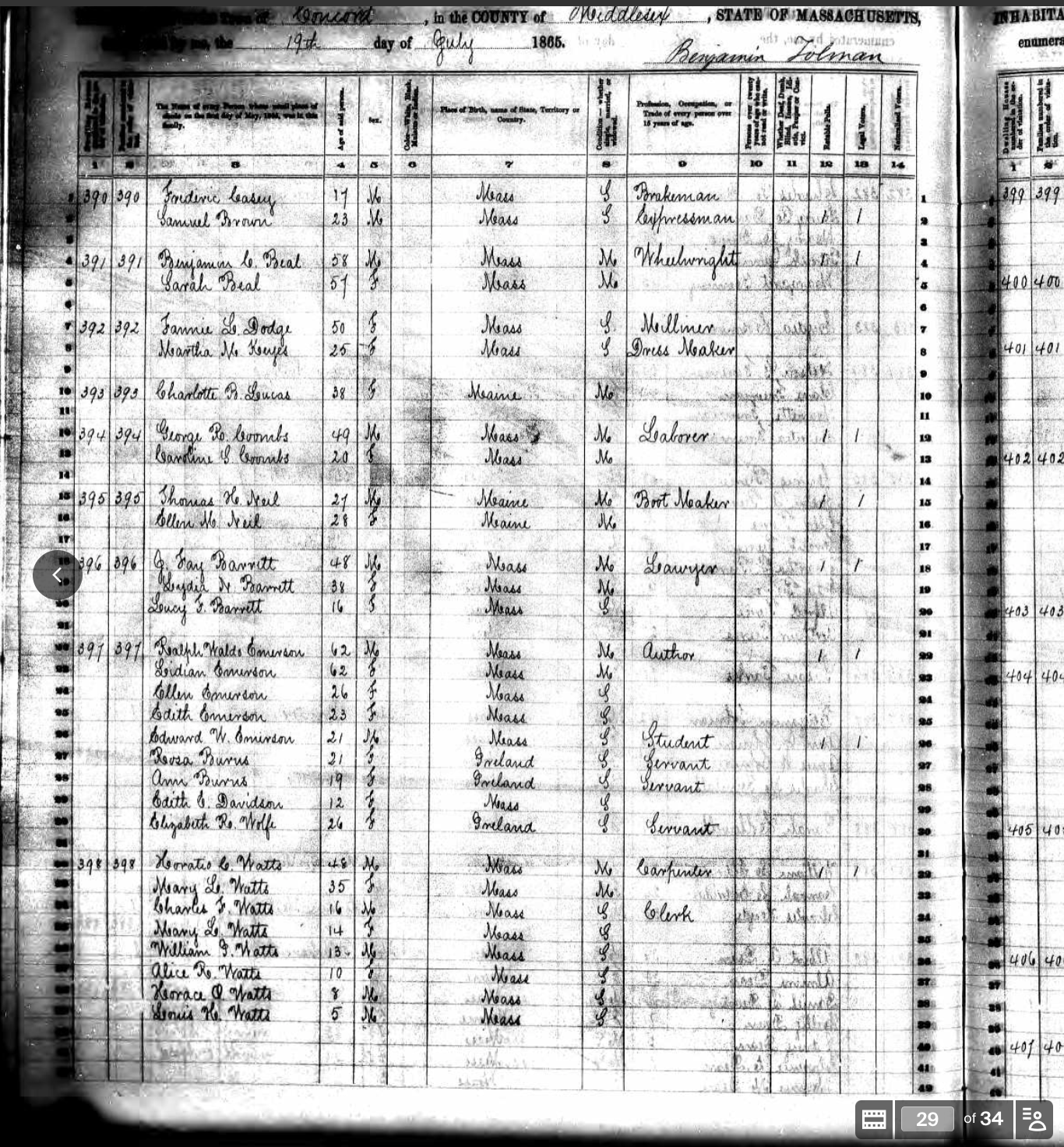
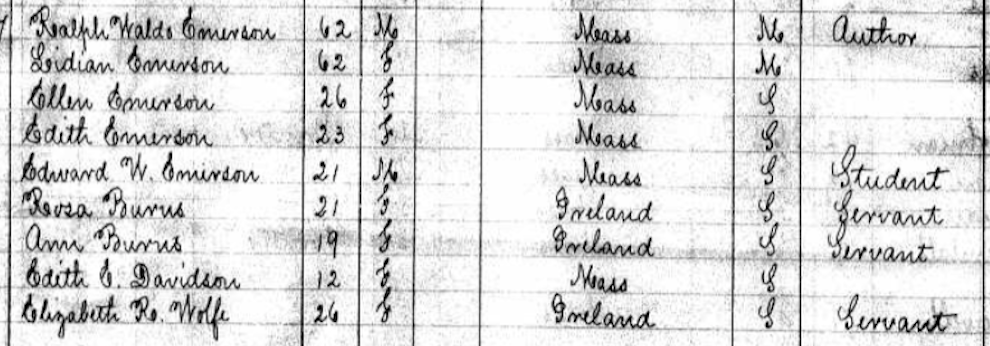
The postscript is that Ann Burns appears in the 1865 Concord census as living in Emerson’ household.
Posted in Boston, England, Family, Ireland, Nautical, New England, The South
3 Comments


 uncomelyandbroken