
I suppose if I were to mention the Post Office and the Irish fight for independence, the first thing to come to mind would be the GPO on O’Connell Street in Dublin. But quite another thing occurred to me as I waited for a bus in Ballsbridge this evening. Right there in front of me was this:

Do you see it? The “VR”? While it may seem like virtual reality, in fact it stands for Victoria Regina, Queen of the United Kingdom and Empress of India. Not only is this a very old mailbox –or pillar box, as it’s called– at something like 110 years old, but it’s a very intriguing remnant of British rule.
According to the website of An Post (the Irish postal service),
Introduced well over 150 years ago by the novelist, Anthony Trollope, who worked for the Post Office in Ireland for several years, the letter box is an instantly recognized symbol of the Post Office.
That’s an interesting literary connection, but there’s more:
Before Irish independence post boxes were red but one of the first acts of the new Irish Government was to order that green would be the new colour for Post Office letter boxes.
It’s hard to day how much I admire this. The mailbox is obviously an implement of the government. It’s a fairly apolitical thing (postcards, bill payments, Christmas cards, etc., all need to get through) but once you put the monarch’s name and crown on the mailbox, it has been politicized. What’s a brand new nation-state to do?
Taking them all down would interfere with the new government’s ability to carry out the most basic of necessary functions: how long would it take to remove and replace thousands of boxes, and how much disruption would it cause? Leaving the mailboxes up as is, on the other hand, gives a sort of symbolic legitimation to the old regime.
So it is on the symbolic level that the matter is resolved. By altering the British mailbox from its iconic bright red (there’s a wonderful piece in the Daily Mail on this topic) to an equally iconic bright green, the transfer of power is communicated with splendid visual power. If the British monarch’s initials and emblems are still visible, all the better. It was not mailboxes he was thinking of when he wrote these lines, but Yeats’ words from “Easter 1916” seem to work just as well, Wherever green is worn, / Are changed, changed utterly.
Interestingly enough, according to thejournal.ie, many of the boxes in town were painted red in 2016 in order to catch the attention of those walking by. “The freshly-painted boxes display a word and a text number. Passers-by can send the word to access special video clips of what would have been happening in the area during the Rising,” they write.
Below are two other pillar boxes I came across in my Dublin wanderings today. The one of the left is more modern, with the inscription now found on them–P&T for Posts and Telegraphs. The other is a former British box, from the time of Edward VII, which features the crown. Most of these older ones do, but the VR one I saw at the bus stop was missing it. Further evidence, I suppose, of Fenian enthusiasm, or perhaps someone with a grievance “going postal,” as they say.


Postscript. I hope this title won’t be confused with The Red and the Green by novelist Iris Murdock, or my own “The Red and the Green: James Loeb and his Classical Library,” Sewanee Review 120.4 (Fall 2012) 553-558





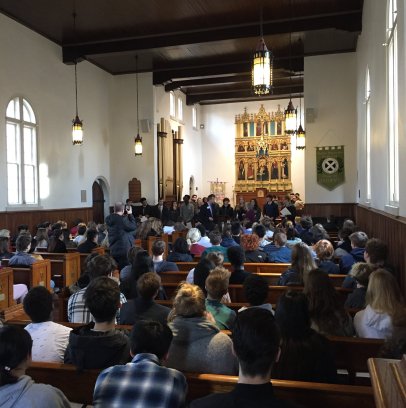
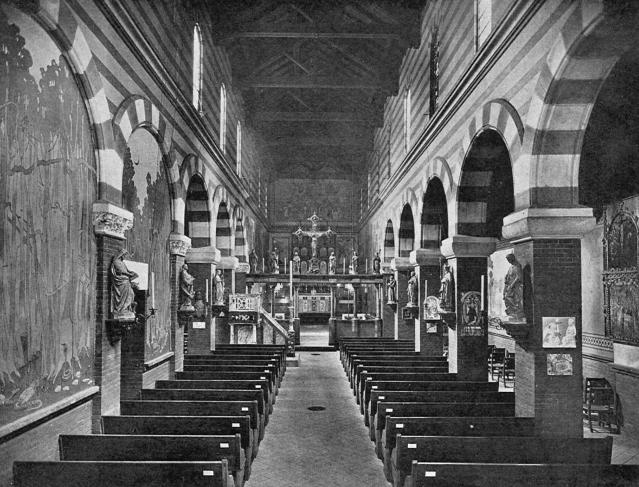

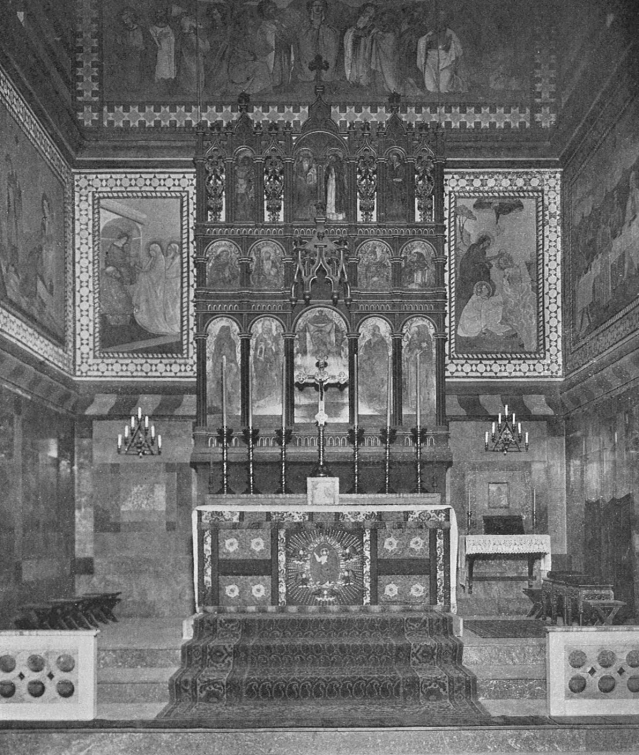
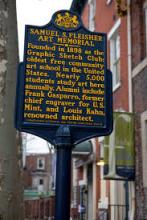 At any rate, Percival became ill in the 1890s, and the Oxford Movement/ Victorian medievalism he espoused fell out of favor in the decades following. The chapel at St. Andrews in Sewanee opened in 1914, as Fr. Wade notes, probably with the reredos now removed from its failing home in Philadelphia. The Church of the Evangelists has had a colorful afterlife: converted into an art gallery in 1922 associated with the Graphic Sketch Club, it became part of the Samuel S. Fleisher Art Memorial. “The mission of the Fleisher Art Memorial,” as stated on their website, “is to make art accessible to everyone, regardless of economic means, background, or artistic experience.” The space is used for exhibits and occasionally weddings (as can be seen in the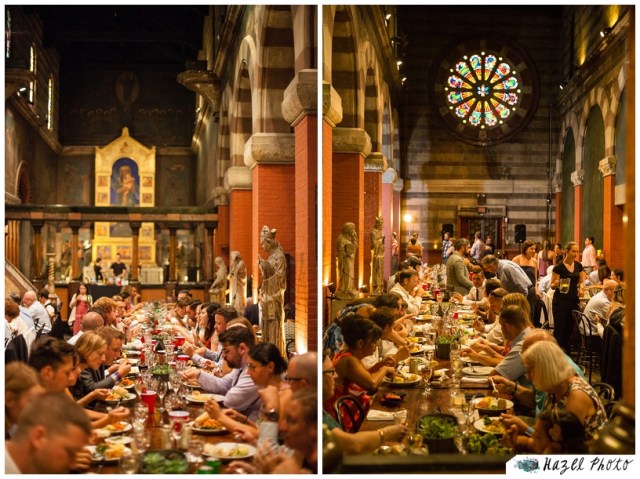
 “It is very happily and kindly provided,” writes Dr. Johnson, “that in every life there are certain pauses and interruptions, which force consideration upon the careless, and seriousness upon the light; points of time where one course of action ends and another begins; and by vicissitude of fortune, or alteration of employment, by change of place, or loss of friendship, we are forced to say of something, this is the last.”


