Scorsese on Bowie as Pilate

Excerpt from interview with Martin Scorsese, from Dylan Jones, David Bowie: A Life

I’m sitting in my director’s chair and there are some chairs behind me and suddenly I feel a tap on my shoulder and I turn around and there I was face-to-face with the ancient world, a being from the ancient world. I suddenly looked into the face of history. His face was right up close to mine and he was smiling and his hair was done as Pontius Pilate, he was in his toga and his eyes, of course, one was one color and the other another color. It was the most shocking, beautiful thing I had seen. This was the ancient world and it has come alive! He was an alien in the best sense of the word! That’s my fondest memory of him. I was stunned; I couldn’t speak … David? Yes! Let me see the toga. It was fantastic. That’s why I wanted him to stay a little still during the shoot because he became that world. He didn’t have to show his authority by moving, he could just glare and speak, you see.

M8DLATE EC005

How to wear the toga—Quintilian, Institutes of the Orator, 11.3.137-150

137 With regard to dress, there is no special garb peculiar to the orator, but his dress comes more under the public eye than that of other men. It should, therefore, be distinguished and manly, as, indeed, it ought to be with all men of position. For  p319 excessive care with regard to the cut of the toga,121 the style of the shoes, or the arrangement of the hair, is just as reprehensible as excessive carelessness. There are also details of dress which are altered to some extent by successive changes in fashion. The ancients, for example, wore no folds, and their successors wore them very short. 138 Consequently it follows that in view of the fact that their arms were, like those of the Greeks, covered by the garment, they must have employed a different form of gesture in the exordium from that which is now in use. However, I am speaking of our own day. The speaker who has not the right to wear the broad stripe,122 will wear his girdle in such a way that the front edges of the tunic fall a little below his knees, while the edges in rear reach to the middle of his hams. For only women draw them lower and only centurions higher. 139 If we wear the purple stripe, it requires but little care to see that it falls becomingly; negligence in this respect sometimes excites criticism. Among those who wear the broad stripe, it is the fashion to let it hang somewhat lower than in garments that are retained by the girdle. The toga itself should, in my opinion, be round, and cut to fit, otherwise there are a number of ways in which it may be unshapely. Its front edge should by preference reach to the middle of the shin, while the back should be higher in proportion as the girdle is higher  p321 behind than in front. 140 The fold is most becoming, if it fall to a point a little above the lower edge of the tunic, and should certainly never fall below it. The other fold which passes obliquely like a belt under the right shoulder and over the left, should neither be too tight nor too loose. The portion of the toga which is last to be arranged should fall rather low, since it will sit better thus and be kept in its place. A portion of the tunic also should be drawn back in order that it may not fall over the arm when we are pleading, and the fold should be thrown over the shoulder, while it will not be unbecoming if the edge be turned back. 141 On the other hand, we should not cover the shoulder and the whole of the throat, otherwise our dress will be unduly narrowed and will lose the impressive effect produced by breadth at the chest. The left arm should only be raised so far as to form a right angle at the elbow, while the edge of the toga should fall in equal lengths on either side. 142 The hand should not be overloaded with rings, which should under no circumstances encroach upon the middle joint of the finger. The most becoming attitude for the hand is produced by raising the thumb and slightly curving the fingers, only it is occupied with holding manuscript. But we should not go out of our way to carry the latter, for it suggests an acknowledgment that we do not trust our memory, and is a hindrance to a number of gestures. 143 The ancients used to let the toga fall to the heels, as the Greeks are in the habit of doing with the cloak: Plotius and Nigidius123both recommend this in the books which they wrote about gesture as practised in their own day. I am consequently all the more  p323 surprised at the view expressed by so learned a man as Plinius Secundus, especially since it occurs in a book which carries minute research almost to excess:124 for he asserts that Cicero was in the habit of wearing his toga in such a fashion to conceal his varicose veins, despite the fact that this fashion is to be seen in the statues of persons who lived after Cicero’s day.c 144 As regards the short cloak, bandages used to protect the legs, mufflers and coverings for the ears, nothing short of ill-health can excuse their use.

But such attention to our dress is only possible at the beginning of a speech, since, as the pleading develops, in fact, almost from the beginning of the statement of facts, the fold will slip down from the shoulder quite naturally and as it were of its own accord, while when we come to arguments and commonplaces, it will be found convenient to throw back the toga from the left shoulder, and even to throw down the fold if it should stick. 145 The left hand may be employed to pluck the toga from the throat and the upper portion of the chest, for by now the whole body will be hot. And just as at this point the voice becomes more vehement and more varied in its utterance, so the clothing begins to assume something of a combative pose. 146 Consequently, although to wrap the toga round the left hand or to pull it about us as a girdle would be almost a symptom of madness, while to throw back the fold from its bottom over the right shoulder would be a foppish and effeminate gesture, and there are yet worse effects than these, there is, at any rate, no reason why we should not place the looser portions of the fold under the left arm, since  p325 it gives an air of vigour and freedom not ill-suited to the warmth and energy of our action. 147 When, however, our speech draws near its close, more especially if fortune shows herself kind, practically everything is becoming; we may stream with sweat, show signs of fatigue, and let our dress fall in careless disorder and the toga slip loose from us on every side. 148 This fact makes me all the more surprised that Pliny should think it worth while to enjoin the orator to dry his brow with a handkerchief in such a way as not to disorder the hair, although a little later he most properly, and with a certain gravity and sternness of language, forbids us to rearrange it. For my own part, I feel that the dishevelled locks make an additional appeal to the emotions, and that neglect of such precautions creates a pleasing impression. 149 On the other hand, if the toga falls down at the beginning of our speech, or when we have only proceeded but a little way, the failure to replace it is a sign of indifference, or sloth, or sheer ignorance of the way in which clothes should be worn.
Posted in Bible, Drama, Music, Pontius Pilate, Rome, Uncategorized | Leave a comment

Sewanee Memoire: Projections for the Project on Slavery, Race, and Reconciliation

Below are remarks I gave for a forum organized by Prof. Woody Register and the Sewanee Project on Slavery, Race, and Reconciliation on about Art, Commemoration, and Sewanee’s Campus, held at Otey Parish on February 19, 2017. Also on the panel was Prof. Shelley Maclaren, whose discussion of the University History windows in the All Saints’ Chapel narthex was brilliant and thought-provoking. I would guess that there were maybe 100 folks in attendance. Write-ups in the Sewanee Purple and the Mountain Messenger   appeared later in the week. 

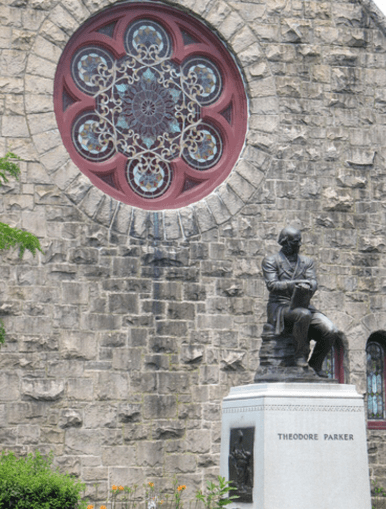
img_0350-0In preparing for today’s panel on “Art, Commemoration, and Sewanee’s Campus,” I thought it might make sense for me to reflect on my own experience of monuments, the earliest of which comes from the time when I was growing up in West Roxbury, a neighborhood in Boston. Outside the Unitarian Church on Centre Street was a statue completely covered in verdigris of a seated man on a high pedestal. I know now he was Theodore Parker, the renowned preacher and fiery abolitionist who aided John Brown at Harper’s Ferry, went into exile shortly thereafter and died in Florence where no less than Frederick Douglass would commission and pay for his tombstone. But to all of us neighborhood kids in the 1960s and 70s, he was a mystery: this was a church none of us had ever been in–everybody I knew was Irish, Italian, Jewish, or Greek–and besides weren’t churches only supposed to have statues of Jesus or Mary? I can remember that a friend of mine once told me confidently that the statue was really George Washington and that he himself was buried in the pedestal, even though THEODORE PARKER was very legibly spelled out in the green copper letters underneath. This friend was not an especially reliable source in other respects, I will admit, but it’s a good indication of how little good spelling out the meaning of a monument can do for many observers. But in any event: famous abolitionist, theological reformer, preacher and phrase-maker? Parker was all of these things, but to us street urchins at the time his statue was just a marker by the bus stop near the Dip-N-Sip, which was the best place in town to buy donuts. In the 90s, the Parker statue was rehabilitated, the verdigris stripped off, the copper treated so it looked like new, and a plaque erected to explain who Parker was and why he mattered. I suspect, though, that most of the kids in West Roxbury didn’t really care and still don’t.

I mention all of this as a way of pointing out that there is a natural life cycle to a monument. Few of them experience the long enthusiasm of, say, the Statue of Liberty or the Lincoln Memorial, which are almost always thronged with school-groups and selfie-taking tourists. Some end their days ignobly, like the colossal statue of Tiberius’ henchman Sejanus that a Roman satirist says was toppled by ropes and melted down into jugs, frying pans, and chamber pots (Juvenal, Satire 10.56-70), a fate Lenin and Stalin have also enjoyed, as well as the Confederate Statue in front of the courthouse in Durham, North Carolina. For most monuments, the highpoint of their life cycles is at the very beginning, that moment when the ribbons are cut, the dignitaries gathered, speeches made, family members tearing up in pride, children and pets running around, and the spirit of celebration at its peak–a scene such as is depicted at the laying of the Sewanee cornerstone. After the unveiling, it is a long slow slide into oblivion. Some monument-makers are aware of this fact, and try to forestall it by kneading the ephemeral hoopla of the moment into the thing itself. The Arch of Titus, for instance, depicts in its interior the triumphal parade of which it is itself the commemoration. Augustus’ Altar of Peace likewise depicts the imperial entourage marching to the altar’s own inauguration. (We see something like this in the final narthex window in All Saints, the procession of Vice-Chancellor McCrady and other notables in front of the chapel, still under construction.) The move here is to avoid the future disregard by remaining eternally in an unfolding celebratory present.

It is the fate of most monuments, however, once unveiled, to sit like immoveable stones while the current of history flows around and past them. Occasionally, a well-meaning history buff will take pains to try to re-inject some significance into the thing, or a dedicated group decides to scrapes off the verdigris and erect a new, inevitably to-be-ignored plaque. But mostly the monument is forgotten or subject to critical reinterpretation, as the ideological basis on which it was made comes under scrutiny. The statue of Christopher Columbus in New York’s Columbus Circle, for instance, erected by proud Italian-Americans in the 1890s, once symbolized the successful integration of immigrants into American society; the statue is now the locus of protests against imperialism and genocide, which it also encodes.

In its time, own Kirby-Smith Memorial has  certainly traced this same trajectory. As Tanner Potts told us all a few months ago, it was set up in the late 30s by the United Daughters of the Confederacy to honor a university founder, an impulse in itself inoffensive. As a Jim Crow monument, though, it also helped to designate public space as white space, and is intimately connected with the university’s segregationist history. In 2016, as some of you will know, I exchanged correspondence in the Sewanee Purple with the head of the local UDC chapter about the memorial. As I said,

I think the University ought to hire an artist to make an installation that would sit in front of it [the monument], and draw attention to it [to answer] the question of what does it memorialize and what does it remember,” he said. “And that doesn’t have to be a rejection—it can be a sort of open question about, ‘What is it that we remember about the Civil War? What does it mean to us?’

It had been my idea, when suggested that an installation be put in front of the Kirby-Smith memorial, that we might reinvigorate the space as a sort of reflection garden, a place to go where the artworks could serve as a jumping off point to ponder what we are doing with our own lives and how it will look sub specie aeternitatis, in view of eternity. I still think that would have been the best way to proceed–to leave the UDC memorial in place but to give artistic voice to another point of view about the ideology it enshrined–but in the wake of the deadly Charlottesville protests of the next year, the Vice-Chancellor removed the medallion and name from University Avenue and relocated them to the cemetery. I wish the chance to debate that decision as a community had not been precluded, but that is the VC’s prerogative and so there’s no point to revisiting the matter.

IMG_6762So where does this leave us now? In a famous essay he wrote for the Nation in 1985, the philosopher of art Arthur Danto outlined the critical distinction that “we erect monuments so that we shall always remember, and build memorials so that we shall never forget.” Defenders of Confederate monument sometimes elide this distinction–claiming to want to never forget the horrors of the Civil War when in fact they often want to always remember the Confederacy as a noble endeavor. The Romans had a similar practice, the damnatio memoriae, which seems to split the difference by commanding us to Always Forget an individual fallen from grace. I invoked this idea in a blogpost last fall about the now empty plinth of the Kirby-Smith last fall. Some people really liked this idea, and some were very upset and pained by it. I think, insofar as the project whose auspices we are gathered under is named the “Project on Slavery, Race, and Reconciliation,” my idea about damnatio memoriae is not an especially useful one.

But larger than that, far larger, I think is the issue of the “Always/Never” dynamic that Danto points out in his essay. An inherent problem of all monuments and memorials, it seems, is their totalizing nature, their insistence on being taken to have a single, indivisible meaning which we must either accept or reject entirely (Something like this seems to be at work with honorary degrees, I have to say, though I won’t say anything more about that … right now). As an educational institution, we don’t accept the idea of a single monolithic meaning in other works of art of literature, nor do we believe that history or politics are ever simple matters. It may be that, in this age of polarized politics and weaponized nostalgia, we all could use a lot less all-or-nothing certitude and a little more hesitancy in the middle ground.

And so, in this respect, I am very attracted to the Cité Mémoire project in Montreal that Shelley Maclaren has introduced me to, in which images from the past are projected into various locales that do not confirm or negate strongly-established principles but instead unsettle us a little about what we think we already know. I like the temporary nature of the images, their connection to the visual culture we occupy now–screens–and not one that is associated with boring old History–statues. The idea of an exhibit that can be curated, questioned, re-curated, and re-questioned. If I had to select a few images for such an outdoor exhibit on Slavery, Race and Reconciliation at Sewanee, here are some of them: 

img_7403The autographed picture of Louis Armstrong dedicated to English professor Charles Harrison, now in the Ralston Listening Room. When Armstrong played at Sewanee in the early 60s, it was Harrison’s home he stayed at because, as a black man, he was excluded from the old Sewanee Inn. As Richard Tillinghast notes in Sewanee Poems, “Coming down the morning of the gig he is greeted / With the question: “How would you like your eggs, Mr. Armstrong?” /Armstrong comes back at him /In that melodious throaty bass of his: / “However you’re having yours, Daddyo.”  There’s much to reflect upon in this story–the private accommodations that had to be made in the face of Jim Crow, the place of music in the process of reconciliation , and the nature of hospitality that culminates in the wonderful anecdote Armstrong gave Harrison as a gift.

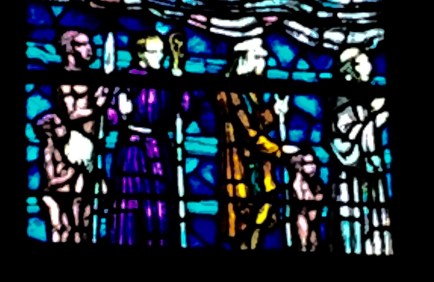
IMG_7330This image of a procession of “natives”  which makes up part of the base of one of the windows behind the high altar in All Saints. This I would throw up outside of the chapel, on the McClurg side where it would be seen by many, as a way of forcing us to confront at eye-level what this kind of iconography means. Why is this offensive, racialized image in the church windows? What does it say about those who made it and installed it, that the Jesus they approach is himself white, indeed Anglo?

One last image below would be Allan Crite’s amazing engravings of the Stations of the Cross, with Christ suffering at the School of Theology Dean’s house (now the Spanish House) behind the old Seminary, crucified and then risen in front of St. Luke’s Chapel. The originals of these are small, and sit in a frame over in Hamilton Hall–enlarged, and projected onto St. Luke’s, they could be quite powerful. Crite, an African-American artist and devout Episcopalian, visited Sewanee in the early 1950s, and made this engravings on-site. The images, very much of but also far ahead of their time, were intended to encourage people in the seminary here to see the sufferings of black people in light of their avowed Christian faith. “As a visual artist,” Mr. Crite said in a 1998 interview with the Harvard Extension School Alumni Bulletin, “I am . . . a storyteller of the drama of man. This is my small contribution – to tell the African-American experience – in a local sense, of the neighborhood, and, in a larger sense, of its part in the total human experience.”

escru_sewanee_allan_crite

There are other images I can think of, but I have no doubt the people in this room have fuller and more interesting ideas of their own. I welcome your response to this proposal, and would be more than happy to gather a database of possible images to project and suggested places to show them. Many thanks, and good evening. 


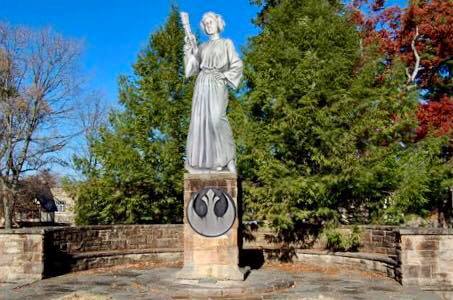
Postscript. During the Q&A the followed the panel, someone asked me what I would put in place of the Kirby-Smith monument if it were up to me. I said that it, in keeping with the spirit of the gift from the UDC, we should make. a point of honoring another rebel general and suggested we put up a statue of Princess Leia. My friend Yuliya sent me this image the next day.

24991069_945620043138_7382914600007893488_n.jpg


Posted in Bible, Boston, Classics, Education, Emblems, Florence, Music, Poetry, Pontius Pilate, Race, Saints, Sewanee, Slavery, Statues & Monuments, Uncategorized | 1 Comment

Protected: Trump an ironic Perseus

This content is password-protected. To view it, please enter the password below.

Posted in Cartoons, Mythology, Statues & Monuments, Uncategorized | Enter your password to view comments.

Protected: The very bottle …

This content is password-protected. To view it, please enter the password below.

Posted in Sewanee, Time | Enter your password to view comments.

Head-copping

photo1.sunsphereAn evening or two ago, I stopped into Mooney’s, the great little local market just on the border between Sewanee and Monteagle, to pick up some garlic powder. I had paid for it, when it occurred to me that I should grab one of those delicious chocolate bars they sell as well–grabbing one, I laid it on the counter though the garlic powder had already been rung up.

Oops. A minor inconvenience. “Oh, sorry,” I said. “I should have …” and I paused there. “You know, there are so many things I could say after those three words.”

“Now you’re just head copping yourself,” said Joan, the owner, and we both cracked up laughing. “Hey, what do you expect? It’s a hippie place.” So I left with the garlic powder, the chocolate bar, and a new expression.

To head cop is not a phrase I’d ever heard before, though its meaning is instantly understandable as something like “to subject one’s conscience to an external source of perceived authority” (my stab at a definition). In his New Introductory Lectures on Psychoanalysis, Freud had called the super-ego as “the vehicle of tradition and of all the time-resisting judgements of value which have propagated themselves in this manner from generation to generation” (1933, 105). The expression head copping, however, is not simply descriptive as Freud is here, but dismissive. In the same way cop is a pejorative term for police, so head-cop is a pejorative way to refer to the super-ego– both point to a figure with power tending toward abuse.

As it turns out, the phrase head cop was coined by Stephen Gaskin,”an often tie-dye-clad hippie philosopher, a proud ‘freethinker’ and iconic founder of The Farm,” as he was described in his 2014 obituary in the Tennesseean. I know Joan spent quite a few years living on The Farm, the utopian collective founded in 1971 in Summertown, Tennessee, and so she probably heard the term from Gaskin himself at some point. I haven’t looked up the phrase in Gaskin’s own work, but in a chapter called “The Formation of Hippie Spirituality” (from Seeking the Sacred with Psychoactive Substances), he is quoted on the topic.Screen Shot 2017-11-14 at 7.46.39 AM

As a synonym for mind control, Gaskin is clearly using the term here in a more serious way than Joan had been. And it can be a serious matter to let allegiance to an authority devolve into mindless obedience. But it seems the phrase head cop can also be employed in a more light-hearted way to dismiss the bossy “shoulda-woulda-coulda” voices of the super ego. You don’t just have to have garlic powder; go ahead and have a candy bar.


Posted in Language & Etymology, Sewanee, Tennessee, Uncategorized | 6 Comments

The Graveyard on Devil Step Island

My friend Adam and I had been planning to take his boat out on to Tims Ford Lake, and this Sunday seemed like the last possible day to do it until springtime. It was an unseasonably warm November day. Why not, we thought, and out we went for some “messing about in boats,” as Rat puts it to Mole in The Wind in the Willows.

This was no idle trip, though–far from it. Adam wanted to scout out some island campsites. Myself, I was interested to see another island feature–the Shasteen Cemetery on Devil Step Island.


Tims Ford is a man-made lake, and not an especially old one. The TVA began flooding it in the 1960s, and by 1971 is as you see it, about 34 miles long and as much as 175 feet deep. The town of Awalt–or Mashbread, as some locals had called it–was abandoned and flooded, along with many other properties. Not everybody was happy about losing their homes, of course. An older friend of mine once told me, “Chris, you haven’t lived till you have stood at public auction to buy back property from the government that was in your family for generations.” As a girl, she had played on the hilltop which is now a headland on the lake, a point she was lucky enough to buy and build a home on.

The TVA made a point of relocating old cemeteries that the flood would cover. The Shasteen cemetery, however, was on top of a high hill, and so was left in place. So while some of the people buried there were carried up by carriage, now you have to get there by canoe.

Why is Devil Step–the island, and the hill which it used to be–named for the Devil? I haven’t found the reason for the place-name, but there are various possibilities. The hill might have been difficult to climb, giving early settlers a devil of a time to get up. Perhaps there was a folktale of the Devil’s occupying the place: some sulfurous caves are named for the Devil, given the smell. Or maybe the nearby Boiling Fork creek, now submerged, suggested demonic activity. A political reason may also be in the background: some Native American sacred places were associated with Satanic worship and witchcraft by European settlers and thus connected with the Devil.

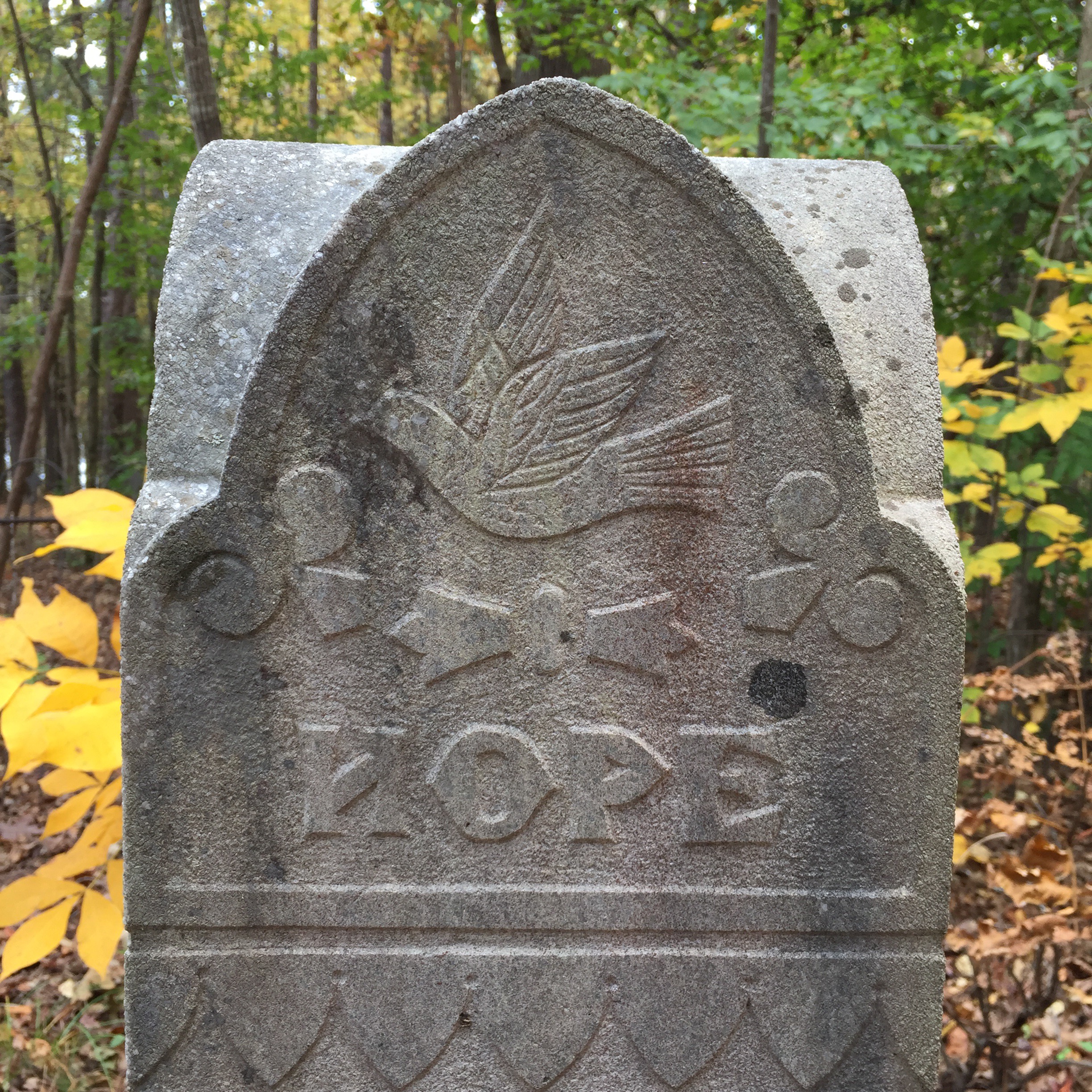
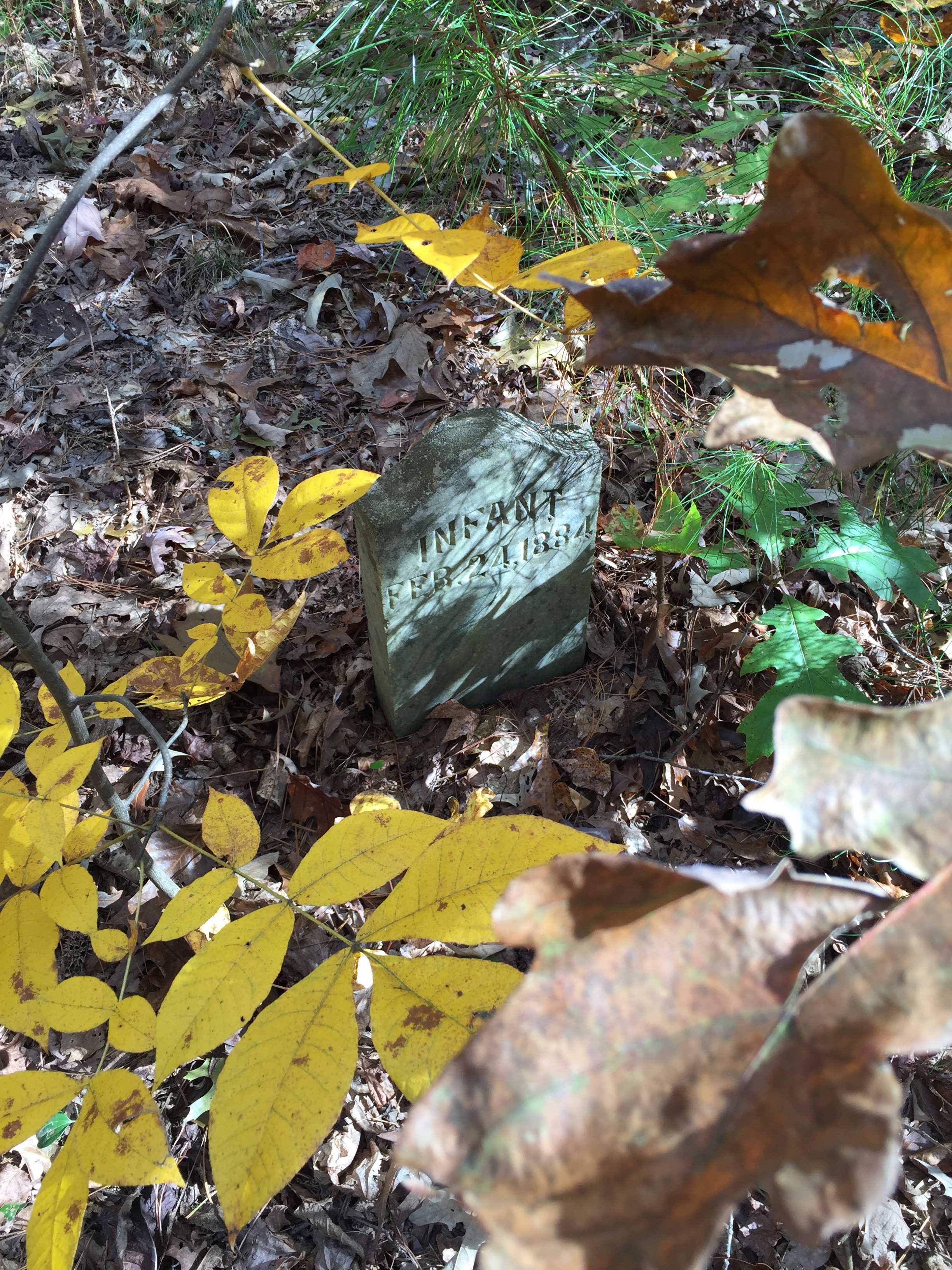
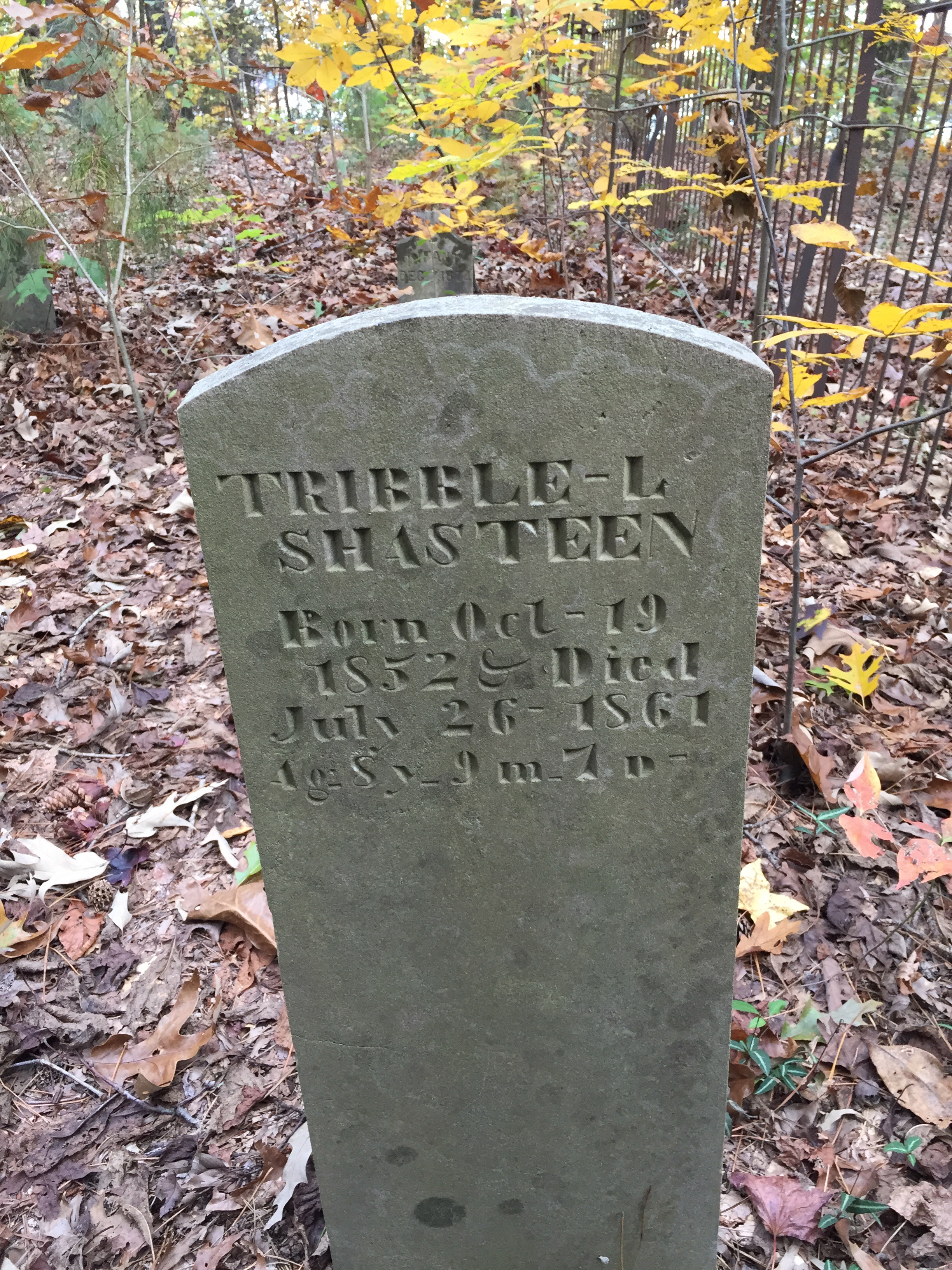
In any event, nothing demonic is suggested by Devil Step Island today. It’s a peaceful place with a pleasant little campsite that is, perhaps, a little too close to the graveyard. Below are some pictures from our outing, my favorite of which is the detail up above from the gravestone of Mary E. McCoy, wife of R.S. Shasteen, who died in 1910. It features a pretty dove in flight over the word HOPE. Doves are usually associated with Peace, of course, but perhaps this is the one released by Noah, who “could find nowhere to perch because there was water over all the surface of the earth” (Genesis 8:8), thus anticipating the flooding of area by the TVA? No place to perch, that is, but Devil Step.

Posted in Bible, Birds, Cemeteries & Funerals, Emblems, Nautical, Race, Tennessee, Uncategorized | 3 Comments

Post in which social media doesn’t suck

So, I’m in Milwaukee for the Film & History conference where I gave a talk on Nina Paley’s film, Sita Sings the Blues and her ongoing Seder-Masochism project. Vince Tomasso, one of the other attendees, has been tweeting the conference, and there was a nice response from Paley herself! Woot!

As a classicist, it is so rare to hear back from an artist you’re writing about …

Screen Shot 2017-11-04 at 7.28.09 AM.png

Postscript. So I ended up sending Nina Paley my paper, which she seems to have read right away.  The last part of what I had written reads,

If her work seems blasphemous, though, I will tell that of the many, many people whom I have forced to watch clips like “This Land is Mine” or “Tabernaculous!,” most have ended up at some point putting their hands to their mouth to say, “Oh my God!”

Her response, edited:

“Oh my god!” I love it. It is amazing and flattering and encouraging to see my work written about like that. Thanks! {there follow a few corrections, and additions} Thank you again, my cockles are warmed for the week.–Nina

So how cool is that!? I’m not sure that I will do much more with this paper, at least not until all of Seder-Masochism is out and until I’ve made substantial progress on my Pilate book. But it is nice to know that I’m not dead wrong in my initial read of these two fine cartoons.

Posted in Bible, Cartoons, Mythology, Uncategorized | Leave a comment

Protected: You have heard of Gettysburg, but does it haunt you?

This content is password-protected. To view it, please enter the password below.

Posted in Cemeteries & Funerals, Family, Ireland, Military, Sewanee, Slavery, The South, Uncategorized | Enter your password to view comments.

Damnatio Memoriae Sevaniae

EKS Damnation Memoriae

A year or so ago, I had an exchange with the United Daughter of the Confederacy about the monument to CSA General Edmund Kirby-Smith on the campus of the University of the South in Sewanee, TN, where I teach. My proposal was to hire an artist to make an installation to sit in front of the monument to draw attention and enter into a sort of artistic dialogue with it. The UDC didn’t like my idea but, as I never formally suggested it to the administration, nothing came of it. Frankly, it seemed like a pipe-dream that anything could happen with the monument.

Since that time, a lot has happened. Trump has become President and extreme right-wing movements have been emboldened. During the summer, a large protest of Neo-Nazis marching together with the KKK took place in Charlottesville, Virginia, and a protester was killed by them. The rallying point for the alt-right demonstrators was a statue of Robert E. Lee. In the wake of Heather Hayer’s death, communities across the nation began to reconsider the purpose of their monuments honoring of the Confederate cause. The mayor of Baltimore ordered all Confederate statues taken down in single night. Protesters in Durham, NC, took matters into their own hands and, like people in Eastern Europe after the fall of Stalin, pulled another such statue down from its pedestal themselves.

Locally, interest was renewed in our own Confederate memorial in light of these events. The Sewanee Slavery Project, headed up Woody Register and Tanner Potts, held a forum to discuss the monument, and all such signs of the Lost Cause dotting the campus. The day before, the Vice Chancellor sent out an e-mail indicating that, at the request of one of the Kirby-Smith family, the monument was to be relocated to the University Cemetery, presumably by the general’s grave.

As it happened, I had wanted to get the feeling of some of the Kirby-Smith family living in town, and was talking with one of them when the e-mail came out. I know he felt left out of the conversation–the cousin who had made the request lives in another state–but acknowledged that, had he or any of his local relatives been consulted, they would probably have agreed to the moving of the monument to their great grandfather. Not that their feelings about the matter were determinative, but still it might have made sense to have consulted them. For the sake of the family, some of whom I consider close friends, I am happy to see the monument removed and to see this particular burden lifted from them.

In any event, the Vice Chancellor made his decision a month or so ago, and time has marched on. The leaves have changed, the weather has gotten cold, and soon we will turn back the clocks. It was only a matter of time, I knew, before I would walk by the monument and see–or rather, not see–the General’s visage in bas-relief on its plinth there on University Avenue. The sandstone all around has grown dark and discolored, but the spot where the medallion was affixed is still the bright yellowish-brown it was back in the 1940s when the monument was dedicated. The letters of the general’s name have not been removed, or at least not yet. Soon, I suspect they and the plinth itself will be gone as well.

Speaking for myself, I wish it would remain in the very place where it is right now, and in the very condition of my photo up above. The Romans had a term for this (or rather, they had the concept, to which classicists have given the term), damnatio memoriae, “the condemnation of memory.” The process did not involve the removing of all traces of a disgraced public figure, but rather removing the name and image in such a way that they could still be made out. The point was not to consign the figures in question to oblivion once and for all, but rather to consign them to oblivion every single time one came across their oddly missing presence.

And I wish the same would happen to the general, to the cause he fought for, and to the organization that put up this memorial.  I would like it if, every time we walked down University Avenue, we saw his ghostly absence on the street, and remembered that once, on this spot, it was OK to honor those who fought a brutal war to keep others enslaved. It’s all too easy to decide the past is past, that it has nothing to do with us, and to let it all go down the memory hole. And then, one pleasant summer day, there’s a neo-fascist torchlight parade in a university town and somebody gets mowed down by a car. Evidently, amnesia isn’t a viable solution to our national ills concerning racism. To forget the disgraceful reasons the Civil War took place, and the disgraceful people who fought for it, is not enough. We must always remember to forget them, and to remember why we are doing so.

* Quite a few people, some of whom I admire, have taken issue with my line “and the disgraceful people who fought for it,” so I’ve decided to give it a little damnatio memoriae of its own.  I’m still torn on this, to be honest. Disgraceful causes don’t do the fighting for themselves, after all. But then I think of the even-handedness with which Homer treats both the Greeks and the Trojans, perhaps possible only because it is a fictional war without real-world consequences.

This summer I read Plato’s Laches and parts of the Protagoras on courage–I was especially interested to know whether it is possible to be noble in the service of ignoble causes? Could we honor Confederates for their gallantry, even if we had to condemn their ideology? I don’t think Socrates ever really sorts the issue out, but if all virtues are part of one great Truth, he thinks it’s not possible for any of them to ultimately be at odds with one another.

In the end, I suspect that name-calling is not especially virtuous itself. There’s something about motes and beams in another ancient text that I recall.

Posted in Cemeteries & Funerals, Classics, Emblems, Military, Race, Sewanee, Slavery, Statues & Monuments, The South, Time, Uncategorized | 6 Comments

Regnet Pax Omnem Per Terram

This morning’s Sewanee Elementary School assembly was a real treat–this year’s petition for peace for the Peace Pole was in Latin: “Regnet Pax Omnem Per Terram.” To prepare, Kathryn Gotko Bruce had the 4th grade students do some study on ancient Rome. You can see some of the posters of their work lining the hallway (ancient gender relations seem to have especially surprised the kids–about Roman men, one student wrote “They’re Evil!”). After the petition was read, 5th graders performed “Dona Nobis Pacem.” Jim Turrell and I had discussed whether they would use classical or church pronunciation, and in an ecumenical spirit, they used both!

Posted in Classics, Education, Emblems, Language & Etymology, Music, Sewanee, Uncategorized | 1 Comment