
-
Recent Posts
Recent Comments
Uncomely and Broken on Pope Leo on cinema: “an… David Cronin on Pope Leo on cinema: “an… Uncomely and Broken on Ishi and the Algorithm Dennis Davenport on Ishi and the Algorithm Uncomely and Broken on Theodore Parker’s Grave,… Archives
- April 2026
- March 2026
- November 2025
- December 2024
- April 2024
- October 2021
- February 2021
- September 2020
- July 2020
- June 2020
- May 2020
- April 2020
- March 2020
- January 2020
- August 2019
- July 2019
- June 2019
- May 2019
- April 2019
- March 2019
- February 2019
- January 2019
- December 2018
- November 2018
- October 2018
- July 2018
- June 2018
- May 2018
- April 2018
- March 2018
- February 2018
- November 2017
- October 2017
- September 2017
- August 2017
- April 2017
- February 2017
- October 2016
- September 2016
- May 2016
- April 2016
- March 2016
- February 2016
- January 2016
- November 2015
- October 2015
- September 2015
- August 2015
- July 2015
- June 2015
- April 2015
- March 2015
- February 2015
- January 2015
- December 2014
- November 2014
- October 2014
- September 2014
- August 2014
- July 2014
- June 2014
- May 2014
- April 2014
- March 2014
- February 2014
- January 2014
- December 2013
- November 2013
- October 2013
- September 2013
- August 2013
- July 2013
- June 2013
- April 2013
- March 2013
- February 2013
- January 2013
- December 2012
- November 2012
- October 2012
- September 2012
- August 2012
- July 2012
- June 2012
- May 2012
- April 2012
- March 2012
- February 2012
- January 2012
Categories
- AI
- Animals
- Astronomical
- Bible
- Birds
- Books
- Boston
- Cartoons
- Cemeteries & Funerals
- Classics
- Coal
- Dogs
- Drama
- Education
- Emblems
- England
- Family
- Film
- Florence
- Ireland
- Italy
- Language & Etymology
- Military
- Music
- Mythology
- Nautical
- New England
- Numismatics
- Oxford
- Poetry
- Pontius Pilate
- Race
- Rivers
- Rome
- Saints
- Scotland
- Sewanee
- Slavery
- Sports & Games
- Statues & Monuments
- Tennessee
- The South
- Time
- Trees & Flowers
- Uncategorized
Meta
Protected: The Afterlife of the Gifts of the Magi
Posted in Bible, Italy, Uncategorized
Enter your password to view comments.
Lauro de Bosis’ Gesture

From George Garrett’s “A Wreath for Garibaldi,” Kenyon Review 23 (1961) 487-88:
It is hard for me to know how I feel about Lauro di Bosis. I suffer from mixed feelings. He was a well-to-do, handsome, and sensitive young poet. His bust shows an intense, mustached, fine- featured face. He flew over Rome one day during the early days of Mussolini and scattered leaflets over the city, denouncing the Fascists. He was never heard of again. He is thought either to have been killed by the Fascists as soon as he landed or to have killed himself by flying out to sea and crashing his plane. He was, thus, an early and spectacular victim. And there is something so wonderfully romantic about it all. He really didn’t know how to fly. He had crashed on take off once before. Gossip had it (for gossip is the soul of Rome) that a famous American dancer of the time had paid for both the planes. It was absurd and dramatic. It is remembered and has been commemorated by a bust in a park and a square in the city which was renamed Piazzo Lauro di Bosis after the war.* Most Romans, even some postmen, know it by the old name.
Faced with a gesture like Di Bosis’, I find usually that my sentiments are closer to those of my sculptor friend [who, earlier in the essay, had declared such gestures to be “bullshit”]. The things that happened in police station basements were dirty, grubby, and most often anonymous. No poetry, no airplanes, no dancers. That is how the real routine of resistance goes on, and its strength is directly proportionate to the number of insignificant people who can let themselves be taken to pieces, piece by piece, without quitting. It is an ugly business and there are few, if any, wreaths for them. I keep thinking of a young woman I knew during the Occupation in Austria. She was from Prague. She had been picked up by the Russians, questioned in connection with some pamphlets, sentenced to life imprisonment for espionage. She escaped, crawled through the usual mine fields, under barbed wire, was shot at, swam a river, and we finally picked her up in Linz. She showed us what had happened to her. No airplanes, no Nathan Hale statements. Just no spot, not even a dimesize spot, on her whole body that wasn’t bruised, bruise on top of bruise, from beatings. I understand very well about Lauro di Bosis and how his action is symbolic. The trouble is that like many symbols it doesn’t seem a very realistic one.
*CMcD: It is a grim irony that the piazzo near the Olympic Stadium is dominated, still, by a large pillar reading “Mussolini Dux.”
Posted in Emblems, Italy, Military, Poetry, Rome, Statues & Monuments
Leave a comment
Fake Jan!
You may not know this, but January 2nd is, to some online hipsters that I do not count myself among, sometimes called “Fake Jan” Day. Jan 2. Get it? The whole thing involves the Brady Bunch Variety Hour in some lame retro-cool kind of way. And though such things out to be ignored out of hand as the flotsam of a tossaway culture, perhaps we ought to give Fake Jan a bit of a think on this, her evident feast day.
So, a long time ago, in the in the late 70’s/early 80’s, some friends of mine in the very Irish Catholic West Roxbury neighborhood of Boston had a band (with a genuine record deal) called the Visigoths. I saw them play live once (at the Penalty Box, the dive bar across from the street from the Boston Garden, I think?) but maybe not. Their music wasn’t really to my taste, being of the deafening punk-rock garage variety, the sort I imagine blaring out of some band-member’s mother’s basement while she consoled herself with the thought, “Well, at least they’re not out drinking in the woods.” Anyway, what I do remember after all these years, is that they had a song–it turns out to be the opening number on their album, Pining by the Grave of Stardust, which I astoundingly discovered online–called Fake Jan. This consists of a very loud guitar and drum track over which the singer shouts, now and again, “Fake Jan!”
The first time I heard this song, the first time anybody I knew heard it, we all knew precisely what it was the Visigoths were yelling about. We had all grown up watching The Brady Bunch–it was a staple of our TV watching, and every kid in the neighborhood had as intimate a knowledge of the Brady family’s triumphs and travails as they did of their own family’s. The members of the Brady family were real to us, but they never seemed like real people because they were more than real because they were the Brady Bunch.
As my friends and I reached our middle teenage years, television culture began to change–the age of the variety show had descended upon us, with all of its manufactured razzmatazz through which we would sit stoic and stony-faced. Some of this genre was not terrible (e.g., Sonny and Cher, or at least Cher) but mostly it was shitty, and the Brady Bunch were not immune to the pervasive shittiness. In late 1976, the Brady Bunch Variety Hour aired while millions mourned. Watching your TV family sing and dance was awful, and surely as much of a trauma as it might have been to watch your own parents and siblings forced to sing and dance on national TV. The crowning insult of the whole BBVS thing, however, was that Eve Plumb had been replaced by Geri Reischl as Jan. Geri was a lovely and talented young woman, and of course, everybody hated her right away.
The whole Geri Reischl Fake Jan story has been told before– how Eve Plumb had other career irons in the fire (Dawn: Portrait of a Teenage Runaway), how Geri auditioned and beat out thousands of others for the role of a lifetime, and how she really was a very fine singer and actress who never got a fair shake– but none of that mattered to us watching the show in the 70s. The replacement of Eve Plumb by this, this impostor was an insult as great to our collective self as has been the whole Dick York-Dick Sargent debacle of a decade before. It reminds me of the line from the great Boston band J. Geils’ hit song Centerfold, “My blood runs cold/ My memory has just been sold.” Yes, our memory had been SOLD, without so much as asking permission. Who did these people think they were to do this?! Well within their rights were the Visigoths to call it out. “Fake Jan!” they screamed over blaring guitars on behalf of a betrayed generation. “Fake Jan!”
And yet, what was it that our outrage was really all about? I sometimes have thought about this issue in the intervening years.
There is, on the most superficial level, the snarkiness of pop culture itself, the relentlessly judgmental way by which it determines What’s In and What’s Out, never more apparent than at the end of the year, when relentless judging is at its height. It is, of course, the entertainment world’s last shot at entertaining us– to roll out its less successful ventures and then join in with its disappointed customers in the public stoning. In this black-and-white way of thinking, we’re asked to decide between Eve Plumb, whom we’ve grown up with, or this Geri girl whom we’ve just met. Jan or Fake Jan? How can Geri not lose that contest every time?
But I think there’s more to “Fake Jan” than this. What really stuck in our universal craw about Fake Jan was not the false choice between the two pretty young women who played the part of the middle daughter, but something far more elemental.
I suppose you could call the situation a form of “gaslighting,” but honestly that strikes me as too harsh–I think most of us understood that Sid and Marty Kroft, the BBVS producers were doing their best with the casting situation they had on their hands and would have far preferred to have Eve in the role than somebody else. What bothered us, I think, was that Geri had been brought in as Jan, and nobody said a word about the fact that she was not Eve Plumb. We were all supposed to just accept the idea that this person, who had not ever been Jan, was now supposed to be Jan and had always been Jan. This is your sister. Don’t you recognize your sister?
As I said, the Brady Bunch was everybody’s family, and we knew their lives as well as we knew our own. They had their problems, but every week seemed to work them out. And they all seemed to like each other– even though their architect father had designed a cavernous living room, the kids shared bedrooms and seemed more or less OK with it. Given that I would grab my baby brother by the ankles and flip him upside down in order to bump his head on the floor as I ushered him out if he dared to enter my room, the Brady’s essential harmony was a marvel to me.
But in fact, the Bradys were not an ideal nuclear unit–they had always been a blended family, in which Mike’s children were Carol’s step-children, and vice versa. We would be reminded of this fact at the start of every episode, and then miraculously forget it. What was the name of the mother of Greg, Peter, and Bobby? What did the father of Marcia, Jan, and Cindy look like? Do we ever see a portrait of them? Is the anniversary of either one’s death ever commemorated? Aren’t there grandparents from the previous marriages to visit? Do the children get any counseling to deal with their loss? Do the children ever make invidious comparisons (“Mike is nice, but our real Dad was way funnier/nicer/richer/etc., etc.”), unfair as they might be but as human as they inevitably are for children?
Questions like this never arise on the Brady Bunch, because ultimately, the premise is a phony one. Their family as it appears in every episode is precisely as their family is supposed to always have been, without any other possibility ever actually arising or existing. The counter-factual questions, about what might have been and why, never get asked. They “must somehow form a family,” we are told in the theme song, but what compromises and conditions are contained in that somehow never get an airing.
For those of us watching the show in West Roxbury in the 60’s and 70’s, questions of the same sort about our own families were also in the air. Weren’t all our own families necessarily a product of a similar sort of contingency? Weren’t our own identities within those families likewise without any sort of inevitability? Ours was a heavily Irish-Catholic neighborhood, and the idea of what a family was, of maternal and paternal roles, and of relations between family members were very much set in stone by the Church. Families were supposed to look a certain way, and there was an end on it. But in almost every household in the parish there were exceptions, and exceptions to the exceptions, that nobody talked about.
When I think back on it, it is painful to realize how many divorces, how many remarriages, how many adoptions, how many “situations” were taking place all around us. So many people trying to work out acceptable lives for themselves in the teeth of an Irish Catholic culture that turned a voluntary blind eye to their problems. The Church of Rome has had to own up to the great misery it has caused, but in the 70’s, all of this was in the future.
It has been many years now, as I say, that I have thought about the Visigoths, that band named for the migratory tribe that set about destroying Rome. I will not be tracking down their album on eBay, nor will I be trying to reach out to any of the band-members on social media. The music, as I recall it, was not worth listening to, and the conversations could not be anything but awkward, I’m sure. But it occurs to me that, perhaps in their juvenile way, the Visigoths were doing their part to pierce the awkward silence that surrounded us in our repressive Catholic neighborhood. Fake Jan was not just about an unsuccessful alternative actress on a forgettable TV show; it was really all those family problems we never had a chance to talk about but would only yell out loud with a beer over the loud music in places like the Penalty Box.
Protected: Good and faithful servant
Posted in Animals, Bible, Cemeteries & Funerals, Dogs, Emblems, Military, Poetry, Statues & Monuments, Uncategorized
Enter your password to view comments.
No middle way out of the waste land?
I just love the March 6, 1950 cover of Time magazine, which depicts T.S. Eliot poised between a cross over his left shoulde, and a martini (or is it a grail?) on his right. The caption below reads, “No middle way out of the waste land?” Should we go to church or to a bar?

Posted in England, Language & Etymology, Poetry, Uncategorized
Leave a comment
“Gassed”: My Thoughts and Another’s, Unknown
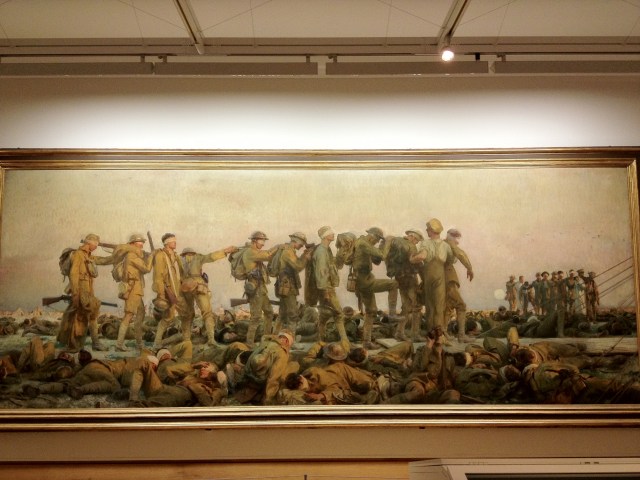
John Singer Sargent’s Gassed (1919)– I’ve seen it twice, last fall at the Frist’s WWI & American Art exhibit and, more memorably, in 2012 at the Imperial War Museum in London. The Olympics were on, and service men and women were being allowed into many of the events for free, so you saw lots of them in the city that summer. One guy in uniform at the IWM I particularly recall, because he stood in front of this painting for quite a while. I thought of that moment today, on the anniversary of the end of the Great War.
Just after the war, Sargent had been commissioned to inaugurate the Hall of Remembrance at the IWM with a work on the theme of the Anglo-American alliance. He chose instead, however, to depict the survivors of a mustard gas attack which he had himself seen in France. Rodin’s The Burghers of Calais (1889) was certainly in Sargent’s mind as he made this , as well as Pieter Bruegel’s The Blind Leading the Blind (1658). Naturally, I thought of Wilfrid Owen’s Dulce et Decorum Est from 1917,
Men marched asleep. Many had lost their boots,
But limped on, blood-shod. All went lame; all blind;
Drunk with fatigue; deaf even to the hoots
Of gas-shells dropping softly behind.
Sargent’s painting captures the horror of Owens’ poem, as well as the allegory in Bruegel. There’s much to look at, and one of the most interesting details is the off-duty soldiers in the background playing football– a grim reference, perhaps, to the quote attributed to Wellington that “the battle of Waterloo was won on the playing fields of Eton.” Gassed is an enormous work of art, 7.5 x 20 ft, and the soldier whom I saw that day at the IWM studied every inch of it. I was tempted to start up a conversation with him, but it seemed to me that he deserved to be alone with his thoughts and this masterpiece. Still, I would have liked to know what was going through his mind.


Posted in Cemeteries & Funerals, Classics, England, Military, Poetry, Sports & Games, Time
Leave a comment
Their Ancient, Glittering Eyes: Prefatory Remarks for the Alderson-Tillinghast Inaugural Lecture

Many thanks to all of you for being here today, a day I have long been awaiting, because it is the day when I finally get to express my deep gratitude to the University and its benefactors, and particularly to Mrs. Diane Alderson, for the chair that has been so generously bestowed upon me, the Alderson-Tillinghast Chair in the Humanities. The late Edwin Boyd Alderson, Jr., was a distinguished judge, and Richard Tillinghast, here with us today, is a celebrated man of letters, and my talk today—about the cinematic representation of Pontius Pilate—is to some degree about the areas Alderson and Tillinghast represent, the complexity of the Law and the intricacy of the Arts.
But I would be sorely remiss, in these grateful remarks of mine, if I did not make some mention of that other element in the title of the chair, the smallest part but the one that I hold most dear, and that is the hyphen, for that little half-dash suspended midair between the names seems to me to contain within it, with supreme understatement, all that existed between Edwin and Richard, by which I mean their tremendous friendship. The picture of them you see here is one I lifted from Richard’s Facebook account. I keep it on the cluttered desktop screen of my computer, and now and again I have opened it up to consider it since the surprising announcement of my receiving ths chair was made at the University Convocation in January. I take heart from this picture, and not just because of the boldness with which Richard has mixed checks and stripes. But what I’m really struck by is the fun they are so obviously having there in Shenanigan’s.
It is just such fun, a capacity for joy, that the Humanities ought to cultivate in us, it seems to me, especially at times like the present when there is so much joylessness in our national scene. There is actually nothing new in the difficult and trying political circumstances we find ourselves in currently—in fact, it is the oldest and most predictable story there is, that the powerful will be filled with corruptions and outrages that we will be called upon to combat. To seek justice as a judge does, and to speak truth to power as does a poet—these can be wearisome tasks, but if we do so in the company of our friends, this picture seems to say, it will all come out all right. And so, in that spirit, let me bring these remarks to a close with a few lines of Yeats, from the final stanza of Lapis Lazuli:
… and I
Delight to imagine them seated there;
There, on the mountain and the sky,
On all the tragic scene they stare.
One asks for mournful melodies;
Accomplished fingers begin to play.
Their eyes mid many wrinkles, their eyes,
Their ancient, glittering eyes, are gay.
Posted in Poetry, Pontius Pilate, Sewanee, Time
Leave a comment
Pulvis et Umbra
A final shot from Mine 21, a beautiful image of miners’ headlamps which flicker like stars about to go out.
Nos ubi decidimus
quo pater Aeneas, quo dives Tullus et Ancus,
pulvis et umbra sumus.–Horace, Odes 4.7.14-16
When we descend to that place where Father Aeneas and wealthy Tullus and Ancus have gone, we are but dust and shadow.
Posted in Cemeteries & Funerals, Classics, Mythology, Poetry, Tennessee, The South, Time
Leave a comment
The Drunken Pat Argument
A fine piece by Adam Gopnik in this week’s New Yorker on Frederick Douglass indicates that there was tension between the movements to enfranchise women and blacks, with a remark on how anti-Irish sentiment was used by either side:
[Elizabeth Cady] Stanton, like her fellow-campaigner Susan B. Anthony, thought that Douglass failed to grasp that they were not a minority seeking protection by the ballot but a majority forever excluded from any exercise of political power, and declared that a government with the participation of black men as well as white men would merely “multiply the tyrants.” They were incensed by the condescension they detected in him. And both Douglass and Stanton felt free to use the Drunken Pat argument, asking why the feckless, inebriated Irish immigrant had the vote when—depending on who was arguing—black men or white women didn’t. None of it is to our taste: Douglass insulted women, Stanton insulted blacks, and both felt free to insult the Irish.
… As for the ethnic joking that pains Blight [David W. Blight author of Frederick Douglass: Prophet of Freedom, the book Gopnik is reviewing] it was an assertion of Americanness: no longer an outsider, Douglass could make after-dinner jokes about the Irish, right along with the rest of his countrymen.
Posted in Ireland, Race, Slavery, The South
Leave a comment


