Adjectives in English absolutely have to be in this order: opinion-size-age-shape-colour-origin-material-purpose Noun. So you can have a lovely little old rectangular green French silver whittling knife. But if you mess with that word order in the slightest you’ll sound like a maniac.”
So Mark Forsyth wrote for the BBC a few years ago. I just wanted to hold on to this insight, as I’d like to test it out for Latin when I have more time this summer.
But thus far, it seems right to me for English: right now, I’m looking at a little orange paperback Greek textbook on my desk, as well as an old broken porcelain coffee mug.
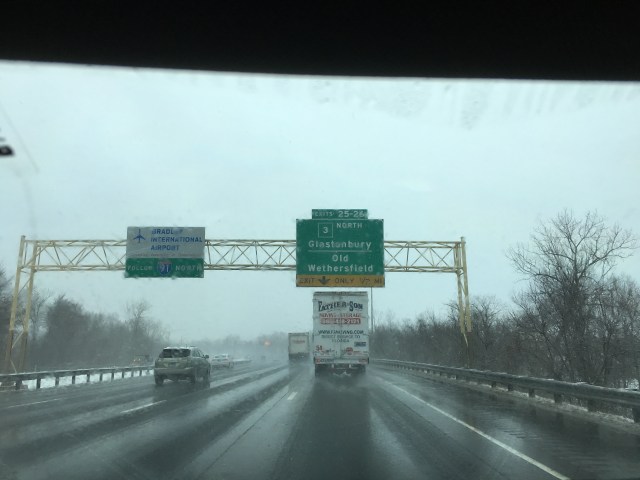
If you’ve been following my inquiries (here and here) into the mysterious inscription in my old edition of Cicero, you know that I’ve pinpointed Glastonbury, CT, as the place where all the principals lived. I was at Yale with some students this week for a screening and presentation on “Mine 21,” and decided I would drive over to Glastonbury to see if there were any further clues particularly about Elijah Smith, the black sheep of the story. Sure, the weather was bad, but Winter Storm Scott was no match for my insatiable curiosity and a decent enough Chevy Impala rental.
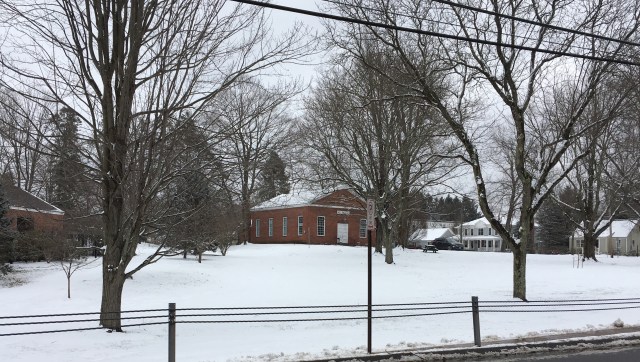
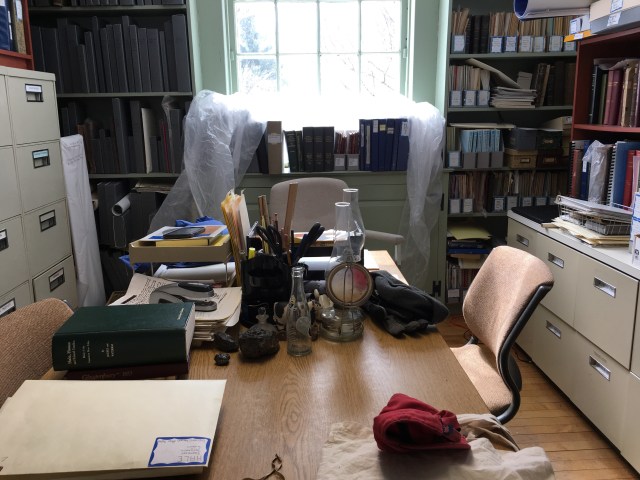
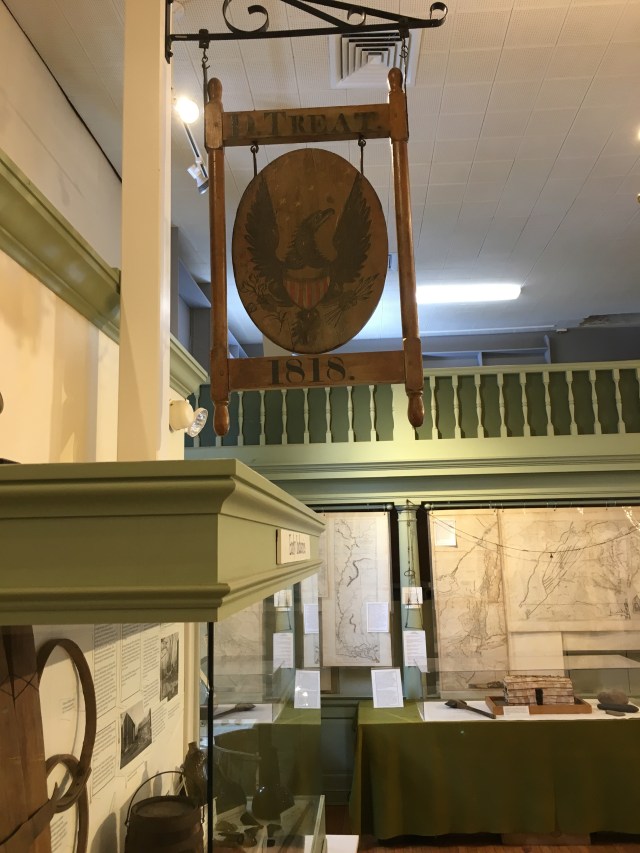
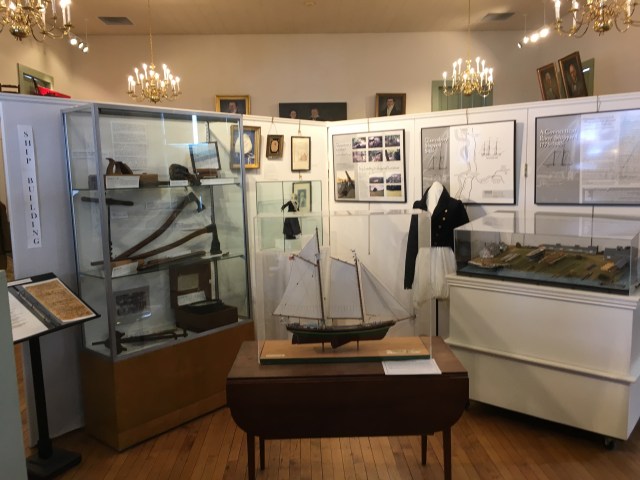
The Glastonbury Historical Society museum and archives are located in what was the old town hall. It’s a quaint red-brick building in a town of quaint old buildings. “Only Marblehead has more eighteenth-century structures,” the director, Jim Bennett, tells me with a slight twinge of envy. He’s been good enough to come out in the snow to meet me this morning. When I explain what I’m looking for, he starts to pull out books and folder from the various shelves and cabinets.
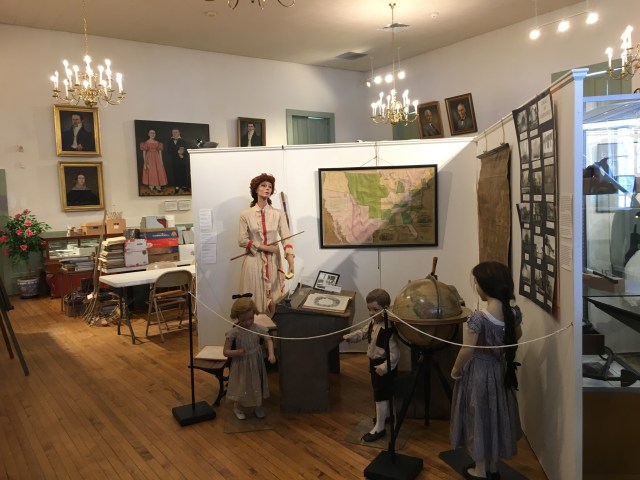
While Jim is looking into the numerous Hale and Welles files, I take a look around the museum. “We’re giving it a long overdue paint job,” Jim explains, “so pardon our appearance.” A few display cases are covered in heavy plastic, and some others are pushed together to make space for ladders and such. But the general feel of the place, the very evident pride of the locals in their long history, is evident throughout.
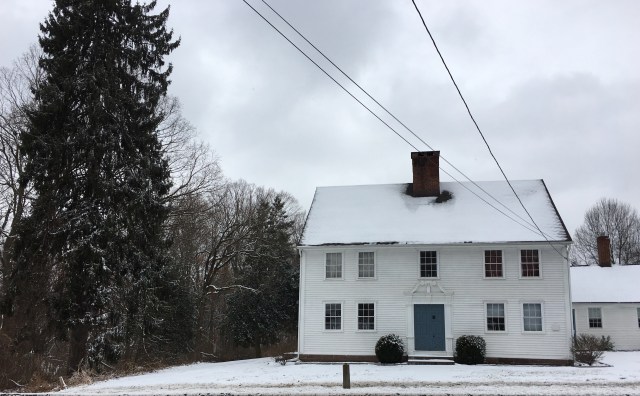
As I have found, Hales and Welleses are thick on the ground in Glastonbury, both in the archives and in the town’s many old houses as well. Below is the Gideon Hale house, where the Gideon of my inscription live and raised his large family over two centuries ago. Because of the snow, I decided to forego a trip to the graveyard, and instead got back into the car to drive north where my brother- and sister-in-law were bringing my son to meet me for lunch.
The person I had really come to find out more about, the hapless Elijah Smith who once owned the 1750 copy of Cicero now in my possession, was not much in evidence. There is a Smith brook I had to pass over as I drove from the museum to the Hale house, and I believe it is likely to have crossed Elijah’s family property in the eighteenth century. But as for the old debt-welsher himself, nary a peep. “He hath absconded himself,” indeed, and my search will have to take me elsewhere.
So I’ve done a little sleuthing about the characters mentioned in my last post who appear on the mysterious inscription in my 1750 edition of Cicero.
I had looked on the British DNB, thinking these folks lived in England. I had been misled by London place of publication of the book and the use of shillings in the price (acc. to Wikipedia, “Due to ongoing shortages of US coins in some regions, shillings continued to circulate well into the 19th century.”)
But in fact, the story all seems to center on society in Glastonbury, CT, and at Yale.
Genealogical excerpts from the 1886 book “The History of the Susquehanna & Juniata Valleys” – page 466:
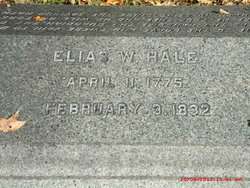
Elias W. Hale was born in Glastonbury, Conn., April 18, 1775. He graduated at Yale College in 1794, and soon after began the study of law…..after completing his studies he removed to Lewistown and was admitted to practice in May, 1798. He died February 3, 1832 and is buried in St. Mark’s Cemetery. Mr. Hale was married to Miss Jane Mulhollan, who survived him many years. Their children were George G., Reuben C., John M., Elias W., Mary and Caroline. Mary became the wife of Gideon Welles, of Hartford, Conn., and Caroline married George D. Morgan of New York. Dr. Elias W. Hale is now living at Bellefonte.
Source is book “Hale, House and Related Families” by D. Jacobus.
Elias Hale was born at Glastonbury, Hartford County, CT on 11 April 1775, son of Gideon and Mary (White) Hale. Married 26 Feb 1810 to Jane Mulhollan. Died at Lewistown, Mifflin County, PA.
Gideon Welles who was his son-in-law was Secretary of the Navy during the Civil War.
***
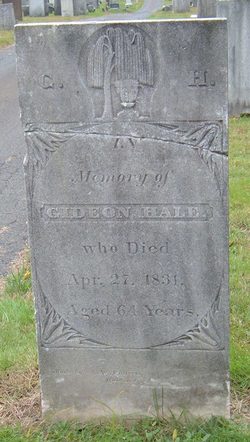
Gideon Hale
BIRTH
Glastonbury, Hartford County, Connecticut, USA
DEATH
27 Apr 1831 (aged 64)
South Glastonbury, Hartford County, Connecticut, USA
Connecticut Courant (Hartford, CT), November 17, 1834
DEATHS
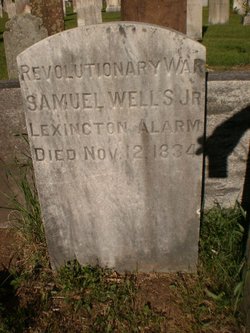
At Glastonbury, Samuel Welles, Esq, aged 80 years,”
New England Historical and Genealogical Register 85:306
Samuel Welles, was the son of Capt. Samuel and Lucy (Kilbourn) Welles. Married first, at Glastonbury on 2 May 1782 to Anne Hale. Five known children. Married second, on 8 Nov. 1816 to her sister, Hannah Hale.
“Hale, House, and Related Families”, Donald Jacobus
On this tombstone, it’s interesting to note that his name is spelled “Samuel Wells Jr”
***
Elijah Smith
Find A Grave doesn’t have anything on the ne’er-do-well Elijah Smith, but there is this notice from Franklin Bowditch Dexter’s Biographical Sketches of the Graduates of Yale College: May 1745-May 1763 (Holt 1896) p. 771:
It seems likely that this is the man who owned my copy of Cicero’s Orations. The connection with Yale, Glastonbury CT, and the notice of his insolvency, all seem to cohere with the portrait sketched out on the flyleaf of my book.
***
Septimius G. Huntington
Lastly, what of Septimius G. Huntington, whose name also appears on the flyleaf, though it seems to be of later date (1795)? This person too has Connecticut connections, and my guess is he went (as his brother Samuel, later the governor of Ohio, had) to Yale. According to The Huntington Family in America: : a genealogical memoir of the known descendants of Simon Huntington from 1633 to 1915 (Privately printed, Hartford CT 1915) p. 594:
***
Postscript to the Postscript. My friend Betsy has gotten very interested in this mystery, and adds the following.
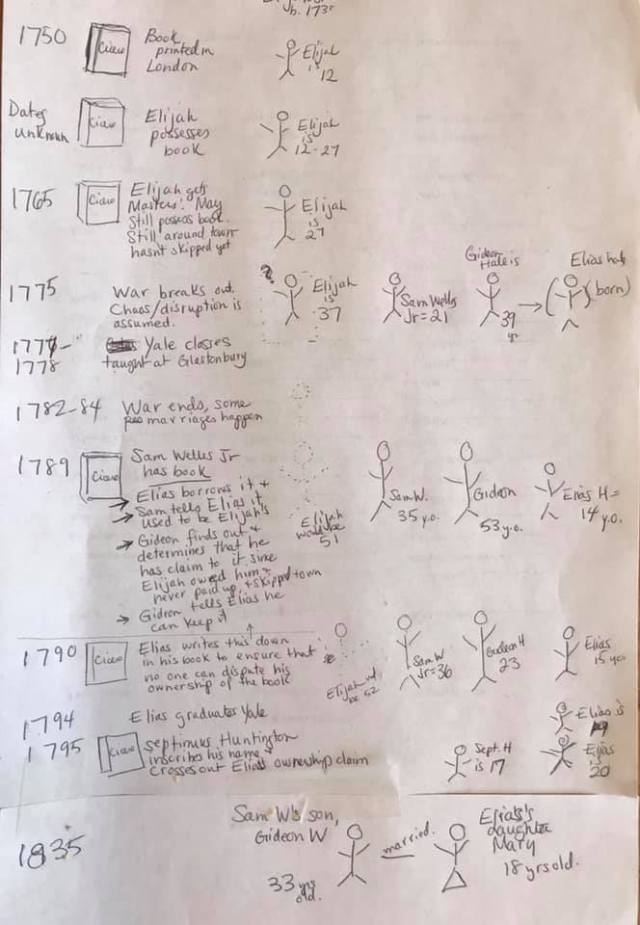
I looked around a little bit out of interest and I have it all figured out. I believe you have the wrong Gideon Hale in your postscript. Otherwise it doesn’t make sense that when Elijah Smith skipped town between the ages of 27 and 51 as per our evidence, he would’ve been indebted to someone that was a teenager. It seems that the Gideon in your book, Elias’s dad, was born 1736 as per my other sources (and 2 yrs older than Elijah). See my illustration.. 🙂
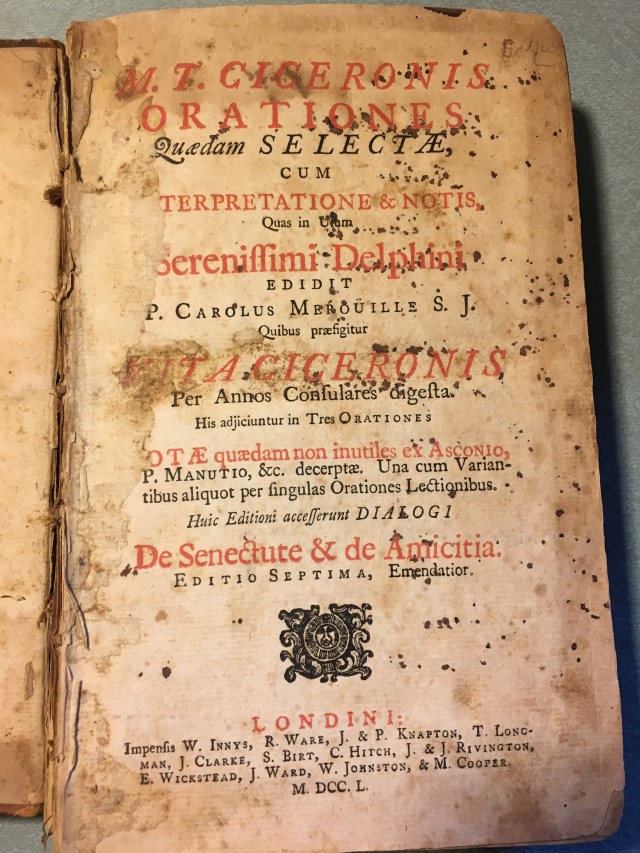
How this book came into my possession, I really can’t say, but it’s probably the oldest one I own, a copy of select orations of Cicero (together with Asconius’ commentary) as well as De Senectute and De Amicitia, originally edited by Charles de Mérouville, S. J., and printed in London in 1750. In fact, this edition is a British reprint of the original French edition in the Delphin Classics series produced ad usum Delphini, for the use of the Grand Dauphin, Louis (son of Louis XIV and father of Louis XV). My copy is the seventh edition of this volume; you can find the twelfth edition (1780) on Google Books.
The book’s not in great condition–the pages are very brittle, the binding almost entirely undone, but it’s a charming old thing.
And it’s full of mysteries. To wit, from the flyleaf:
Here’s how I transcribe it:
This Book was borrowed by the
subscriber in the Year 1789 of Mr. Samuel
Welles Junior—Who then informed me
that it was the property of Mr. Elijah Smith.
As the said E. Smith hath absconded
himself & left his debts unpaid, This Book
was taken by Mr. Gideon Hale for a just &
lawful debt which the said Elijah Smith
owed him & was presented by the said Gideon
Hale to Elias Hale whose property it
now is divino jure
April 11, 1790Elias Hale
Septimius G.
Huntington 1795
Pretium 10/
Evidently the book was valued at 10 shillings (Pretium 10/ ) which, according to the UK National Archives currency converter, means its present-day value is £38.38 ($49.72).
But who are the people in this sordid tale? Who is the ne’er-do-well Elijah Smith, classically educated and once wealthy enough to own an expensive volume of Cicero until “abscond[ing] himself” and pissing off his friend? Who are the self-righteous brothers Elias and Gideon Hale, who believe it is their divine right to just take their suffering buddy’s book? And what about the figures who lurk on the fringes, Samuel Welles Junior, whose only involvement is borrowing a volume of Cicero, or Septimius Huntington, who may be no more than a later owner of the book just as I am? They’re none of them mentioned in the Dictionary of National Biography, as I had hoped.
Furthermore, on pp. 444 & 445–right in the middle of the Second Philippic, someone at some point has pressed a leaf.
I wrote to my friend Ken Smith, in Sewanee’s Forestry department, to ask for his opinion. He sent the picture around to some colleagues, and wrote back, “The panel has decided….. Somebody strolling by picked an orchid of some kind.” Who or when is hard to say, but I like to think of Elijah Smith sitting in a field somewhere one spring, more attentive to the flowers around him than his studies or to the bills and obligations he has piling up. He sighs, picks an orchid, and absconds.
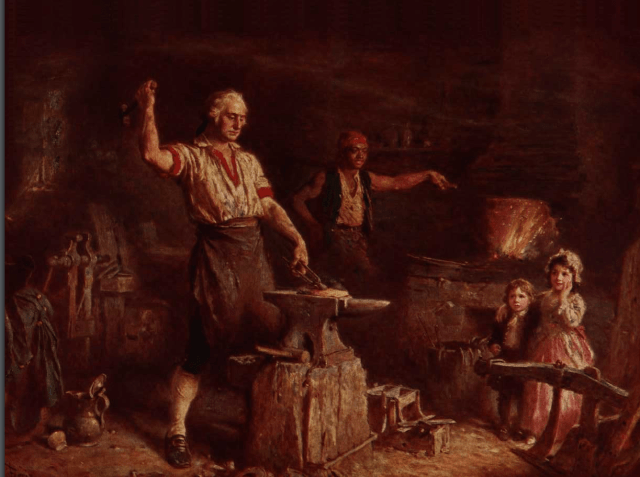
Jean Leon Gerome Ferris, “The American Cincinnatus” (1919)
When I was a kid, I picked up a copy of the 1932 Georgetown yearbook for a dime at a second-hand store my mother and I used to go to. Being a weird kid, I thought it was cool– all these old photos of guys from the 30s, this kind of deco design (see below), and interspersed throughout reproductions of paintings of George Washington (1932 being the bicentennial of his birth). I remembered the one above this week when I was teaching a Latin class and explaining a reference to the Roman dictator, Cincinnatus. Living in the Internet age, it didn’t take much time to track down this image, which, as I came to discover, was painted by Jean Leon Gerome Ferris, an American whose work was once prized and now dismissed. There isn’t really very much to recommend the painting– Washington pretty much looks like he does on the dollar bill, there’s an image of a contented slave that is disturbing, and I have to think those kids shouldn’t be so close to the forge despite the safety gate of the yoke. There’s a part of me that likes these old set-pieces of American history, even though I know they’re a kind of propaganda.
The custom of kidnapping women for marriage, memorialized in Livy’s account of the Sabine Women’s abduction, is not confined to antiquity. A former student of mine, Gambrill, was in the Peace Corps in Kazakhstan, wrote the following to me about a decade ago:
so, bride-napping. yes, it does happen here. from the best i can tell, there are two versions: the romantic, adorable kind and the violent actual kind.
the adorable kind is really more of an elopement than any form of actual kidnapping. Many of the teachers and staff i have worked under have sheepishly admitted they were ‘stolen’ if asked about the nature of their marriage. generally though, what that means is the marriage has already been agreed to or assumed and the young couple cannot or does not want to wait. In that case, the young man comes and steals his bride and everyone goes along with it.
the nasty kind, on the other hand isn’t romantic in the least. it does happen, although i don’t know with what frequency. there was an actual bride-napping in one of our training villages that took place in october. i didnt witness it, but my site mate did. this is the link to the blog he posted about it:
On a funnier note, before I left for site, I was told several times that I was sure to be stolen. It was meant as a compliment, but none-the-less never ceased to crack me up.
Lest the blogpost she references disappear, I am quoting it in extenso here:
I’m going to start with the bridenapping, although it happened more recent. I’ll start with the basics. Bridenapping is common in Kazakhstan (for Kazakhs, not Russians). It is the practice of kidnapping a woman and pressuring her through various means to consent to be a man’s wife. There are two types of bridenapping: the bad kind and the good kind. I know that sounds funny, but its true. Weddings can be expensive here and often families don’t have the resources to fund a large wedding, so bridenappings are “arranged” and the family puts together a shotgun wedding- it is like eloping with the families consent.
The bad kind is more terrifying. A man will have a particular girl in mind and with the help of his family or friends, he will kidnap the girl (16-18 years old usually). He will take her back to his home and the entire family will pressure her to stay and be his wife. Theoretically she has the power to say no and return to her family, but there are many societal pressures to consent. It may sound odd, but the parents of the boy will often call the parents of the girl and inform them that the bridenapping has occurred. The girls parents often agree to support the marriage, often due to societal pressure as well (especially if it was a physical relationship, consensual or not). In the Kazakh Muslim culture, a girl who has had a physical relationship and is not married is considered tainted goods and won’t be wanted by anyone else. You can see how men would and do abuse this and do bad things to insure a girl stays.
We watched a moving video on this a week or so ago and there have been two bridenappings in a town outside Esik while we were here. To be honest, we all knew it went on and that we would hear about it through out service, but didn’t expect to encounter it face to face. I did yesterday.
4 men came into the school where we study and dragged a girl, by her feet, out of her classroom. The ran down the hallway with her. Teachers and students screamed and ran after then, trying to prevent this. The principle of the school caught them at the door. There was a scuffle, where one of the bridenappers pulled a knife and cut the principle in the arm, then barred the door shut, while the other three men picked up the girl and ran away. Eventually the 4th man let go of the door and fled. By the time everyone got outside she was gone.
I was in the bathroom right down the hall when this happened. I heard all the screaming and running. By the time I got to the door, the 4thman had just barred the door with his shoulder. Everyone was screaming and crying. Then he let go and left. I funneled outside with everyone else; saw the director holding his arm and everyone looking stunned. There were two other volunteer friends outside who saw it all from the outside.
One of our language teachers walked by and we told her. She was shocked and suspected that it was ransom related, as the use of a knife in a bridenapping is very unusual. But eventually it was determined that it was in fact a bridenapping. The police were called. The school knew who the men were and where they lived. Even though it is traumatic for those involved, and the friends of the girl, the 3 men who did the bridenapping were determined to have done nothing wrong, as it is part of Kazakh culture. The man who pulled the knife though will be punished by the law. By lunch time we heard that the families were in negotiations about the marriage. I never heard if she married the man or not.
I told my host mom of this last night and she acted like it was no big deal. I told her I knew that it happened, but was shocked that they would go into the school and do it. She said it was common and it was one of the few times when girls are away from their parents and homes.She said it still happens a lot, but not as much as it used to.
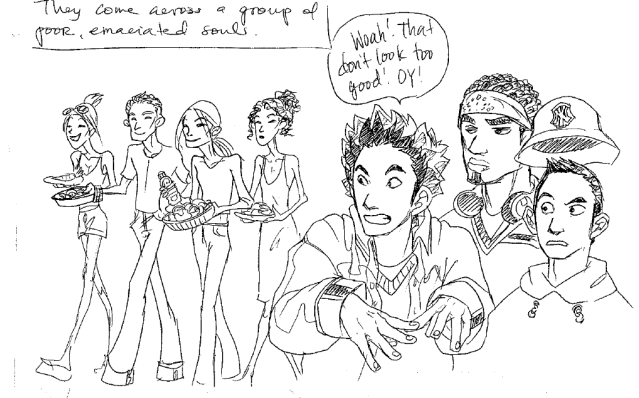
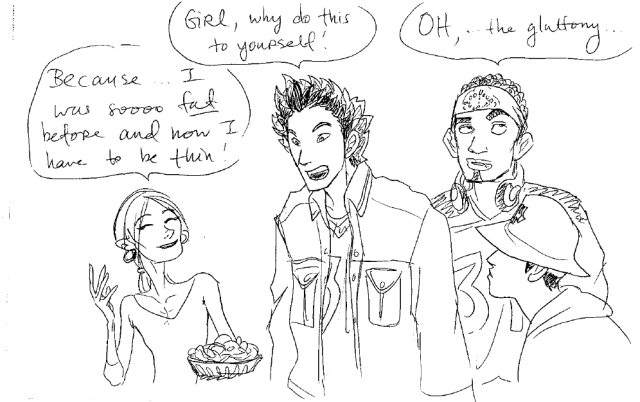
About 20 years ago, former student of mine at Boston College made these cartoons for me of Purgatorio cantos 22-23, on the Prodigal and the Gluttonous. She dashed them off, but I think they’re really wonderful.

 It seems likely that this is the man who owned my copy of Cicero’s Orations. The connection with Yale, Glastonbury CT, and the notice of his insolvency, all seem to cohere with the portrait sketched out on the flyleaf of my book.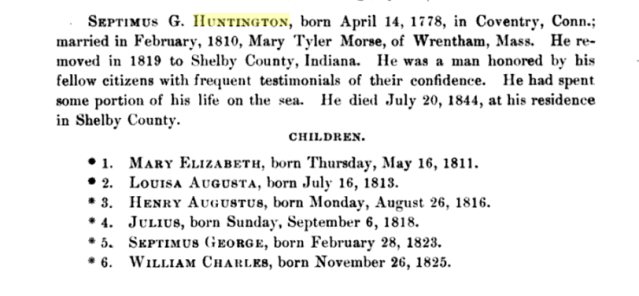


 Jean Leon Gerome Ferris, “The American Cincinnatus” (1919)






 uncomelyandbroken