
-
Recent Posts
Recent Comments
Archives
- March 2026
- November 2025
- December 2024
- April 2024
- October 2021
- February 2021
- September 2020
- July 2020
- June 2020
- May 2020
- April 2020
- March 2020
- January 2020
- August 2019
- July 2019
- June 2019
- May 2019
- April 2019
- March 2019
- February 2019
- January 2019
- December 2018
- November 2018
- October 2018
- July 2018
- June 2018
- May 2018
- April 2018
- March 2018
- February 2018
- November 2017
- October 2017
- September 2017
- August 2017
- April 2017
- February 2017
- October 2016
- September 2016
- May 2016
- April 2016
- March 2016
- February 2016
- January 2016
- November 2015
- October 2015
- September 2015
- August 2015
- July 2015
- June 2015
- April 2015
- March 2015
- February 2015
- January 2015
- December 2014
- November 2014
- October 2014
- September 2014
- August 2014
- July 2014
- June 2014
- May 2014
- April 2014
- March 2014
- February 2014
- January 2014
- December 2013
- November 2013
- October 2013
- September 2013
- August 2013
- July 2013
- June 2013
- April 2013
- March 2013
- February 2013
- January 2013
- December 2012
- November 2012
- October 2012
- September 2012
- August 2012
- July 2012
- June 2012
- May 2012
- April 2012
- March 2012
- February 2012
- January 2012
Categories
- AI
- Animals
- Astronomical
- Bible
- Birds
- Books
- Boston
- Cartoons
- Cemeteries & Funerals
- Classics
- Coal
- Dogs
- Drama
- Education
- Emblems
- England
- Family
- Film
- Florence
- Ireland
- Italy
- Language & Etymology
- Military
- Music
- Mythology
- Nautical
- New England
- Numismatics
- Oxford
- Poetry
- Pontius Pilate
- Race
- Rivers
- Rome
- Saints
- Scotland
- Sewanee
- Slavery
- Sports & Games
- Statues & Monuments
- Tennessee
- The South
- Time
- Trees & Flowers
- Uncategorized
Meta
Protected: One Small Misstep
Posted in Astronomical, Classics, Mythology
Enter your password to view comments.
Protected: “How do you know I’m mad?” said Alice
Posted in England, Oxford, Poetry, The South, Uncategorized
Enter your password to view comments.
Protected: Twists in the Plot
Posted in Classics, England, Mythology, Oxford, Poetry, Statues & Monuments, Trees & Flowers
Enter your password to view comments.
Protected: Flora, in the Country and City
Posted in Classics, England, Mythology, Poetry, Statues & Monuments, Trees & Flowers
Enter your password to view comments.
Swithin and Sewanee
This morning, ironically enough, it is not raining in Oxford. It is St. Swithin’s Day, July 15th, and according to an English proverb,
Saint Swithun’s day, if thou dost rain,
For forty days it will remain
Saint Swithun’s day, if thou be fair,
For forty days ’twill rain no more.
As you may know, Britain has been experiencing its rainiest summer ever, and everyone is exasperated about it. In yesterday’s Times, one columnist lamented, “Worst of all there is no one to blame; no minister to haul on to Newsnight to explain why the front destined for Scandinavia has been stuck for weeks; no calls for a Weatherson Inquiry.” The fact that back in Tennessee it has been hotter than blazes has assuaged my own wet and chilly feelings only a little.
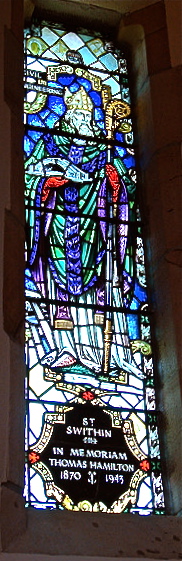 So far, the saint is doing right by us, but there’s plenty of time left in the day for him to screw this up. Swithin was a bishop of Winchester, only an hour or so’s drive from Oxford, and is venerated there particularly in the famous cathedral. Closer to home, there’s a girl’s school called St. Swithin’s in Oxfordshire and a quad named for him at Magdalen College, which I have
 not now seen. Interestingly enough, the image I know best of this saint is in All Saints’ Chapel back in Sewanee (pictured to the left). He’s holding a bridge, his traditional iconographic attribute, to represent the bridge he ordered built over the River Itchen and where he performed a miracle. Why this entitles him to represent “Civil Engineering,” as the window states, is beyond me, but then, Sewanee hasn’t had a department of civil engineering for a long time, if ever, so it’s probably just as well.
Truthfully, I think Sewanee’s program in Environmental Studies ought to adopt the St. Swithin’s window in All Saints. There is a great tradition of rationalizing weather-lore, and everything I’ve read about the inherent wisdom of the Swithin’s Day proverb discusses the jet stream’s position in early summer. This year, the jet stream has not moved north to leave Britain relatively dry but is instead squatting damply in the south. Why is the jet stream behaving this way? Probably for the same reason it’s so damned hot in Sewanee this summer: changes in global climate. The fact is, there is somebody to blame, as the Times columnist wanted, and it is all of us. If skeptics won’t listen to scientists about these matters, perhaps they’ll listen to St. Swithin, and maybe his bridge can be re-interpreted as a symbol of dialogue. That would be miraculous, even more so than this morning’s sunshine.


 uncomelyandbroken