
-
Recent Posts
Recent Comments
Uncomely and Broken on Pope Leo on cinema: “an… David Cronin on Pope Leo on cinema: “an… Uncomely and Broken on Ishi and the Algorithm Dennis Davenport on Ishi and the Algorithm Uncomely and Broken on Theodore Parker’s Grave,… Archives
- April 2026
- March 2026
- November 2025
- December 2024
- April 2024
- October 2021
- February 2021
- September 2020
- July 2020
- June 2020
- May 2020
- April 2020
- March 2020
- January 2020
- August 2019
- July 2019
- June 2019
- May 2019
- April 2019
- March 2019
- February 2019
- January 2019
- December 2018
- November 2018
- October 2018
- July 2018
- June 2018
- May 2018
- April 2018
- March 2018
- February 2018
- November 2017
- October 2017
- September 2017
- August 2017
- April 2017
- February 2017
- October 2016
- September 2016
- May 2016
- April 2016
- March 2016
- February 2016
- January 2016
- November 2015
- October 2015
- September 2015
- August 2015
- July 2015
- June 2015
- April 2015
- March 2015
- February 2015
- January 2015
- December 2014
- November 2014
- October 2014
- September 2014
- August 2014
- July 2014
- June 2014
- May 2014
- April 2014
- March 2014
- February 2014
- January 2014
- December 2013
- November 2013
- October 2013
- September 2013
- August 2013
- July 2013
- June 2013
- April 2013
- March 2013
- February 2013
- January 2013
- December 2012
- November 2012
- October 2012
- September 2012
- August 2012
- July 2012
- June 2012
- May 2012
- April 2012
- March 2012
- February 2012
- January 2012
Categories
- AI
- Animals
- Astronomical
- Bible
- Birds
- Books
- Boston
- Cartoons
- Cemeteries & Funerals
- Classics
- Coal
- Dogs
- Drama
- Education
- Emblems
- England
- Family
- Film
- Florence
- Ireland
- Italy
- Language & Etymology
- Military
- Music
- Mythology
- Nautical
- New England
- Numismatics
- Oxford
- Poetry
- Pontius Pilate
- Race
- Rivers
- Rome
- Saints
- Scotland
- Sewanee
- Slavery
- Sports & Games
- Statues & Monuments
- Tennessee
- The South
- Time
- Trees & Flowers
- Uncategorized
Meta
Protected: Father Time and the Baby
Posted in Cartoons, Classics, Emblems, Language & Etymology, Mythology
Enter your password to view comments.
Piper at the Gate
I swear this is the last post about The Wind in the Willows, but I came across a picture on my hard drive that I’d taken this summer of an Oxford doorpost, and it reminded me of a famous passage in Chapter 7, “The Piper at the Gates of Dawn,” quoted below.
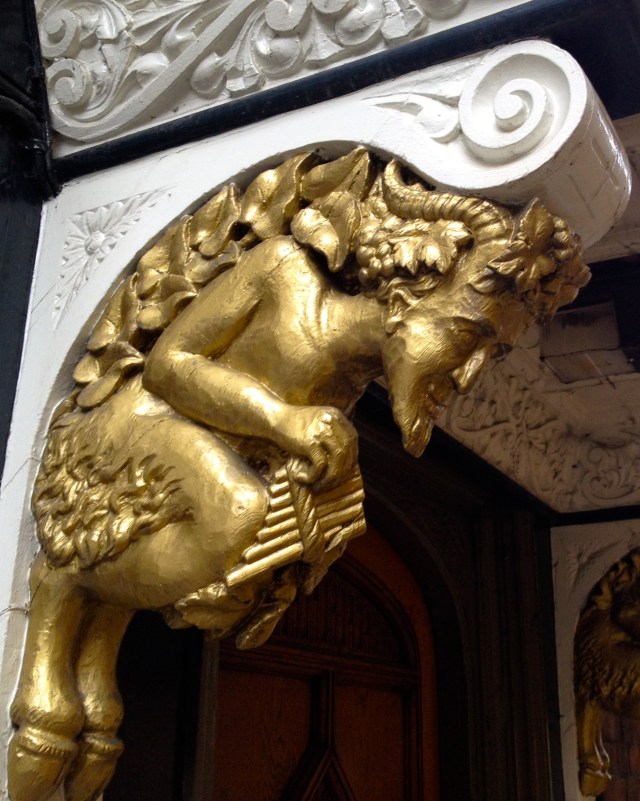 And then, in that utter clearness of the imminent dawn, while Nature, flushed with fulness of incredible colour, seemed to hold her breath for the event, he looked in the very eyes of the Friend and Helper; saw the backward sweep of the curved horns, gleaming in the growing daylight; saw the stern, hooked nose between the kindly eyes that were looking down on them humourously, while the bearded mouth broke into a half-smile at the corners; saw the rippling muscles on the arm that lay across the broad chest, the long supple hand still holding the pan-pipes only just fallen away from the parted lips; saw the splendid curves of the shaggy limbs disposed in majestic ease on the sward …
My son thinks the figure looks like Mr. Tumnus, and maybe he’s right. Anyway, I’d love to know more about this figured lintel, who made it, when, why, etc. If you know, send me a note–my guess is that it’s a conscious allusion from a fellow Grahame fan. I’m not the only one who loves this passage, after all (check out Van Morrison’s tribute below).
Follow-up, August 2013. I wrote to Professor Alan Bowman, principal of Brasenose College, about these satyrs (not figures of Pan!). He writes,
The house is in St Mary’s Passage and was incorporated in the development of the High Street side of the college in the late 19th century (architect was Jackson who also did the Examination Schools). There is a brief reference in Joe Mordaunt Crook’s history of the college (p.294) but nothing on the gilded Pan figures. I have asked the archivist to see if we have any more information on them. You might also have noticed that the door itself has a (more recent) carving of Aslan. That connects to the fact that there is a little passage at the back corner of the chapel which leads through to St Mary’s and is supposed to have inspired C.S. Lewis to Narnia and the Lion, the Witch and the Wardrobe (especially the last).
So it turns out my son was right, or at least closer to right than I was! Furthermore, according to a PDF from the College Archives Prof. Bowman attached,
The name ‘St. Mary’s Entry’ seems originally to have been
attached to an area north of the present site, approximately
where the quadrangle known as the Deer Park now stands. The
building now known as St. Mary’s Entry has been occupied by
Brasenose since at least 1510, the year after the foundation of
the College. …This may have been the point [the 1880’s] at which the doorway was added, but we have no information about it. Nikolaus Pevsner ascribed the ‘ornate door hood on two satyrs as brackets’ to the Oxford architect Harry Wilkinson Moore (1850-1915). The Royal Commission on Historical Monuments described them as ‘winged grotesques’.
Protected: Petraeus to Penelope
Posted in Classics, Military, Mythology, Sewanee, Uncategorized
Enter your password to view comments.
Protected: Recombobulation?
Posted in Language & Etymology, Uncategorized
Enter your password to view comments.


