The Biting Bishop

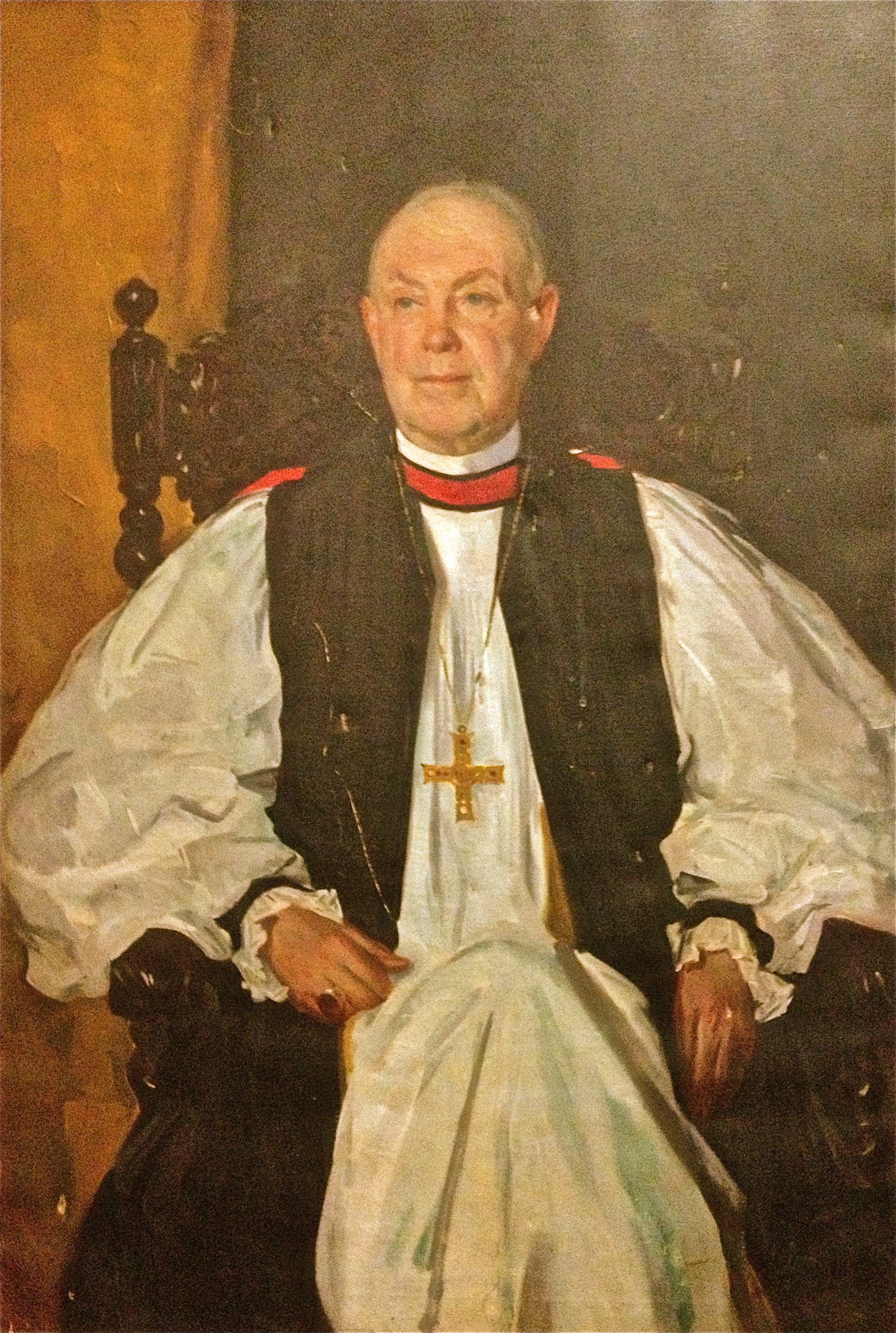
IMG_4601One of the principal founders of the University of the South, where I teach, was Leonidas Polk,  the Episcopal Bishop of Louisiana as well as a Confederate Brigadier General. His occupation of both roles earned him the title “The Fighting Bishop” (as indeed a piece in the New York Times about him last year is entitled).  For what it’s worth, though, I prefer another important cleric of the University’s past, Thomas Gailor.  I work in the building named for him, where the portrait to the right now hangs.  In the past few weeks, I have begun to think of him as “The Biting Bishop.”

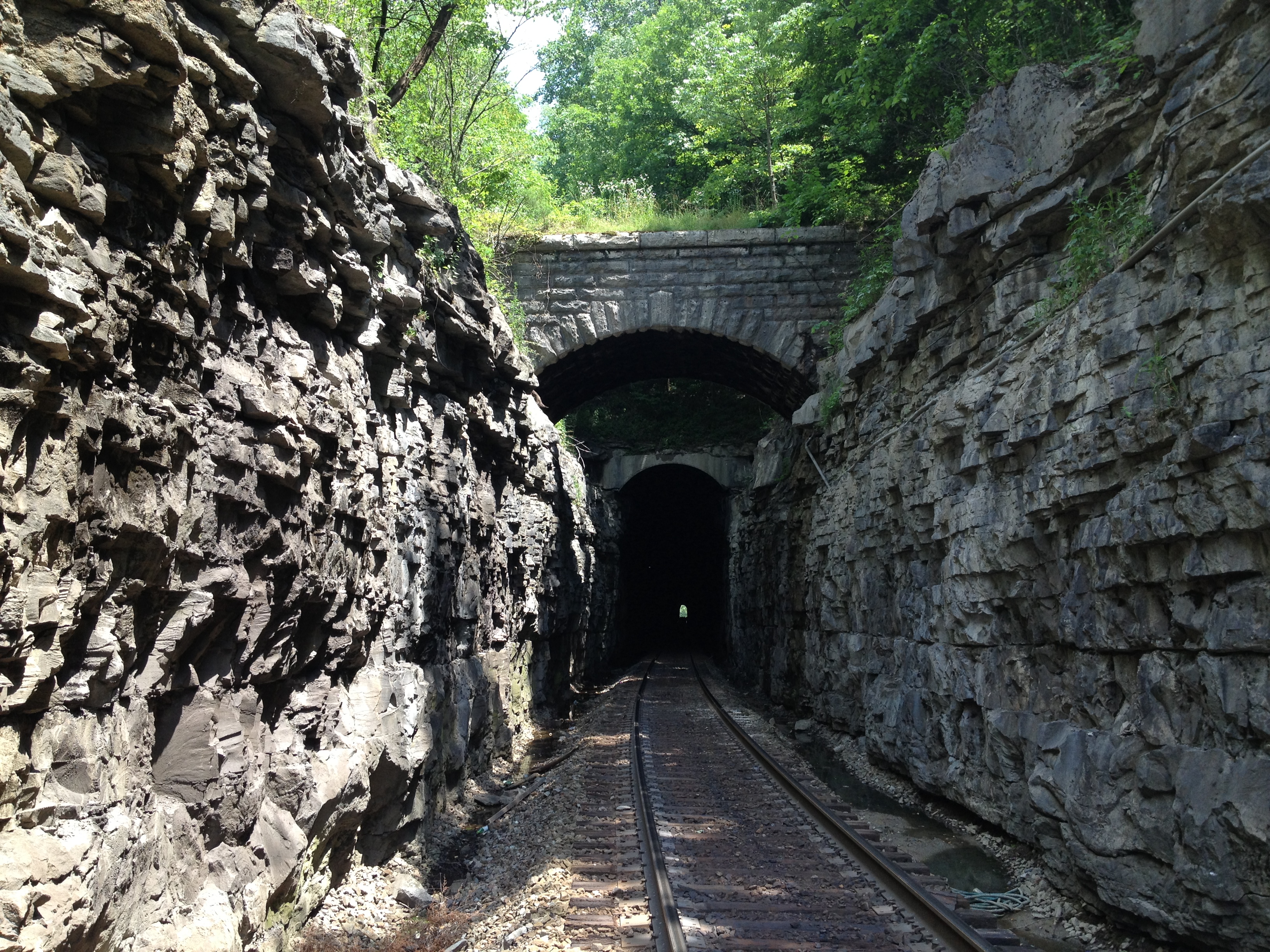
Here’s why.  As re-told in Purple Sewanee, Gailor’s first encounter with Sewanee took place not on the Domain but in “the Sewanee Tunnel” (i.e., the Cumberland Tunnel) in 1863, when he was six and a half years old.  Gailor’s mother and he were in search of news about his father, who had died while fighting under Braxton Bragg’s command the previous year.  As he recalls,

I remember eating raw sweet potatoes, given to me by Confederate soldiers on the train.  Major Martin Walt, Quartermaster of Wood’s brigade, came to my mother and handed her a satchel, saying, “We are about to enter a long tunnel, and there are no lights. This satchel is full of money for the soldiers, who are to be paid in Chattanooga. There are rough people on this train, and they may attack me in the tunnel. Please keep the satchel and hold it tight until we get out of the darkness of the tunnel.”

The Cumberland Tunnel in Cowan, built 1849-1852

The Cumberland Tunnel in Cowan, built 1849-1852 by Irish laborers

My mother took the satchel, and, just as we dashed into the tunnel, she said to me, “Catch hold of this satchel; somebody us trying to take it from me.” I, a small boy, remember grabbing the satchel, and biting hard on a hand that was trying to take it—so hard, that the hand let go—and when we emerged from the darkness of the tunnel, my mother called Major Walt and gave him his satchel, and told him the story; but there was no one we could accuse; tho I suspected a hard-faced woman in the seat in front of us, who kept her right hand in a muff. I hope that that hand had the marks of my bite.  (Lily Baker, et al., eds, Purple Sewanee [Sewanee, TN: 1932, rep. 1961] pp. 25-26)

Postscript.  Now, I would love to leave this blog-post at that, but there is another story about Bishop Gailor told by Sam Williamson a few years ago that deserves mention. Many years after the encounter in the Cumberland Tunnel, when he was in his late seventies, Gailor raised his powerful voice on the eve of another war. On March 28, 1933, he was the keynote speaker before a crowd of 1500+ in Memphis gathered in protest against Nazi treatment of the Jews. “It is impossible to believe that sane men would so indulge their madness. Their acts are sheer and brutal barbarism and a contradiction of the principles of civilization,” Gailor said on that occasion, then going on to warn against “a relapse into savagery.”  According to the next day’s Memphis Commercial-Appeal, the bishop was greeted with “thunderous applause.”  It sounds as though, even late in life, Thomas Gailor knew that sometimes direct confrontation was the correct ethical instinct.

Posted in Ireland, Military, Sewanee, The South, Uncategorized | 5 Comments

A Visit to Highlander Folk School

IMG_4432As part of Sewanee’s new “Finding Your Place” program for freshmen, my students and I today went to the nearby site of the Highlander Folk School, the populist educational facility founded by Myles Horton in 1932 that helped to midwife the Civil Rights movement.  Highlander was chased out of Grundy County in the 60’s on what are apparently trumped-up charges, but not before luminaries such as Pete Seeger, Eleanor Roosevelt, Rosa Parks, and Martin Luther King, Jr., had been there.  The school re-opened in the Knoxville area, and has since then continued to do significant work on the environment and voters’ rights issues. But what of the facility in Monteagle, only a few scant miles from my home?

Truth be told, this site so important in the battle for Civil Rights had been all but forgotten locally.  While I knew the name of Highlander, it didn’t really ring any bells for me, a situation not all that uncommon among most of my friends in Sewanee. Some of the buildings in which Horton’s school had been located had burnt down, while others had been substantially re-modelled by subsequent owners. “There’s nothing worth seeing there anymore,” I had been told.

In putting together this new course about place, however, I began to realize what a critical role Highlander had played in an important chapter of Southern–indeed American–history, and my desire grew to see what was there, regardless of whether it was “worth” seeing. In order to prepare my students for the visit, I had them watch the filmmaker Lucy Massie Phenix’s documentary about Highlander, You Got to Move, which features marvelous footage of Horton and the children’s author May Justus defending the school from its bigoted detractors, as well as interviews with inspirational characters like the singer and protester, Bernice Johnson Reagon.

As it happens, an article by my friend Michael Cass entitled, “TN preservationists are out to save training ground of Rosa Parks, other activists” appeared in the Tennessean last week.  The Tennessee Preservation Trust, it turns out, has been actively engaged in raising funds to purchase the property, not only to restore it to its former condition but also to turn it back into an education center. According to the article, David Currey, the Trust’s director,

believes returning Highlander to the way it looked in 1961 would be well worth the trouble.

“This place has the potential,” he said, “to tell a story that hasn’t been told.”

In the days following the article’s appearance, it came to pass that a deal had been successfully brokered that would allow the Trust and others to acquire the property, so long as funding could be secured. And so, through a friend, I got in touch with Ray Banks, the realtor whose agency had been involved in the proceedings, and when he heard that I wanted to bring a group of Sewanee students over to look at the Highlander property, he was eager to help us out.  “When do you want to come? Monday at 1?  I’ll meet you on the front steps of the old library.”

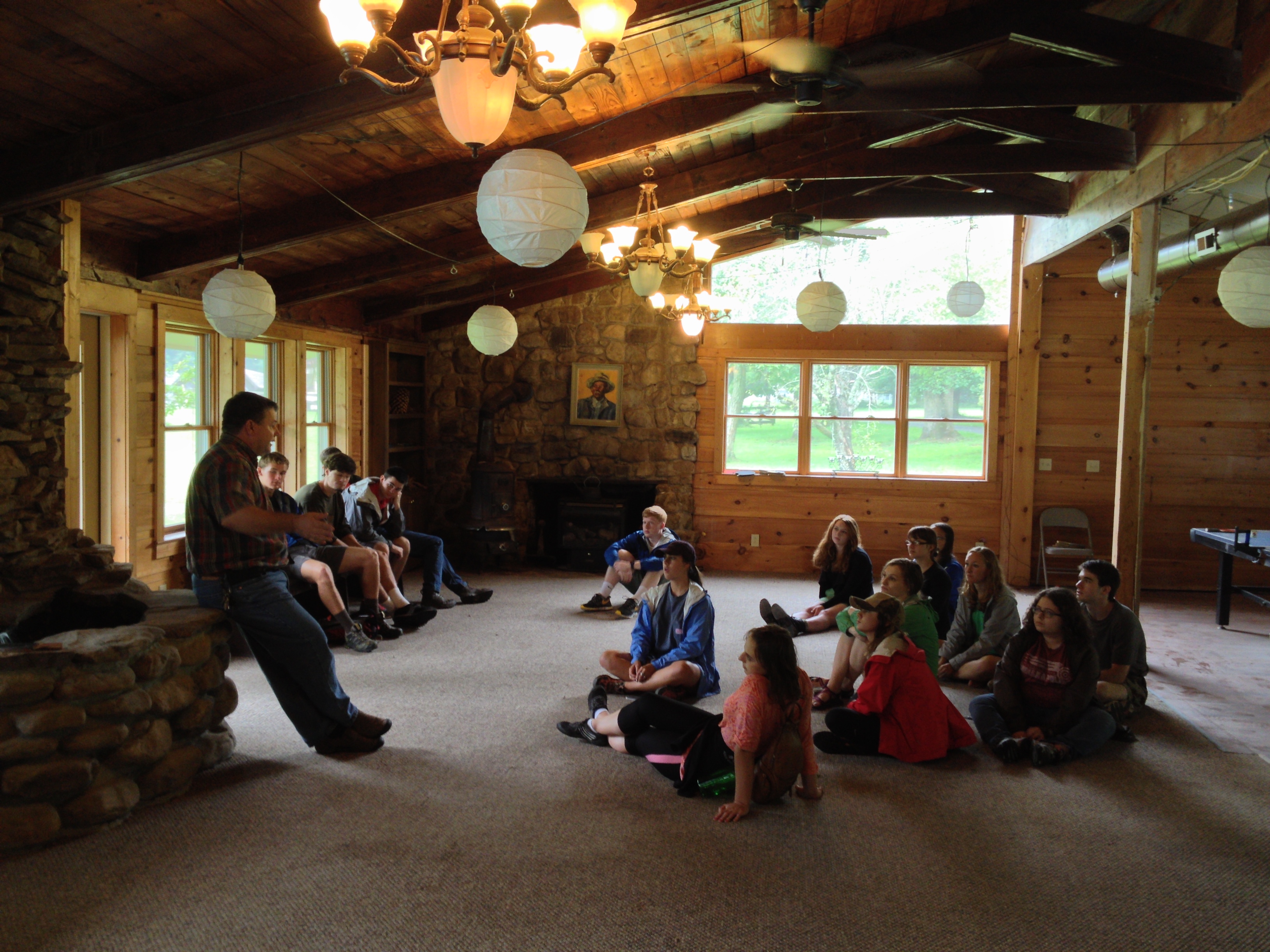
We showed up today, my students and I, and sat on the floor of the old library building. Ray explained its unique history to my students. It was in this very room that Rosa Parks had trained before refusing to give up her seat on a bus in Montgomery.  We marveled to think that we were in the very spot where Martin Luther King heard “We Shall Overcome” for the very first time.  “There’s something about that song that haunts you,” he told a friend as they left Monteagle, and from there, it became the anthem of the Civil Rights movement.

Ray told us that there were plans afoot for Bruce Springsteen to put on a benefit concert.  The rain picked up outside, but some of us decided to walk around the grounds, while a few others stayed in to play on the ping-pong table. Most of the students took out their journals and spent time reflecting on the afternoon.  Later, I took out my iPhone and, punching up Pete Seeger on Youtube, held it up for the students to hear. Later in the afternoon, a friend sent me a link to a recent article about two protesting firemen in Madison, Wisconsin, being arrested for singing “We Shall Overcome.”  And I was reminded of what Myles Horton told the police who had come to close down the Highlander Folk School, over fifty years ago. “You can padlock a building,” he said, “but you can’t padlock an idea.”

IMG_4383

IMG_4401

IMG_4408

IMG_4420

IMG_4403


Posted in Education, Music, Sewanee, The South | 23 Comments

Remarks for “Foundations of Place” Panel

My colleagues, John Willis and Jerry Smith, have given better talks than I ever could about the historical situation of the University’s founding a century and half or so ago, and of course I always tremble to follow Jim Peterman.  I have nothing of substance to add to their remarks.  But I wonder if it would be alright for me to dig a little deeper into the past, our past, to see what insight is to be found there.  As a classicist, I know one thing for sure, which is that long after the University of the South is a distant memory and together with it, the United States, there will still be people reading Homer and the New Testament in Greek.  But let our archeology not stop there. As Henry David Thoreau writes in the chapter of Walden from which you read, “My instinct tells me that my head is an organ for burrowing, as some creatures use their snout and fore paws, and with it I would mine and burrow my way through these hills.”  So let me borrow his idea and burrow a little into these hills.

You will find, if you look into the etymology of the word foundation, that is related to the word profound. The Latin word from which they derive has to do with what lies deep beneath, and just how bottomless those depths very often seem to be. Yesterday my group went down into the caves just off Gate G7, and at one point Luke Padgett told me we were standing on a stratum of limestone about 400 millions old.  If you’re courageous, you can burrow even further, but I think Solomon’s Temple was deep enough for me, and the wisdom that might be found in a system named for the Biblical king is sufficient, to my mind, at least for this weekend.

I hope it will be OK if, at an Episcopal school, beneath the images of all these bishops, on a Sunday, I quote from the Bible.  You will maybe remember that Jesus, when asked what was required of us, said, “Thou shalt love the Lord thy God with all thy heart, and with all thy soul, and with all thy mind,” and “Thou shalt love thy neighbour as thyself.”  In that two-fold statement Jesus asks us to cast our glance vertically and horizontally, up to heaven and across to the people of our community; in doing so, we trace with our gaze the form of a cross.  In fact, there is a long-standing Christian tradition distinguishing religious vocation into the active life and the contemplative life, the life dedicated to working with and for others, and the other dedication to introspection and prayer.  These are inclinations seemingly at odds, but in actuality believed to inform and support one another, although at times it is hard to see how. They appear to be at cross purposes (I use the term advisedly).

Even if you are not particularly religious–as I am not–it is not such bad advice, to spend some time thinking of things that are eternal and transcendent, things which rise, as Plato would tell us, into one immortal Form of Truth and Beauty, with a capital T and a capital B.  It is easy to believe that “truth is beauty, beauty truth” (to quote Keats’ Ode on a Grecian Urn) here in so lovely a location. The bishops who founded the University, in situating Sewanee where they did, knew what they were doing, offering us in this place so many exquisite vistas to look out upon, and thereby encouraging in us the contemplation of heaven. “It’s a long way away, even from Chattanooga, in the middle of woods, on top of a bastion of mountains crenelated with blue coves,” Will Percy writes in Lanterns on the Levee. “It is so beautiful that people who have once been there always, one way or another, come back. For such as can detect apple green in an evening sky, it is Arcadia—not the one that never used to be, but the one that many people always live in; only this one can be shared.”

I really love that passage, and I will admit that it brings an involuntary tear to my sappy Irish eyes. I worry, though, that it forms part of the “symbolic complex” that Walker Percy talks about in Loss of the Creature that prevents us from having an authentic experience of place.  Sometimes this Arcadian vision of Sewanee is a bit much for me, particularly when I travel into the poverty-stricken areas of Grundy, Marion, or Franklin Counties.  It’s so alarming when you read thing like I did in this week’s Winchester Herald-Chronicle that, according to the Tennessee Bureau of Investigation,  Franklin County (this county) had reported over 100 cases of human trafficking over a 24-month period. “It is not uncommon,” the paper reports, “to see cases of children being traded for sex in drug cases.” Facts like that make my heart heavy, and make me wonder whether I should quit my navel-gazing and all that “detecting of apple green in an evening sky,” and get up off my ass and do something to help out the least of my brothers and sisters.

This reaction is correct and human, I think, to want to reach out and to offer what help we can. Let me say that my colleagues Deb McGrath and Jim Peterman possess that deeply ethical impulse to a great degree, although they are too modest to talk about it.  It is possible, however, in looking at human misery simply to become bitter and jaded about human nature.  By losing hope in transcendent ideals like Truth, Beauty, or Justice, we might be tempted to make an escape into despair, self-indulgence, and cynicism. In this way, we really lose our way, and lose our selves.

The tension between the contemplative and active lives is a hard one to manage, and always has been. I thought of this tension yesterday afternoon, when some of us watched the documentary, You Got To Move, about Highlander. In the film, Bernice Johnson Reagon spoke of her work inspired by the Highlander group, saying,  “Now I sit back and look at some of the things we did, and I say, ‘What in the world came over us?’ you know. But death had nothing to do with what we were doing. If somebody shot us we would be dead. … And we went and did the next thing the next day, because it was really beyond life and death. It was really like… Sometimes you know what you’re supposed to be doing, and when you know what you’re supposed to be doing, it’s somebody else’s job to kill you.”

Bernice Johnson Reagon, later the winner of a MacArthur Genius grant, would go on to be the founder of the a capella group Sweet Honey in the Rock, whose inspirational music I recommend to you, perhaps to be listened to in the wonderful Raulston Listening Room in duPont.  “Music is the first thing to cross borders,” Richard Tillinghast writes in Sewanee When We Were Young.  “What lucky dogs we were to be there when jazz / Crossed the mountains and reached the Cumberland / Plateau.” What lucky dogs we are to live in a place where a charming neo-Gothic building or a well-timed sunset can remind us of the things beyond us, or to have neighbors like Laura Willis whose book Finding God in a Bag of Groceries some of you will read, or one-time neighbors like the Highlander School, where the song “We Shall Overcome” was first heard by Martin Luther King. All such things offer sustenance to our minds and souls when they are run ragged by the things of this often cruel and awful world.

It’s important, then, to remember when our spirits are all but crushed, when our heads are too heavy to lift them, to draw strength from what we know to lie beneath us, for much is there.  Beneath us are layers of sandstone and limestone, from which our splendid buildings have been wrought and awesome caves been formed. Beneath us are layers of history encompassing the Civil Rights movement and the Civil War both of which offer images of nobility to inspire us.   Beneath us are the rich roots of musical traditions embracing Memphis and Nashville and the mountains of east Tennessee (as well as invasive species like jazz); beneath us are literary giants like Allen Tate, Tennessee Williams, or Flannery O’Connor, whose work who was so often published in our Sewanee Review. Underlying us, too, are the traditions of liberal education that extend back through Oxford and Cambridge to the Christian Middle Ages and from there way back to the schools of Athens where Aristotle and Plato taught, those old Greeks whose statues you can see here in a courtyard in Woods Laboratory, not so far from another statue of Charles Darwin.

These then are the foundations of the University, our University, or to be more precise, your University.  Remember, foundations are laid to be built upon, and cornerstones are set for capstones eventually to rest on. Let me be clear. This place was made for you students, for you to derive joy and strength from, knowledge and wisdom, foundation and profundity.  All that remains now is the answer to the question, What is that you will build upon this rock?  Here endeth the lesson.

Posted in Bible, Classics, Education, Emblems, Ireland, Language & Etymology, Oxford, Poetry, Sewanee, Tennessee | 5 Comments

Colonel Shaw and Some Anniversaries

Robert Gould Shaw Memorial, Boston, from Wikipedia

Robert Gould Shaw Memorial, Boston, from Wikipedia

One hundred and fifty years ago this week, Colonel Robert Gould Shaw was killed during a desperate assault on South Carolina’s Fort Wagner while leading the Massachusetts 54th Regiment, the first all African-American volunteers corps. Perhaps you know about Shaw from the movie Glory, starring Matthew Broderick, or from Robert Lowell’s famous poem, For the Union Dead, about the equally famous monument on the Boston Common by Augustus Saint-Gaudens (pictured above). It is a story I have known for a longer time myself, at least since the time I attended the Robert Gould Shaw Middle School. My experience there, however, at the tumultuous start of Boston’s busing crisis in the mid-1970s, was about as far as one one could get from the high-minded ideals for which Colonel Shaw gave his life.

It has only been in recent years that I’ve come to realize how much the figure of Shaw surrounded my young life in West Roxbury.  As a boy, I rode my bike through the streets that once made up the Shaw family estate, though I wasn’t aware of  it at the time.  I suppose, if I had been clever, I might have figured it out from the name of Shaw Street.  The bulk of the former estate now comprises the grounds of the prestigious Roxbury Latin School.  In the same neighborhood are streets named for John Alden and Myles Standish, which might give you some sense of the Shaws’ Puritan pedigree, and why it was Lowell wrote about him being as lean as a compass-needle and seeming to wince at pleasure, and suffocate for privacy.

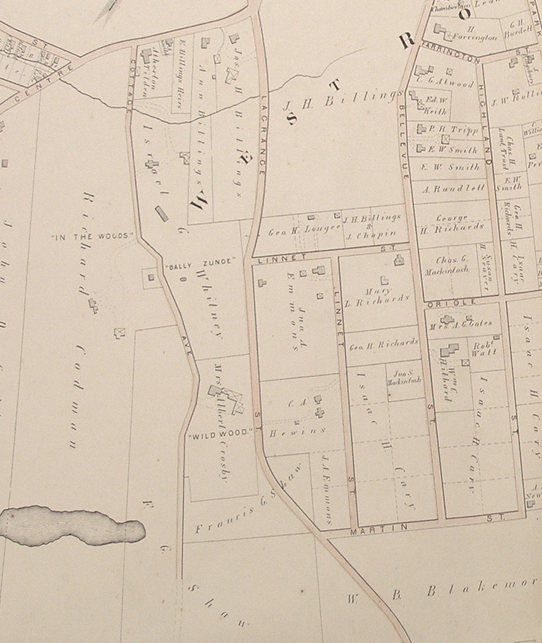
... and in 1874

West Roxbury, Bellevue Hill area in 1874

West Roxbury, Bellevue Hill area today

… and today

From Anthony Mitchell Sammarco's book, West Roxbury

From Anthony Mitchell Sammarco’s book, West Roxbury

Yet the Shaw family of the 19th century were not Puritans, but devout Unitarians and dedicated abolitionists. At the bottom of the hill from Shaw’s estate–in a spot now occupied by St. Theresa’s Catholic Church (where I went for years)–stood the home of the well-known Unitarian preacher, Theodore Parker. Not far away, there is a statue of Parker scowling away on Centre Street. In one of his more famous anti-slavery sermons, the preacher intoned, I do not pretend to understand the moral universe; the arc is a long one, my eye reaches but little ways; I cannot calculate the curve and complete the figure by the experience of sight; I can divine it by conscience. And from what I see I am sure it bends towards justice. It was a sentiment Shaw would certainly have shared. If Parker’s phrasing seems familiar, it is because it was famously adapted a century later by Martin Luther King (as NPR reported a few years ago).

In a powerful way, Robert Gould Shaw’s death is connected to Martin Luther King’s dream, and perhaps his death as well; the significance of both figures was very much at stake iwhen I went off to the middle school named after the Union colonel at the age of twelve. The experience of forced busing in the so-called Athens of America was a brutal one, captured well in the PBS miniseries, Eyes on the Prize (Episode 13), as well as in books like J. Anthony Lukas’ Common Ground and Alan Lupo’s more journalistic Liberty’s Chosen Home.  Indeed, in one of his opening chapters, Lupo writes about a rally against busing in West Roxbury that some of my neighbors and probably my mother went to.  “On this night in late August, 1974, white people who don’t want kids bused are filing into the auditorium  of the Robert Gould Shaw School in West Roxbury. It is possible that they don’t see the irony.”

Although I was only a preteen at the time, I know for sure the crowd did not see the irony.  The following autumn I would attend the Shaw School, when, after every last measure legal and illegal had been tried to stop them, buses full of black and Latino kids rolled into West Roxbury and an angry white mob met them there. Terrified, I made my way through the crowd on the first day of school, and walked up stairs where cops in riot gear occupied every other landing. I remember not knowing where my homeroom was and stopping to ask somebody who simply said, Keep moving. And so I kept moving, as we all did that year. Things proceeded, as they will, and if they didn’t exactly get much better, at least they seemed to stop being quite so awful.  I remember that the teachers, by and large, were kind, and that all my fellow sixth graders, regardless of race, were mostly good kids. But the atmosphere was always tense, and we always seemed to be treading along a minefield. I was glad to leave for Boston Latin the next year.

Here in the South, the racial tension had been felt a full decade earlier, as is well-known. In Franklin County, Tennessee, which I now have the privilege to represent as a School Board member, the movement to desegregate was spearheaded in 1963-64 when a handful of Sewanee families, black and white, brought a civil rights lawsuit to force the matter. The objections of the School Board then–that there was not enough room in the school for more students, and that the black children were unprepared academically–were met with resolve and ingenuity, and people in Sewanee volunteered money for the construction of additional buildings, and donated time tutoring students. The fiftieth anniversary of their successful effort is soon upon us, and the Sewanee Community Council are arranging for a historical marker. This past weekend, the sesquicentennial of Shaw’s death, I spent a part of the morning with my friend Lizzie–herself the great grand-daughter of a Confederate general–looking around  Sewanee Elementary School for just the right spot to place this marker, which will be unveiled this coming Martin Luther King Day.

Lowell’s poem about the Shaw memorial was published in 1964, though it had been written a few years earlier, and draws some connection between the issues of the Civil War and the those of the Civil Rights movement.

Shaw’s father wanted no monument
except the ditch,
where his son’s body was thrown
and lost with his ‘niggers.’


when I crouch to my television set,
the drained faces of Negro school-children rise like balloons.

Colonel Shaw
is riding on his bubble,
he waits
for the blessed break.

It is not quite accurate, I must admit, to excerpt For the Union Dead as I have, giving the impression that Lowell ended on an optimistic note. Nor is it entirely accurate to smile with satisfaction about the end of segregation at Sewanee Elementary, when there are very few black families who can afford to live in town or make the drive up the mountain on a day-to-day basis. We live at a time when a black man has recently been re-elected President, and yet another has been shot down while innocently walking along the street. Sometimes it is hard to feel, in matters of race, the resolute forward progress of Colonel Shaw as he is depicted in the Saint-Gaudens monument. Things proceed, as they will, and if they don’t exactly get much better, at least they seem to stop being quite so awful.

Posted in Boston, Education, Family, Military, New England, Poetry, Race, Sewanee, Slavery, Statues & Monuments, The South, Time | 2 Comments

Gene’s Eulogy for Mark

Eulogy for Mark McDonough – for Funeral Service 1/13/12

We loved Mark and we are going to miss him a lot.  We take comfort from knowing that he has completed his mission here on earth and returned to his Father in Heaven.

I would like to share with you some reminiscences about his life.  I was Mark’s guardian for most of his life.  He lived with me for 17 years, from the age of 7 until he was 24.  He was there because he was wanted.  He spent the last 10 years of his life at the Institute of Professional Practice.  He was there because he was wanted.

In between those times, as he bounced around between different adult residential and day programs, because he could be difficult to care for, he was not always where he was wanted.  He knew when he was wanted and when he wasn’t, and he had some dark years because of that.  I am thankful for these last 10 years when Mark was again where he was wanted.

Mark was born with autism.  His disability was actually a lot more complicated than that one word, and at times he had real difficulty controlling his emotions and behavior, and making contact with reality.  The religious perspective in our Church is that people born with disabilities may have chosen them before they came to earth, because they were tough enough to complete their mission here with those disabilities. Mark shared that perspective, and he did complete his mission.  He didn’t overcome all of his disabilities, no one could, but he overcame many of them, and by the end of his life, you could honestly say that he was really a nice guy.

Working with Mark successfully, relating to him, teaching him, forming a bond with him, was a lot like playing a musical instrument – a complicated one, not just a piano, but more like a harpsichord or maybe even a pipe organ.  You had to be good at it.  Some people could do it, and some couldn’t.  But if you could, he was always a fascinating person, and he was a lot of fun to be with.

Mark never forgot anything.  He could tell you the name of the cab driver who took him to school once when he was 5 years old.  He grouped things in his memory by emotional impact rather than chronologically.  If you realized that, he actually made a lot of sense when you talked with him.

He was a talented artist.  When he was younger, he had an easel and a complete set of art supplies.  Those went with him when he moved into the adult system, but were eventually lost.  My wife and I were looking for another easel for him for his birthday next month.

To appreciate his art, you again had to know his style.  Mark was very parsimonious with his drawing paper.  He would make drawings one on top of the other, many of them, all on the same sheet.  If you teased them apart, they were very good drawings.  I am not sure why he started stacking them up that way; I don’t recall that we ever had a shortage of drawing paper when he lived with me, but he started doing that when he was very young. Occasionally, if you could get him to give you a sheet when it just had the first drawing on it, his art work was worth putting on display, and we often did that.

Mark appreciated music.  When he was a child, we got him an autoharp on the recommendation of a music therapist, and he would sometimes play some of his own songs.  He was a connoisseur of Barry Manilow and Jim Croce.  I got him what I think was the last Barry Manilow album he didn’t already own for Christmas.  He also liked Neil Diamond and Johnny Cash.  He probably picked up his liking for Croce, Diamond, and Cash from me, but Barry Manilow was entirely his own choice.

When Mark came to live with me as a 7 year old, he could talk, but he was almost entirely echolalic.  That means that he would echo back anything you said to him, but that was usually all he could say.  He had almost no functional speech at all, no way to communicate his own thoughts or wants or needs.  But our family included another young man who was non-verbal, who I was also guardian for, and whom I had taught American Sign Language.  That was Patrick, who became Mark’s foster brother. They lived together for the 17 years Mark was with me, and they were very close.  Patrick is here today to say goodbye to Mark.

Living with Patrick, Mark also became interested in signing, so I taught him American Sign Language too.  Today, this is a standard method in the armamentarium of Special Education, but in the 1970’s, it was heresy.  It was considered tantamount to abuse to use sign language with a hearing child with speech problems.  Do people remember that?  The orthodoxy in speech and language therapy at that time was that signing would retard children’s speech acquisition.  It was not done.  I am not much for orthodoxy, so I did it anyway.  Mark learned signing quickly, and he was not echolalic at all in sign language!  It was his breakthrough.  Eventually, by pairing his signs with words, he learned functional speech.  And as you know, he ultimately became quite articulate.

Orthodox methods didn’t work well with Mark in many ways.  He was always his own man. The orthodox method in special needs for transitions, especially for big events, is to give lots and lots and lots of advance notice.  That was always disastrous for Mark.  He would become anxious about the pending event, be it a visit, a dance (by the way, he was a good dancer), a restaurant trip, whatever, obsess about how he was going to behave, and ultimately lose control.  But if a big event just happened, without advance warning, he was fine.  The folks at IPP learned that.  Lots of people before them, who tried to work with Mark and who were not willing to accept that breach of orthodoxy, were not successful with him.

Mark, as a child, loved Mr. Rogers.  Remember him?  He was a children’s television guru, and he was pretty good.  I think Mark learned most of his moral code from Mr. Rogers.  He had all of the Mr. Rogers books, and never stopped asking for another one.

Mark wanted a digital watch this last Christmas.  I got him an analog one.  I always did that, because it took me almost a year to teach him to tell time on a round clock face, and I was always afraid he would lose that skill.  I guess I should have gotten him what he really wanted.

I have other regrets for things undone, gifts ungiven, words unsaid, and. time that should have been spent with him.  A lot of us probably do.  That opportunity is gone for the time being.  But we know Mark is in a good place, that he has been welcomed back by his Father in Heaven, and that we will eventually see him again.  I bear my testimony to you that the Savior lives and is there for all of us, that the Atonement and the Plan of Salvation are real, and  I leave this farewell to Mark with you in the name of Jesus Christ, Amen.

Posted in Bible, Boston, Family, Music | 2 Comments

Protected: A Block Off Dinah Shore Boulevard

This content is password-protected. To view it, please enter the password below.

Posted in Uncategorized | Enter your password to view comments.

A Day on Dimmick

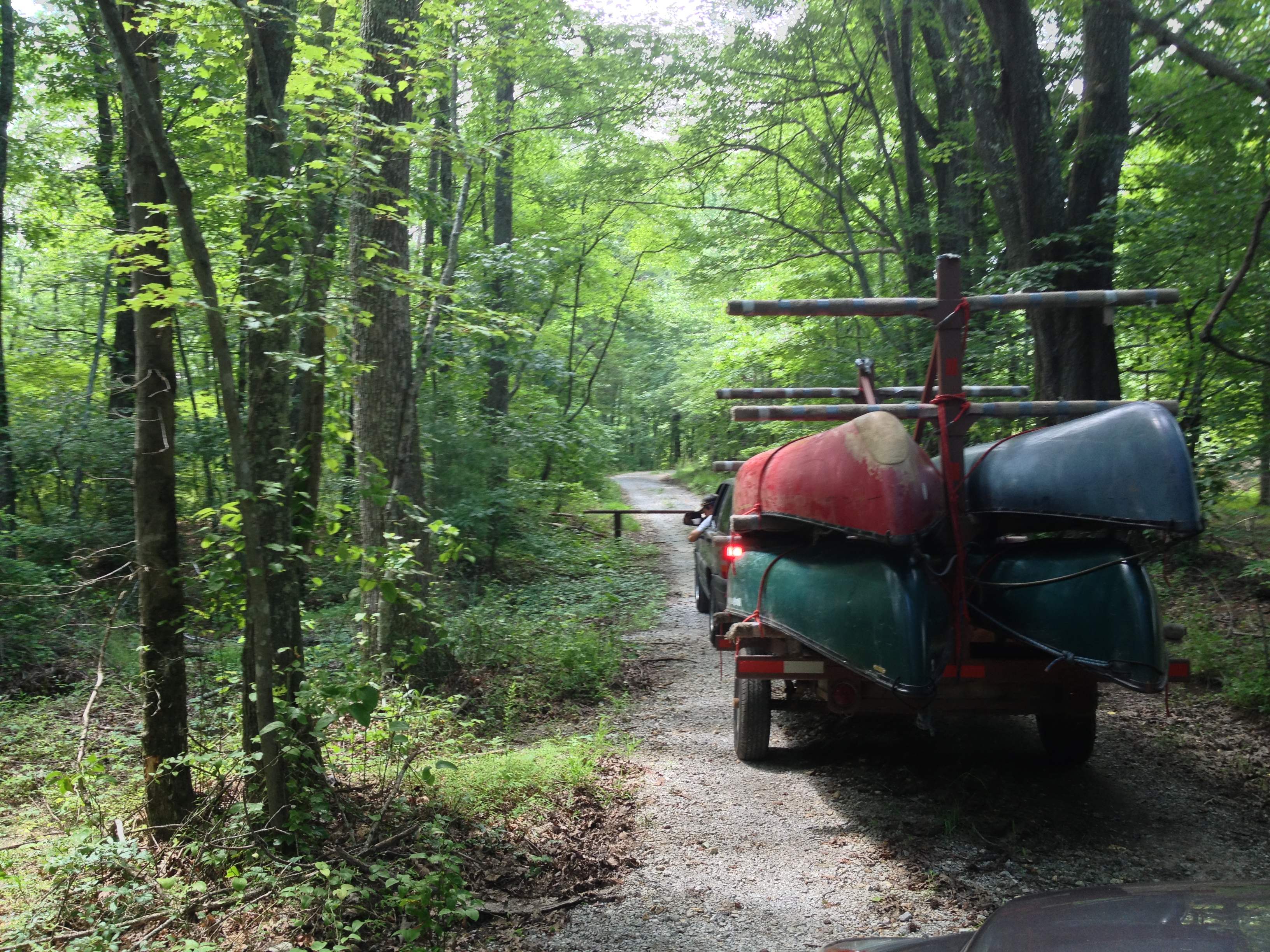
“Believe me, my young friend, there is nothing–absolutely nothing–half so much worth doing as simply messing about in boats.”  Thus says Rat to Mole in The Wind in the Willows, a favorite book of mine, as some will know. And so it was this weekend we got some canoes, some kids, and the key to Lake Dimmick and got ourselves out onto the water.

IMG_3196

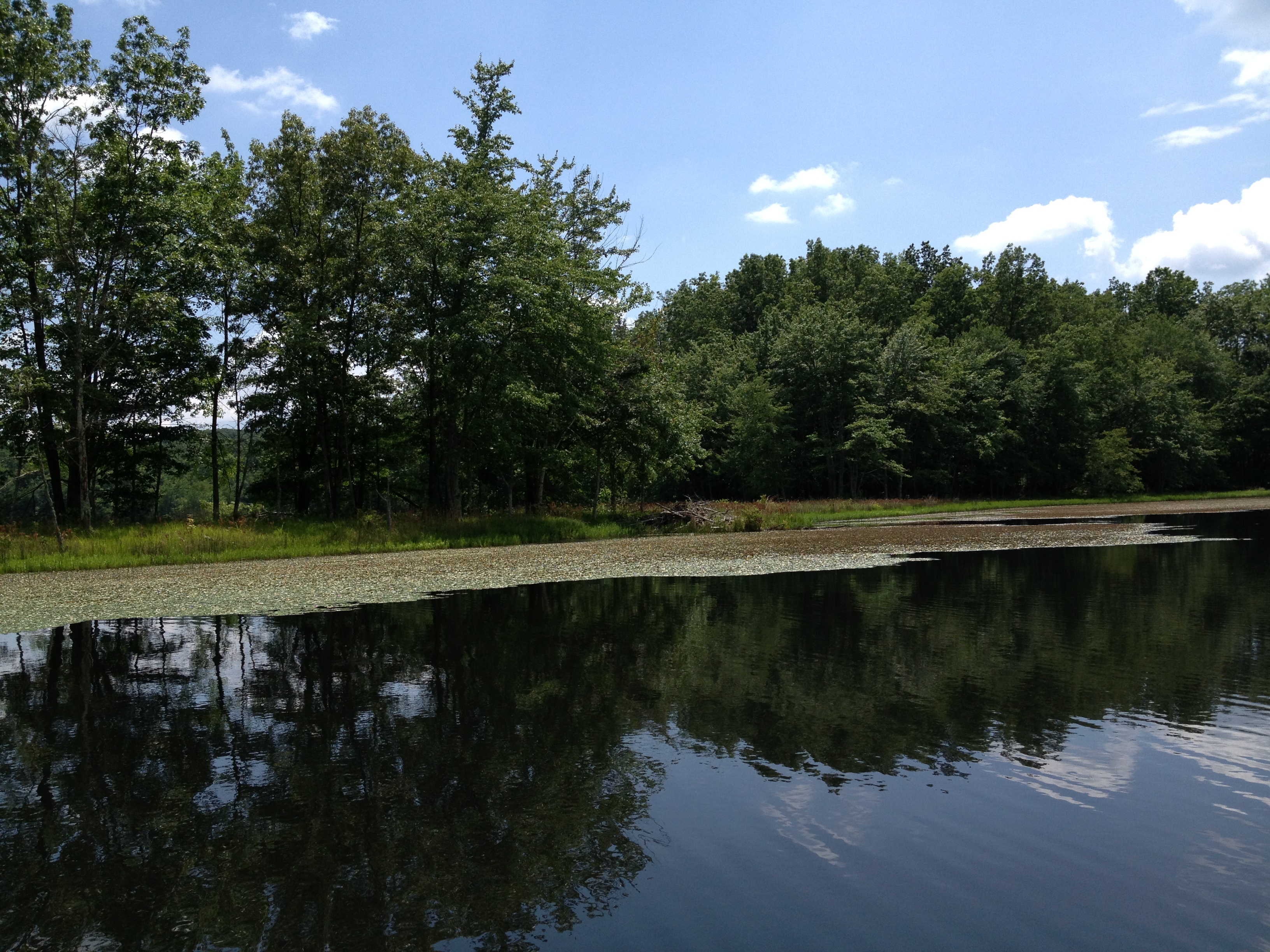
According to the Sewanee Messenger, Lake Dimmick is the largest of the lakes on the Domain, occupying 80 acres, about ten times the size of Lake Cheston. Originally named for Clarence Day, who donated most of the property, the lake was rechristened to honor the Rt. Rev. William Arthur Dimmick, at Day’s request. As you make your way from the dock, you can see the dam that’s responsible for creating the lake in 1971. Together with Lakes O’Donnell and Jackson, Dimmick is a critical part of Sewanee’s water supply.

IMG_3077

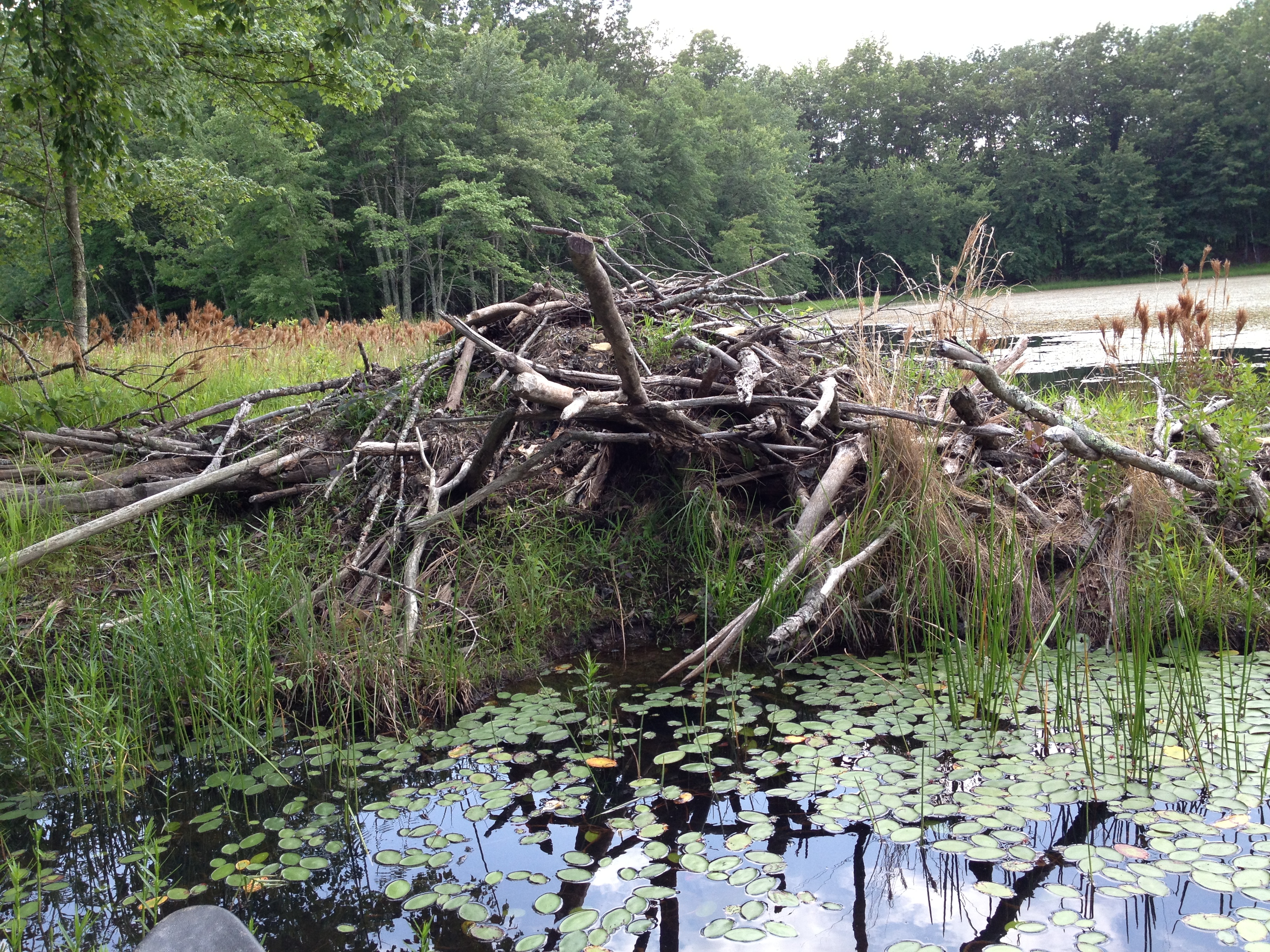
Occasionally other dams show up on the lake, the work of industrious beavers, whose activities cause trouble by blocking the spillway and consequently eroding the base of the man-made dam.  It has been the case in the last few years that the USDA has had to come out to conduct a beaver cull to control the population with traps and snares. “Isn’t that a beaver dam over there?” I asked, looking up from the dock. “It’s a beaver lodge,” my son said, and tolerantly explained to me the difference.  Empowered with this new knowledge, I suggested we to paddle on over to investigate.

IMG_3107 IMG_3109 IMG_3113IMG_3119

Alas, no beavers appeared to be at home. I like to think they were out on a weekend holiday of their own.

In 2005, all the talk about this lake concerned real estate development.  The University Regents had commissioned a study to investigate “the feasibility of creating a residential development with the possibility of an 18-hole golf course and/or small conference center.”  The hope was to lure investment to the Domain, not an entirely terrible goal, I guess, but the reaction on campus was universal horror. Full-scale protests helped to dissuade the powers-that-be, as then they were, from moving ahead with the project.

“Imagine if the Regents hadn’t listened to the protesters,” my friend said as we headed back. “Just picture what would have happened if they’d gone ahead and decided to put in a huge development with all these million-dollar homes, just in time for the real estate crash of 2008.  Think of this place surrounded by bunches of foreclosed-on McMansions. What a disaster that would have been.”

I thought about it, with a little shudder, and looked back at the empty beaver lodge.  “Beyond the Wild Wood comes the Wide World,” the Rat tells Mole, while they row along. “And that’s something that doesn’t matter, either to you or me. I’ve never been there, and I’m never going, nor you either, if you’ve got any sense at all. Don’t ever refer to it again, please. Now then! Here’s our backwater at last, where we’re going to lunch.”

IMG_3158

Posted in Animals, Family, Nautical, Sewanee, Sports & Games, Tennessee, Trees & Flowers | 6 Comments

A Marian Shrine in Marion County

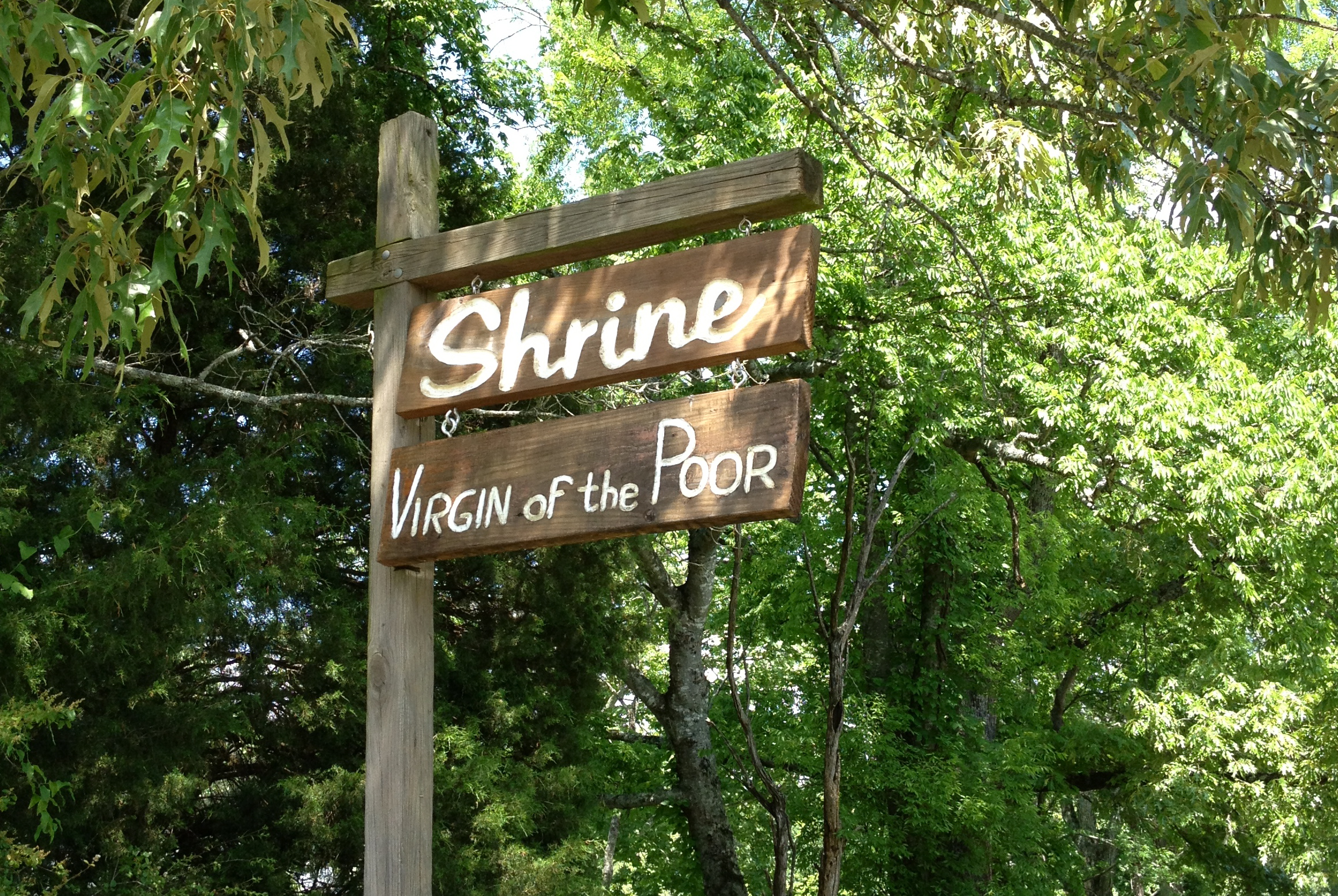
IMG_1972In my last post, I wrote about driving along TN-156 south of Lake Nickajack–further along the highway, coming into the town of New Hope, I saw a wooden sign by the roadside: “Shrine. Virgin of the Poor.”

Huh? There are a lot of shrines to the Blessed Mother in the Northeast I know of, but a Marian shrine here in Marion county?  This I had to see.

It’s a long drive down a backwoods road, but after 15 minutes or so you come to a meandering driveway at the top of which is a field with this building in it:

IMG_1975

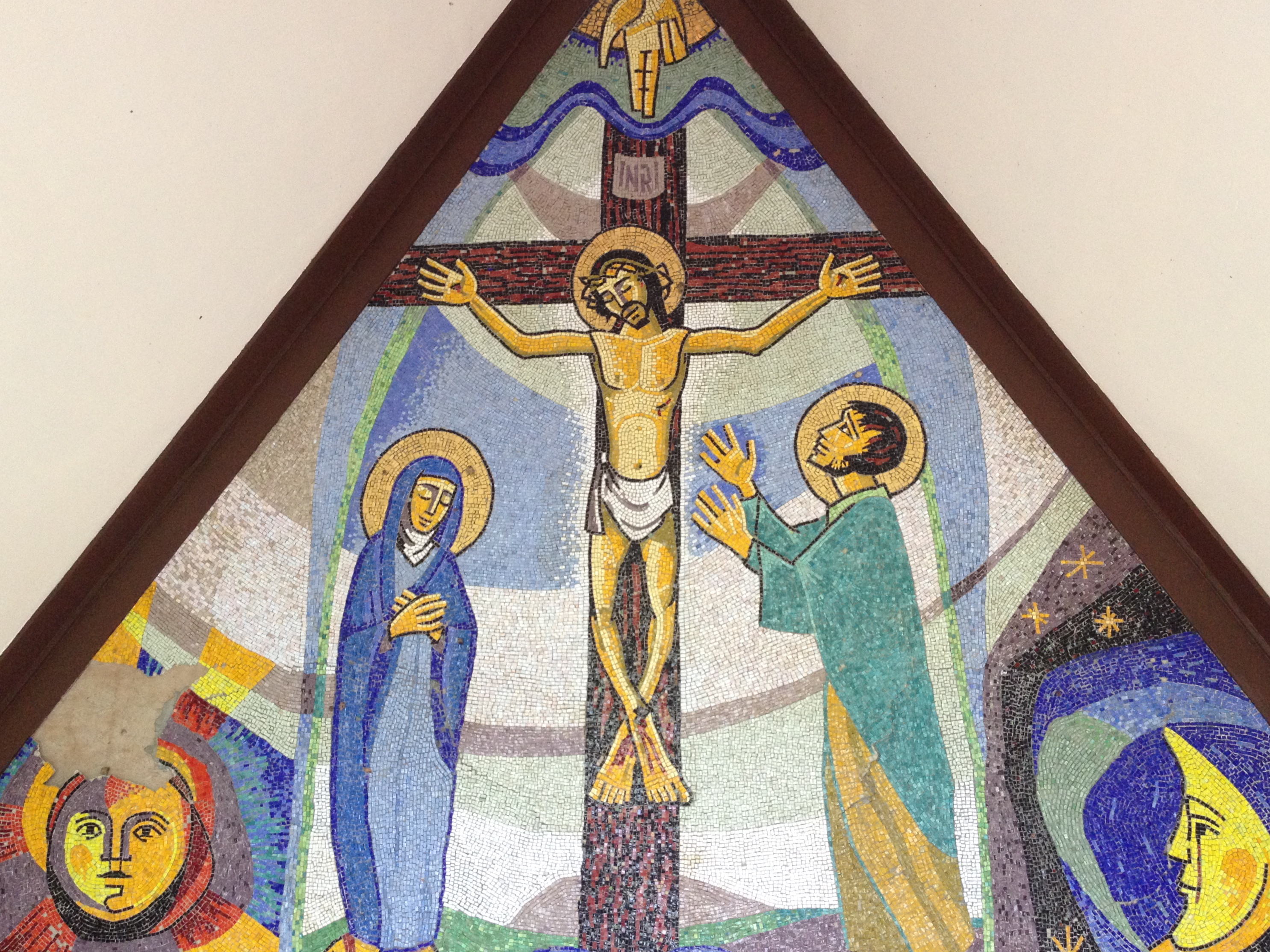
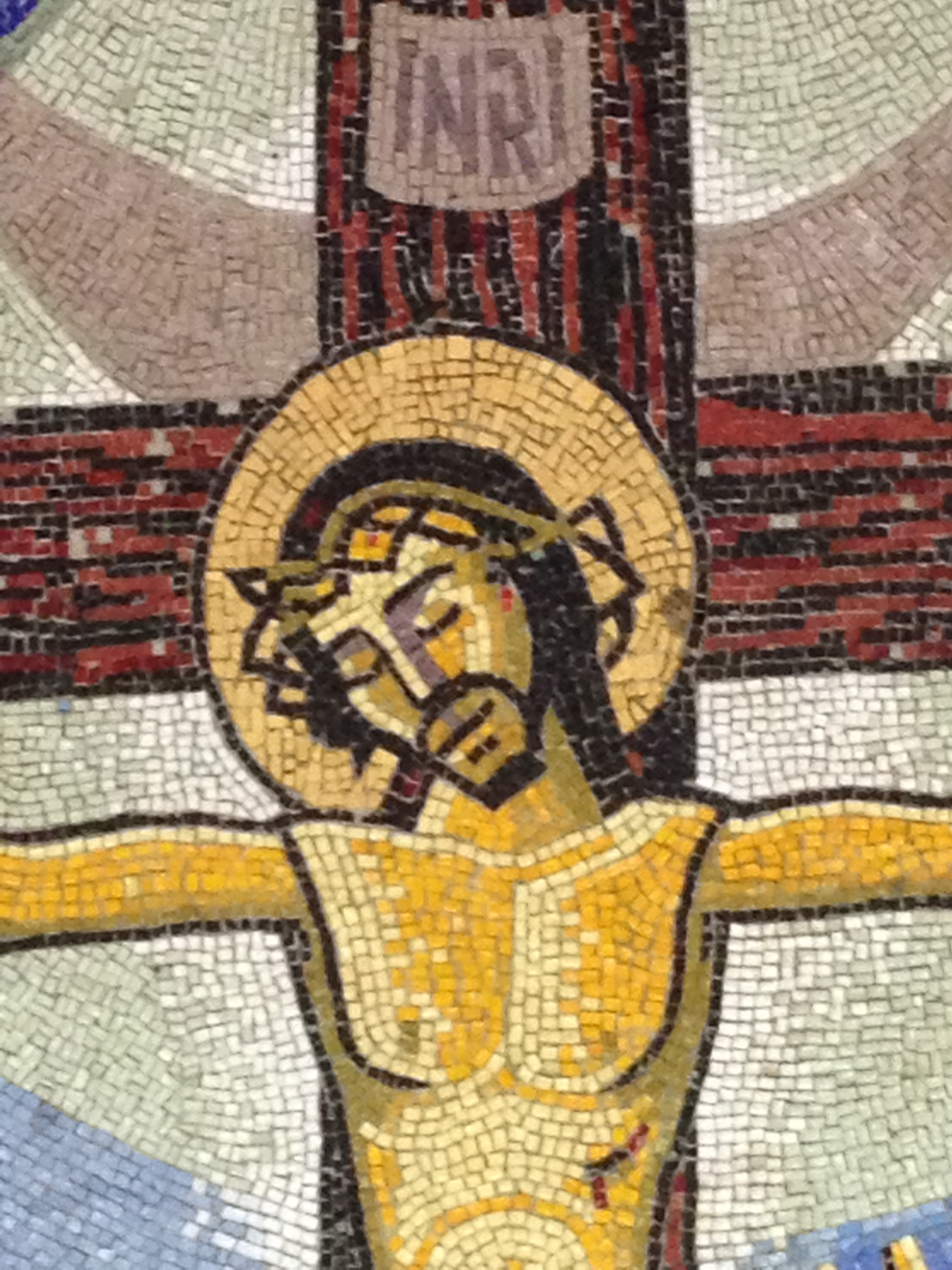
According to a plaque at the site, the site is dedicated to Our Lady of Banneux, who the appeared in the 30s to an 11-year old Belgian girl named Marietta Beco.  As the plaque further reads, “Built by Benedictine monks under the direction of Fr. Basil Mattingly in 1982, the Virgin of the Poor Shrine is located on a 600 acre farm willed to the Catholic Church by the Duncan family. The Chapel houses a statue made by a local parishioner and features an exterior mosaic depicting the appearance of Mary to Marietta in 1993. The interior mosaic shows Jesus speaking to St. John as He gives us His mother.”  Father Mattingly now lives at the Peace of Prince Abbey in Oceanside, California.

IMG_1979

IMG_1977

IMG_1989

IMG_1993

It really is a beautiful and peaceful place.  According to the sign, “Devotions are held every Sunday in May through October at 2:00 pm. Everyone is invited.”

Posted in Bible, Boston, Emblems, Saints, Tennessee | 4 Comments

Invisibles Lines, Local Realities

From an 1852 map of northern Alabama and Georgia and southern Tennessee. http://www.davidrumsey.com

From an 1852 map of northern Alabama and Georgia and southern Tennessee. http://www.davidrumsey.com

On a lovely day last month, I was driving home from Chattanooga and decided to take a detour off I-24, to satisfy a simple, geeky desire to stand at the precise point that divides Tennessee from Alabama and Georgia, as well as Eastern from Central Time. “I know I’m not the only one who gets this liminal thrill from standing on borders,” writes Ken Jennings in his 2011 book, Maphead, before going on to note that 200K+ tourists a year visit the Four Corners monument, to see where the states of Utah, Arizona, New Mexico, and Colorado all meet. For some reason, I wanted to gaze upon the spot nearby where geographical abstraction triumphs over topographical realities.

There was another reason I wanted to go there, though, one a little more timely.  At the very place where the three states meet is the point where the state of Georgia is about a hundred feet from Nickajack Lake, the body of water formed by a TVA dam on the Tennessee River.  The border has been much in the news lately, ultimately because of global warming. In the past few years, drought conditions in the South have worsened and state governments have been looking for new sources of water as a result. The large metropolis of Atlanta has a particularly acute problem, water-wise, and so Georgia has turned a thirsty eye to its northern border.  Naturally, Tennessee has no interest in ceding any part of the river to Georgia.

Lines arbitarily drawn on the land that end up unexpectedly significant? Pissed off politicians?  Water rights in dispute?  All of this was just too Chinatown to be missed, so I took exit 161 off I-24 to see what was what.  Besides, there might be a cool little marker I could take a picture of.

BillboardBigDaddyThe Federal Georgia Road south of Lake Nickajack is easy to find–just look for the exit to Big Daddy’s Fireworks (“Best ‘Bang’ For Your Buck”).  It’s an old road, constructed between 1805 and 1808  according to the historical marker by the roadside, in order to connect Tennessee to the Atlantic seaboard.  On the map it’s called TN-156, but the local signs along the way read Old Ladd’s Road and, further on, Shellmound Road.  It’s worth noting that most of this area was in Cherokee hands at the time the Federal Road was constructed, and they had roads of their own running through it.

A few miles on, I’m looking to take a left onto what the GPS is calling Macedonia Road.  Why Macedonia, I wonder?  Surely, at this place of dispute between borders there isn’t a subtle reference to the geographical problems of the former Yugoslavian republic of Macedonia, which the Greeks insist should be called Skopje? But again, local realities clear the matter up. It’s Macedonia Church Road, a reference to the people of Phillippi, whose church was founded by St. Paul after he’d had a dream: “And a vision appeared to Paul in the night; There stood a man of Macedonia, and prayed him, saying, Come over into Macedonia, and help us” (Acts 16:9 KJV). I don’t know how old the Macedonia church here in Shellmound is, but probably it was founded as a mission to the Indians. Interestingly enough, the Pauline vision, together with an Indian, features in the  the oldest American emblem, the state of Massachusetts’ first seal.

IMG_1942At the end of Macedonia Church Road, it’s a little hard to figure out which way to go, but a sign pointing to State Line cemetery seems like a safe bet. There’s an abandoned school bus in an overgrown lot in the other direction which I’m glad enough to avoid.  I drive down a long straight street, Huckabee Lane, which, as it happens is the line dividing Georgia from Tennessee. On the TN side is the old graveyard, with a sign noting “Decoration Day is Saturday, June 1st, 2013.”  Decoration Day (as opposed to Memorial Day, which takes place on the last weekend in May), is a tradition going back to the commemoration of the Confederate dead right after the Civil War.  It is intriguing to see here the persistence of this local custom, even a century and a half after the war.

IMG_1946

Just before the cemetery is this pretty patch of land, the bone of contention between the states.  The screen-shot from Google Maps below shows what’s at stake–my photo above was taken from the Georgia side of Huckabee Lane, but the tree just a few dozen feet away is in Tennessee. Behind the tree, also in Tennessee, is Lake Nickajack. Look at all that water. Sweet, sweet water that Atlanta would desperately like to get its parched little mitts on.

Screen Shot 2013-06-05 at 3.10.37 PM

As a matter of course, rivers make good borders: Canada is on one side of Rainy River, for instance, while Minnesota is on the other.  Between Texas and Mexico runs the Rio Grande.  The same is true of state boundaries, of which many examples can be given.  The Connecticut River divides Vermont from New Hampshire, while the Ohio River separates Illinois, Indiana, Kentucky, and West Virginia from the state that bears its name. Good fences make good neighbors, Robert Frost reminds us.  On the other hand, though, the sense of competitiveness that exists between those having to share a body of water has given rise to the English word “rival,” from the Latin word rivalis, describing one who lives on a river bank.

At this very point on the map, in the original sense of the world, Georgia and Tennessee are not rivals, because they do NOT in fact share the river. And yet, they should, as Georgia never tires of pointing out.  In 1818, a mathematician named James Camak was hired to survey the boundary line dividing Tennessee from Georgia which, according to the Articles of Agreement and Cession dealing with the dispensation of lands formerly in the Mississippi territory, ought to have been the 35th parallel. Camak did the best he could with the instrument he had at hand, a nautical sextant, but nonetheless ended up drawing the line too far to the south.

And there the boundary has stood ever since.  A bill that has been overwhelmingly passed this year in both chambers of the Georgia legislature demands that the line stipulated by the treaty be respected (the entire resolution, Georgia HR 4 2013-2014, can be viewed here and here), and they are threatening to take the issue to the Supreme Court. It’s doubtful, though, that the court will redraw so long established a border line.

IMG_1940Talking of which, I wanted to see the boundary itself. End of the street.  Up ahead is a path, which looks like it’s just crawling with ticks, chiggers, poison ivy, and snakes. And I think I hear banjos. (Seriously, Deliverance takes place on north Georgia river). On the other hand, it’s clear enough where you’re supposed to go.  There are a few nice houses around with pristine lawns, and not a single dog has come out and growled at me.  I probably won’t be down this way again very soon, so I pick up my iPhone, open the cardoor, and head for the trailhead.

Just a few feet in, it’s clear that in my shorts and sandals, I’m not suitably dressed for this outing.  The path is close and overgrown, with lots of thorny things unavoidably growing on either side. In addition, the path has divided itself into a several smaller paths.  I take out my phone and check Google maps, thinking to myself that James Camak could really have used an iPhone and GPS two centuries ago. But after a little while I realize that the little satellite-derived “you are here” arrow is only getting me so close to where I want to be.  Maybe I would be better off with a sextant, after all.

I’m beginning to lose heart when I look up and see a piece of orange cloth tied to a branch.  Well, I think, it’s probably there for a reason.  What Apple cannot manage to do, a simple rag somehow has no problem with: showing me the way.

IMG_1967

Climbing along a really thick bit of path, I’m feeling something like Indiana Jones, looking for a hidden temple in the middle of an Amazonian jungle.  And then, I spot it …

IMG_1963

IMG_1964

IMG_1966

… the cool little marker I’d come all this way to see.  The medallion is only about 4 inches in diameter and buried in the middle of a bunch of poison ivy, but it represents a geographical error two centuries old that has aggravated state politicians ever since. For the South’s largest city, it means a world of water-related trouble that climate change will only exacerbate.

Posted in Astronomical, Bible, Language & Etymology, Nautical, Poetry, Tennessee, The South, Trees & Flowers | 7 Comments

A Dozen Days Later

When I first heard about the explosions at the Boston Marathon, I scoured the internet till I found a live feed and called my wife.  “What!? WHAT?!”  We were both horrified.  “This was part of the reason we moved to rural Tennessee,” she reminded me, “to escape awful things like this.”  We had moved to Sewanee only a few months after 9/11.  Monitoring the scattershot information coming out of Boston that afternoon, it was hard to think much about the wisdom of the move.  It was hard to think of anything, really, except fear.

***

Late that Monday night, my sister reached me.  She’s a nurse at Mass General, not in the ER, but she knows a lot of people who work there. “They were all set up for dehydration, hypothermia, the sort of things marathon runners suffer from,” she told me. “They spent the day removing  ball bearings and re-attaching legs instead.” She began to cry. “It was so bloody.” If she hadn’t been scheduled to work, she probably would have been downtown at the finish line, as she had done in years past.

***

As an eighth-grader, I recall, the first place in downtown I really began to explore on my own was Copley Square. My friend John and I would meet at the Public Library and go on walkabout for hours in the building, marveling at the intricacies of the McKim-Mead-White architecture, and then go off into surrounding areas.  John was from South Boston, and I was from West Roxbury–we knew each other from school.  At the end of the day, we would return to the corner of Boylston and Dartmouth to catch the different trains home.  This corner is where the finish line of the Marathon was set up each April.

***

Like everybody elese in Boston in the 70s, I loathed the Yankees, and would vigorously chant “Reggie sucks” when they played the Sox at Fenway. Much as I hated New York as a boy, though, it came nowhere near the detestation I felt for the Canadiens. When the Bruins were playing in Montreal, there was a different national anthem and nobody spoke English. Most of the fun in watching sports in those days was having clearly-defined enemies.

***

On Marathon Day, there’s nobody to hate.  Wherever you stand to watch the runners, there is a crowd of happy people cheering on everyone who comes by.  Some wear shirts with the names of local colleges on them, and you yell out the name of the school. Others wear their names and, even if you have no idea who Jerry is, at the top of your lungs you yell out, Go Jerry!  On one occasion, I have had the honor of seeing Dick Hoyt pass by, pushing his son Rick in a wheelchair. Rick, who was born with cerebral palsy, told his father that when he pushed him quickly in his chair, he didn’t feel handicapped, and so at the age of 37, Dick took up marathoning.

***

At Boston College, where I used to teach before coming to Sewanee, we used to get an awful lot of the month of April off.  Holy Thursday, Good Friday, and Easter Monday usually fell in April, and were all official university holidays. BC was also closed on Patriots’ Day, as was most of the city, because that was the day of the Marathon, and the course went right alongside campus.

Listen, my children, and you shall hear
Of the midnight ride of Paul Revere,
On the eighteenth of April, in Seventy-Five:
Hardly a man is now alive
Who remembers that famous day and year.

So writes Longfellow. My entire life I have been struck by the irony that, while Paul Revere had gone out of the city to spread the alarm to every Middlesex village and farm, the Boston Marathon actually reversed the direction of the ride. That is, the runners were making their way into the city, the way the redcoats had done in ’75.

***

My brother has been a janitor for the Boston Police Department for over twenty-five years.  He works at headquarters, downtown.  Throughout the week, he told me, “there were cops from everywhere down there, state troopers, FBI, military, the place was a zoo. Pizza boxes all over the place.”  The door closest to the dumpster out back had been locked, and all traffic in and out routed through the front entrance. “By the time I have one bag filled up and dumped, there’s another one that needs to go out.”  On Friday, like everyone else in town, he sheltered in place, and  was glad to hear from his boss that he wouldn’t be docked a sick day for the lock-down. Still, he worried about the state of headquarters when he got back. “It’s gonna be a mess.”

***

After the bombings, the lights were dimmed at Bell Centre in Montreal in commemoration of the victims, and at Yankee Stadium, they played “Sweet Caroline.” On The Daily Show, John Stewart noted of the competition between New York and Boston, It is in situations like this that we realize that it is clearly a sibling rivalry. We are your brothers and sisters in these types of events.”  All of this was moving, to my mind.

***

The legend goes that, after the Greek victory at the Battle of Marathon in 490 BC, the runner Pheidippides ran 26 miles to Athens to announce the victory, and then died.  This is not the story that Herodotus tells.  According to the Histories, Pheidippides was sent by the Athenians to Sparta, 140 miles away, to request aid from their sister city against the invading Persians. He made it in three days. For religious reasons, the Spartans had to delay sending help, so the Athenians faced the Persians, and beat them, on their own.

***

You can decide which ancient story is better. Neither is likely to be true, of course, though the mighty Persian army was in fact defeated by a far smaller force.  If there is a defining moment that sets the West against the East, it would be the Battle of Marathon.  How Pheidippides fits into it is hard to say.

***

It was a week after the bombings and just a few days after the man-hunt, and I was sitting in the coffee shop on campus, where my friend Katherine came up to me. “I’ve been thinking about you,” she said. “More than about the people I know who live in Boston now.”  We talked about the surreal nature of the events, the explosions and an entire city on lock-down. She grew up here in Sewanee, but spent part of her life in Connecticut, in Newtown, in fact.  The massacre there was only a few months ago. “You might be the only person who will understand this,” she tells me, “but do you feel guilty that you weren’t there?”  Until she’s said it out loud, I hadn’t realized that that was precisely how I felt.

***

I was in touch with a student on campus from Boston whom I knew to have relatives in Watertown.  “Is everything OK back home?” I e-mailed him, and it was, more or less. He is involved in the Cinema Guild, and thought it might make sense collect money for relief efforts at a special showing of a film that week.  He was thinking of The Departed, which struck me as way too violent to be appropriate. Good Will Hunting came to my mind, but the fact that Ben Affleck and Matt Damon both went to Cambridge Rindge and Latin, where Dzhokhar Tsarnaev had graduated, bothered me, admittedly for no good reason.

***

A day or so later, I was in the gym, and somebody I don’t know very well asked  if I had any family who’d been affected by the events in Boston. He then went on to use phrases like “mercenaries at the finish line,” “markings on the backpacks don’t match,” “CIA,” “Mossad,” “counter-espionage,” “mainstream media,” “Saudi national was Bin Laden’s son,” and “we’ll never know the real story.” The conversation left me a little rattled.  Interestingly, this guy’s remarks were utterly divorced from contemporary politics. Obama, Bush, nobody was mentioned, no liberal or conservative agenda was blamed. There was a paranoid Illuminati-Protocols of the Elders of Zion-Trilateral Commission aspect to all of it, this idea that there’s a secret cabal at work whose intentions are murky and inscrutable.

***

In the 90s, I published an article while I was still at Boston College on the topic, broadly, of witchcraft in Greco-Roman culture. It contained the following paragraph: “In a traditional society, figures such as witches and demons are not the problem but rather the solution to the still more disturbing problem of chance. Deaths without any apparent cause can readily be explained in terms of witchcraft. …Where visible causes for specific misfortunes are lacking, hidden agents (whether divine or human) are assumed: witchcraft, which operates outside the parameters of normal life, thus provides the rationale for misfortunes that would be otherwise inexplicable.”

***

On the day of the bombings, I wanted to know who had done it. I wanted there to be an enemy who was clearly-defined. I thought of the Minutemen at Concord, and of the Athenians at Marathon.  I thought especially of the playwright Aeschylus, who wrote several masterpieces, and had the following lines engraved on his tombstone:

This memorial hides Aeschylus, the Athenian, son of Euphorion
Who died in wheat-bearing Gela.
The precinct of Marathon and the long-haired Mede,
Who knows it well, may tell of his great valor.

I thought about posting that as my status line on Facebook, but worried it might seem racist–after all, who could say if Medes were involved? After the Oklahoma City bombings, various Iranians were held as suspects for no reason at all but paranoia.  In turns out in Boston not to have been Medes but Caucasians, one of the peoples north of Persia, who set off the bombs in Copley Square. One of them did have long hair, as it happened.

***

Aeschylus was proud to have fought at Marathon, but his greatest works are monuments dedicated to the idea of Justice as opposed to Vengeance. Forty-five years ago this month, Martin Luther King, Jr., was assassinated in Tennessee, and Bobby Kennedy quoted Aeschylus to an upset crowd:

My favorite poet was Aeschylus. He once wrote: “Even in our sleep, pain which cannot forget falls drop by drop upon the heart, until, in our own despair, against our will, comes wisdom through the awful grace of God.”  What we need in the United States is not division; what we need in the United States is not hatred; what we need in the United States is not violence and lawlessness, but is love and wisdom, and compassion toward one another …

***

Herodotus says that, while Pheidippides was running to Sparta from Athens, he encountered the god Pan.  The Athenians built a temple to Pan after the invasion, to commemorate his help in the ensuing battle, since the god had brought a blind fear upon the Persians–panic, named for the god.  At Marathon, the Athenians won as the Persians undid themselves with irrational fear.

Posted in Boston, Classics, England, Family, Language & Etymology, Military, Mythology, Poetry, Sewanee, Sports & Games | 2 Comments