
-
Recent Posts
Recent Comments
Uncomely and Broken on Pope Leo on cinema: “an… David Cronin on Pope Leo on cinema: “an… Uncomely and Broken on Ishi and the Algorithm Dennis Davenport on Ishi and the Algorithm Uncomely and Broken on Theodore Parker’s Grave,… Archives
- April 2026
- March 2026
- November 2025
- December 2024
- April 2024
- October 2021
- February 2021
- September 2020
- July 2020
- June 2020
- May 2020
- April 2020
- March 2020
- January 2020
- August 2019
- July 2019
- June 2019
- May 2019
- April 2019
- March 2019
- February 2019
- January 2019
- December 2018
- November 2018
- October 2018
- July 2018
- June 2018
- May 2018
- April 2018
- March 2018
- February 2018
- November 2017
- October 2017
- September 2017
- August 2017
- April 2017
- February 2017
- October 2016
- September 2016
- May 2016
- April 2016
- March 2016
- February 2016
- January 2016
- November 2015
- October 2015
- September 2015
- August 2015
- July 2015
- June 2015
- April 2015
- March 2015
- February 2015
- January 2015
- December 2014
- November 2014
- October 2014
- September 2014
- August 2014
- July 2014
- June 2014
- May 2014
- April 2014
- March 2014
- February 2014
- January 2014
- December 2013
- November 2013
- October 2013
- September 2013
- August 2013
- July 2013
- June 2013
- April 2013
- March 2013
- February 2013
- January 2013
- December 2012
- November 2012
- October 2012
- September 2012
- August 2012
- July 2012
- June 2012
- May 2012
- April 2012
- March 2012
- February 2012
- January 2012
Categories
- AI
- Animals
- Astronomical
- Bible
- Birds
- Books
- Boston
- Cartoons
- Cemeteries & Funerals
- Classics
- Coal
- Dogs
- Drama
- Education
- Emblems
- England
- Family
- Film
- Florence
- Ireland
- Italy
- Language & Etymology
- Military
- Music
- Mythology
- Nautical
- New England
- Numismatics
- Oxford
- Poetry
- Pontius Pilate
- Race
- Rivers
- Rome
- Saints
- Scotland
- Sewanee
- Slavery
- Sports & Games
- Statues & Monuments
- Tennessee
- The South
- Time
- Trees & Flowers
- Uncategorized
Meta
Protected: Plumbing the Depths
Posted in Astronomical, Bible, Classics, Emblems, Language & Etymology, Nautical, Time
Enter your password to view comments.
Scylla or Charybdis? The Homeric Trolley Problem
The recent publication of two new books on ethics have got me thinking about one of my favorite Homeric stories. David Edmonds’ Would You Kill the Fat Man? (Princeton) and Thomas Cathcart’s The Trolley Problem (Workman) each deal with an ethical riddle that the New York Times succinctly describe thus:
You are walking near a trolley-car track when you notice five people tied to it in a row. The next instant, you see a trolley hurtling toward them, out of control. A signal lever is within your reach; if you pull it, you can divert the runaway trolley down a side track, saving the five — but killing another person, who is tied to that spur. What do you do? Most people say they would pull the lever: Better that one person should die instead of five.
The “trolley problem” was first articulated by Oxford philosopher Philippa Foot in 1967, although she didn’t explain why the people in her theoretical world should be so cavalierly loitering around train-yards with runaway trolleys.
But, in any event, what should you do in this predicament? The dilemma seems simple at first, but grows in complexity upon reflection. If you throw the switch, one person will die; if you don’t throw the switch, five will. As a strictly utilitarian matter, clearly it worse that five people should die instead of one, so you ought to throw the switch. And yet, if you throw the switch you are certainly complicit in that individual’s death, whereas were you to do nothing, it would be an accident if the five were killed. Deliberately arranging for an innocent person’s death is obviously worse than not doing so, and hence you ought not to throw the switch.
What to do? Since its original publication, the trolley problem has been fitted out with different variations for the purpose of highlighting other ethical issues implicit in the original dilemma: What if, instead of throwing the switch, all you could do was to push somebody on to the track to stop the trolley? What if it were … your mom!?
You can see how all of these arguments might run but, at its heart, the trolley problem comes down to a numbers game balanced against the guilt associated with intentionally taking a life. A utilitarian argument depends upon a simple consideration of the number of lives saved. The opposite position puts more of a premium on the moral agency of the one who intentionally though unwillingly takes a human life.
There is, as I said at the start, a comparable situation in Homer. In Book Twelve of the Odyssey, the witch-goddess Circe is giving the hero explicit directions on how to get home. There are many dangers to be avoided, to be sure, and among these are the monsters living on either side of a strait his ship must pass through, Scylla and Charybdis. The former, horrible to look upon, is described as follows in Ian Johnston’s on-line translation:
She has a dozen feet,
all deformed, six enormously long necks, 110
with a horrific head on each of them,
and three rows of teeth packed close together,
full of murky death. Her lower body
she keeps out of sight in her hollow cave,
but sticks her heads outside the fearful hole,
and fishes there, scouring around the rock
… No sailors 120
can yet boast they and their ship sailed past her
without getting hurt. Each of Scylla’s heads
carries off a man, snatching him away
right off the dark-prowed ship.
So, Scylla with her six heads is on one side, ready to attack. What about the opposite side of the strait?
Then, Odysseus,
you’ll see the other cliff. It’s not so high.
The two are close together. You could shoot
an arrow from one cliff and hit the other.
There’s a huge fig tree there with leaves in bloom.
Just below that tree divine Charybdis
sucks black water down. She spews it out 130
three times a day, and then three times a day
she gulps it down—a terrifying sight.
May you never meet her when she swallows!
Nothing can save you from destruction then,
not even Poseidon, Shaker of the Earth.
Make no mistake, Charybdis is even worse than Scylla, and she will destroy the ship and everybody on board if she can. While he is contemplating these unpleasant options, Circe offers Odysseus an ancient version of the trolley problem:
Make sure your ship stays close to Scylla’s rock.
Row past there quickly. It’s much better
to mourn for six companions in your ship
that have all of them wiped out together.
It’s interesting to think that this goddess, who is endowed with magical transformative powers (she had turned Odysseus’ men into pigs a book earlier!) is here making a strictly utilitarian argument. One can even picture the syllogism:
- It is better that fewer people should die
- Fewer people will die by sailing alongside Scylla
- Therefore it is better to sail alongside Scylla
Q.E.D.! Yet Odysseus is not convinced. When it comes time in fact to make the treacherous passage, the hero orders his helmsman to hug the cliff of the strait in the hopes that they can find some way to maneuver between the two monsters. With his hand on his sword, Odysseus keeps a sharp eye out for Charybdis, but in vain.
Then Scylla snatched away
six of my companions, right from the ship,
the strongest and the bravest men I had.
When I turned to watch the swift ship and crew,
already I could see their hands and feet,
as Scylla carried them high overhead.
They cried out and screamed, calling me by name
one final time, their hearts in agony. …
Of all things my eyes have witnessed in my journeying
on pathways of the sea, the sight of them
was the most piteous I’ve ever seen.
Many were the things Odysseus saw, we read in the first lines of the epic. And yet the sight of his six men snatched up by Scylla was in Odysseus’ eyes οἴκτιστος, “eliciting the greatest pity,” as Homer famously states. But why should this have caused him the most sorrow? An equal number of Odysseus’ men were eaten by Polyphemus as he watched, and many more were killed when the Laestrygonians trapped eleven of his ships in a harbor and picked off like fish in a barrel. And that’s not even to mention the decade-long war of Troy, with its thousands of grim battlefield deaths.
To my mind, the answer lies somewhere between the utilitarian construction of the trolley problem and its counterargument. Odysseus could not bring himself to accept the cold logic of Circe’s recommendation to sail alongside Scylla, thereby condemning six of his men to death. He can comfort himself with the knowledge that he did not follow her advice and so is not responsible for the deaths of the six men. So, the switch has been thrown in the train-yard, the trolley has run over fewer rather than more, and–according to a utilitarian argument–maximum happiness has been achieved. Homer, however, imagines the human cost of such a decision.
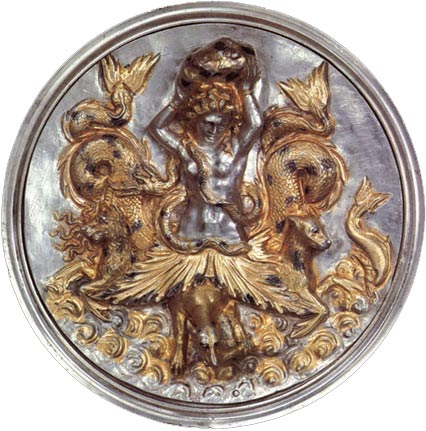
The Scylla Emblem, an ancient silver piece from Morgantina, Sicily. For more, see http://uvamagazine.org/articles/plunder
Posted in Classics, Mythology, Nautical, Poetry
2 Comments
Doug Seiters
The following is a talk I gave at the Sewanee Emeritus Association Annual Banquet in honor of Doug Seiters on Wednesday, April 15, 2009, at the old Sewanee Inn.
When Laurence Alvarez contacted me a few months ago asking me to deliver a
resolution in praise of J. Douglas Seiters, I was delighted, thinking to
myself, Well, this will be an easy way to get a free dinner. After all,
who is there in Sewanee who couldn’t deliver an encomium for Doug? Anyone
has worked with him will offer unsolicited praise form him. Anybody in
this room would do a creditable job, and one could easily walk down
University Avenue button-holing strangers in the street, all of whom would
attest that Doug is the very essence of what is best in our school and
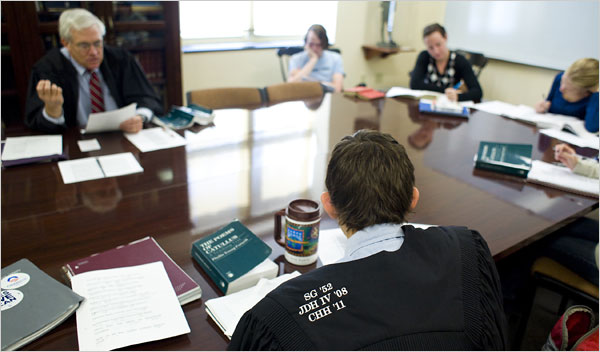
community. Wasn’t it just a few months ago that the New York Times
featured a note in the Educational Supplement about the Sewanee tradition
of gown-wearing, and there on the World Wide Web for everyone to see was a
room full of students in a seminar studying Catullus, with Doug at the
head of the table. You look at that and think, What alma mater can boast
of a son who looks more like her?
Doug’s record of service to the University can hardly be overstated, and
one wonders whether there is anybody in Sewanee’s history to match it.
Were I simply to list the names of the committees, programs, departments,
ad hoc advisory groups, strategic planning sessions, and the like, which
Doug has chaired or served on, we could be here well into the morning, so
I will avoid doing that. To put it more simply, let us note that he has
routinely taken on and succeeded at the most challenging jobs at the
University of the South. Only a few years after his graduation from
Sewane (a period of time in which he taught at the Baylor School and
earned an MA at Florida State), Doug returned to the university to work in
the Admissions Office and teach in the Classical Languages Department.
From there, after finishing his doctorate at FSU, he was promoted to the
challenging position of Dean of Men, an office he held from 1975 to 1986.
It is interesting to see that to many of the local police he is still
known as “Dean Seiters” in recognition of his long service in that office.
(For his efforts in reforming various campus rogues during that time, we
all owe him a debt of gratitude, as I believe both the University’s
current Director of Development and its present Chaplain can uniquely
confirm.)
In more recent times, urgent circumstances have brought Doug back into the
Administration. Like Cincinnatus called from his plough to fight the
Aequians in 458 B.C., Doug was sought out by the University for its
highest offices. And so he acted as Assistant to the Vice-Chancellor
(from 1996 to 2000), as interim Provost (in 2001), and as interim Dean of
the College (in 2003-2004). During this latter stint as Dean, in fact,
Doug served not simply as the college’s chief academic officer with all
the duties pertaining to the job, but had also to find time to mentor a
fledgling junior colleague as the interim Chair of Classical Languages.
If the department did not come tumbling down like a house of cards during
that year, I know who is to thank.
I have to tell you, I recall the moment in the Easter term of 2003 very
well when Doug called me into his office. A few weeks earlier, Bill
Bonds–our brilliant, witty, and occasionally prickly colleague–had died,
and then only a short time later, Dean Tom Kazee had resigned to take a
job at Furman. Doug called me into his office, as I said, to tell me what
I already knew he was going to say, that the VC had asked him to serve as
interim dean.
“Are you ready to do it?” I asked.
“Well, that depends, “ he replied. “Are you ready to be the chair of
Classical Languages?” That part of the equation hadn’t occurred to me,
and I gave it a moment’s thought.
“I think so,” I said. He shook my hand in congratulations, and then
added, “You know, the Dean is very concerned about that open
position you haven’t filled in your department yet.”
All in all, these various tasks–provost, dean of men, dean of the
college–were ones that called not simply for competence but, even more
critically, for that quality which St. Benedict reminds us is most
important in a leader of a tight-knit community, discretion. It speaks
volumes that it was to Doug Seiters that Sewanee turned again and again
during such times when a steady hand and discreet tongue were needed. And
it speaks further volumes still that, of all the many posts he has held
over the years here, Doug speaks with greatest pride of his work directing
Sewanee’s Summer Scholars program, the forerunner of the present Bridge
Program, which brought disadvantaged inner-city high school students to
Sewanee as preparation for college-level work. That he continued to teach
full time during the entirety of the program’s five year run is surprising
only if we are not already familiar with his tremendous work ethic.
We may be certain that neither the high school students in the program nor
the students enrolled in his college classes were given anything but
Doug’s full consideration. His current students appreciate his
attentiveness to them, too, as we can easily deduce from a comment I have
read on the rear window of a comped senior’s car not so long ago, which
stated “We lift our lighters for Dr. Seiters.” On one of his more recent
evaluations I recall seeing a comment written in the inimitable dialect of
the undergraduate, which read simply, “Doug Rules!” And who can disagree?
As a colleague, as a teacher, as a scholar, as a community member, as a
friend, in all these ways and others, we are very much in the debt of this
most serviceable gentleman. And yet, like Cincinnatus, who when the war
was won took off his toga to return to his plough and fields, Doug is
about to take leave of us. We are grateful to him, of course, for all his
many kindnesses, and we are sad, too, though he has taught us by his own
example better than to mope.
Yet, for all our selfishness in not wanting him to go, we would not
begrudge him his time with Ann, who will herself leave Sewanee Elementary
School behind at the end of next month. I do not know who the female
equivalent of Cincinnatus is, but I suspect she would look a lot like Ann.
What a hole it will leave at the Domain’s other fine educational
institution when she goes. I will admit that I cannot help but wonder who
will sing “Happy Birthday, Dear Friends” to future generations of SES
students at Friday Assembly? Our community has been fortunate indeed to
have had two such splendid educators in its midst, and if they have been
an inspiration to us in the past on the way to conduct one’s self properly
and profitably in our community, so we will look to them in the future for
the model of a suitable retirement, whether they are jetting off to visit
grandchildren, enjoying their summers on the Long Island Sound, or
lounging side by side, hand-in-hand, on their back-porch overlooking Tim’s
Ford Lake. And I will think of them often as Ovid imagines a pair of
famous lovers in Book Eleven of the Metamorphoses:
Hic modo coniunctis spatiantur passibus ambo,
nunc praecedentem sequitur, nunc praevius anteit
Eurydicenque suam iam tuto respicit Orpheus.
Here they walk together with equal strides,
Now he follows her as she goes ahead, now he precedes her on their way
and Orpheus looks safely back upon his Eurydice.
Many thanks to all of you for this opportunity to speak with you, and many
thanks, Doug and Anne, for all you have done for me, my family, and for
Sewanee.
Posted in Classics, Education, Poetry, Sewanee
2 Comments
Protected: To Spiral (transitive)
Posted in England, Language & Etymology, Sewanee, Sports & Games
Enter your password to view comments.
Protected: Regarding “Our F***ing City”
Posted in Boston, Language & Etymology, Sports & Games
Enter your password to view comments.
Protected: Penny with Counterstamp
Posted in Classics, Emblems, England, Numismatics
Tagged Canadian penny, Mason
Enter your password to view comments.
My First and Only Bowtie
A few months into my freshman year, I decided to conduct some sartorial experiments, hoping against hope I might discover a sense of style. One day I saw a checked bowtie in a store downtown and bought it with the thought of wearing it to school the next day.
There was a only silence during my morning classes, a fact I attributed tothe seething envy of my fellow students, and afterward, I proudly strolled off to the cafeteria for lunch. Checked bowtie, I thought to myself, you are very cool.
A few minutes later, I passed by a table where some friends of mine were sitting. One of them raised his finger and shouted, “Waiter!”
What?! Making fun of my bowtie?! Angrily, I sputtered, “Fuck you, asshole,” at which my nemesis looked genuinely shocked.
“What did you say?” he asked.
“You heard me,” I said, gathering my indignation. “FUCK YOU.” His eyes grew wide.
“I can’t believe you would say that,” he replied, and pounded the table. “That’s it. Let me speak to your manager.”
My bowtie was checked, but that was checkmate. Except with a tux, I have never worn a bowtie again.
Posted in Uncategorized
4 Comments
Last Night’s Fireball
I was outside talking to my friend Elizabeth yesterday evening, about 6:45 Central, when, all of a sudden, an enormous fireball appeared in the sky behind her. “Whoa! Is that a comet?!” I asked. “I hope it’s not a burning airplane,” she replied. Although I had my phone with me, I did not have the presence of mind to take a picture.
Evidently what Elizabeth and I saw was a fireball, a meteor “brighter than the planet Venus,” according to the American Meteor Society website, who listed the object as event #2158 for 2013. It was seen by people not just in Sewanee, but all across the South and Midwest.
It was beautiful. Life affirming. I feel very small, wrote someone from Birmingham, Alabama on the AMS page, while another person from Glasgow, Kentucky thought it was scary and beautiful, lasted longer than i thought it would. A witness from Duluth, Georgia, claimed, Most impressive meteor I’ve seen in my 36 years.
But there were others who were unsettled by the fireball. According to the blog End Times Headlines (whose mission “is to inform our readers and viewers of Prophetic Events and how they are unfolding before our very eyes thru News and Headlines presented from a Prophetic Prospective in light of the Holy Bible”), the fireball represented a “sign in the heavens,” and at least one person commenting on their Facebook page claimed, “he worald will be destored by fire and i beleive this is just a warning to alll to repent and fall face down and pray.”
Personally, I did not feel especially small, nor was I inclined to fall forward and pray. It was an astounding event, however, and I made my way home with a genuine sense of wonder.
Postscript. Here’s a video from Alabama on Youtube of the fireball:
Posted in Astronomical, Tennessee
Leave a comment


