Saturnalia and American Slavery

The Roman festival of the Saturnalia, “the best of days,” was celebrated between December 17th and 25th as a period of carnivalesque license. The world was ritually turned upside down, masters served slaves, and freedom of speech was encouraged. The relationship of the ancient holidays to Christmas seems obvious.  The purpose of the Saturnalia seems to have been to “let off steam” in an otherwise top-heavy hierarchical society. It has never occurred to me to ask how the slaves must have felt about all this, nor would it have possible to ascertain their feelings given the paucity of evidence. But the passage below, from Chapter 10 of The Narrative of the Life of Frederick Douglass, an American Slave (1845), gives some evidence of how a later slave felt about this period of “temporary liberty.” I have highlighted especially interesting remarks.

My term of actual service to Mr. Edward Covey ended on Christmas day, 1833. The days between Christmas and New Year’s day are allowed as holidays; and, accordingly, we were not required to perform any labor, more than to feed and take care of the stock. This time we regarded as our own, by the grace of our masters; and we therefore used or abused it nearly as we pleased. Those of us who had families at a distance, were generally allowed to spend the whole six days in their society. This time, however, was spent in various ways. The staid, sober, thinking and industrious ones of our number would employ themselves in making corn-brooms, mats, horse-collars, and baskets; and another class of us would spend the time in hunting opossums, hares, and coons. But by far the larger part engaged in such sports and merriments as playing ball, wrestling, running foot-races, fiddling, dancing, and drinking whisky; and this latter mode of spending the time was by far the most agreeable to the feelings of our masters. A slave who would work during the holidays was considered by our masters as scarcely deserving them. He was regarded as one who rejected the favor of his master. It was deemed a disgrace not to get drunk at Christmas; and he was regarded as lazy indeed, who had not provided himself with the necessary means, during the year, to get whisky enough to last him through Christmas.

From what I know of the effect of these holidays upon the slave, I believe them to be among the most effective means in the hands of the slaveholder in keeping down the spirit of insurrection. Were the slaveholders at once to abandon this practice, I have not the slightest doubt it would lead to an immediate insurrection among the slaves. These holidays serve as conductors, or safety-valves, to carry off the rebellious spirit of enslaved humanity. But for these, the slave would be forced up to the wildest desperation; and woe betide the slaveholder, the day he ventures to remove or hinder the operation of those conductors! I warn him that, in such an event, a spirit will go forth in their midst, more to be dreaded than the most appalling earthquake.

The holidays are part and parcel of the gross fraud, wrong, and inhumanity of slavery. They are professedly a custom established by the benevolence of the slaveholders; but I undertake to say, it is the result of selfishness, and one of the grossest frauds committed upon the down-trodden slave. They do not give the slaves this time because they would not like to have their work during its continuance, but because they know it would be unsafe to deprive them of it. This will be seen by the fact, that the slaveholders like to have their slaves spend those days just in such a manner as to make them as glad of their ending as of their beginning. Their object seems to be, to disgust their slaves with freedom, by plunging them into the lowest depths of dissipation. For instance, the slaveholders not only like to see the slave drink of his own accord, but will adopt various plans to make him drunk. One plan is, to make bets on their slaves, as to who can drink the most whisky without getting drunk; and in this way they succeed in getting whole multitudes to drink to excess. Thus, when the slave asks for virtuous freedom, the cunning slaveholder, knowing his ignorance, cheats him with a dose of vicious dissipation, artfully labelled with the name of liberty. The most of us used to drink it down, and the result was just what might be supposed; many of us were led to think that there was little to choose between liberty and slavery. We felt, and very properly too, that we had almost as well be slaves to man as to rum. So, when the holidays ended, we staggered up from the filth of our wallowing, took a long breath, and marched to the field,—feeling, upon the whole, rather glad to go, from what our master had deceived us into a belief was freedom, back to the arms of slavery.

I have said that this mode of treatment is a part of the whole system of fraud and inhumanity of slavery. It is so. The mode here adopted to disgust the slave with freedom, by allowing him to see only the abuse of it, is carried out in other things. For instance, a slave loves molasses; he steals some. His master, in many cases, goes off to town, and buys a large quantity; he returns, takes his whip, and commands the slave to eat the molasses, until the poor fellow is made sick at the very mention of it. The same mode is sometimes adopted to make the slaves refrain from asking for more food than their regular allowance. A slave runs through his allowance, and applies for more. His master is enraged at him; but, not willing to send him off without food, gives him more than is necessary, and compels him to eat it within a given time. Then, if he complains that he cannot eat it, he is said to be satisfied neither full nor fasting, and is whipped for being hard to please! I have an abundance of such illustrations of the same principle, drawn from my own observation, but think the cases I have cited sufficient. The practice is a very common one.

Posted in Bible, Classics, Slavery, The South, Time | Leave a comment

Introduction for Christopher Hitchens, “The Moral Necessity of Atheism” (Sewanee, Feb. 2004)

0Introduction for Christopher Hitchens,
“The Moral Necessity of Atheism”

Tuesday, Feb 23, 2004
Convocation Hall
The “How, Then, Shall We Live?” Series


I knew that, when we invited Christopher Hitchens to speak, we would draw a large crowd, and sure enough we have, and I am aware, painfully aware, that you all are here to hear him and not me.

Toward that end, let me skip over the elaborate introduction in which Mr. Hitchens’ numerous books and essays would be enumerated at length, to get to the matter at hand, short and sweet. I will not mention Letters to a Young Contrarian, published in 2001, which might be called a guidebook for the gadfly spirit of Socrates, written for the independently-minded person who feels the need to Zag when all the world is Zigging, and which Hitchens wished to call “A Power of Facing,” in reference to George Orwell’s famous quotation about needing to have the power to face unpleasant facts. Since I’m not bringing that up, I won’t mention Hitchens’ incisive volume, Why Orwell Matters (from 2002), nor the very recent introduction he’s written for the new edition of Animal Farm and 1984.

No, not a word on any of that, since, were I to do so, I might give you the wrong impression that Hitchens is simply an Orwell scholar, or enthusiast– which he is, mind you– but since I would be eager to convey to you a fuller sense of who he is and what he writes about, I would be compelled to mention his other literary essays– on Proust in last month’s Atlantic, or John Buchan, in this month’s issue of the same magazine, or the scads upon scads of well-written and thought-provoking reviews in The New York Review of Books, the Times Book Review, and so forth.

And then, to disabuse of the notion that he is merely a literary critic, working in a journalist mode, I woulf have to bring up his book, 2000’s No One Left to Lie To, Hitchens’ manifesto against the dishonesty and moral bankruptcy of the Clintons; I’d probably have to also bring up his sworn statement before the Impeachment committee that Clinton adviser Sidney Blumenthal had perjured himself in defending the President, an event which earned him the nickname from a fellow columnist at the Nation, “Hitch the Snitch.” And lest anyone get the idea that it’s only Democrats Hitchens skewers, I might then feel the need to describe Hitchens’ book, The Trial of Henry Kissinger, a compelling book and now documentary, in which Hitchens argues that former Secretary of State under Richard Nixon, Henry Kissinger, is a war criminal , whose crimes against humanity deserve to and must be punished according to all international law.

I suppose it would be best not to start down that road, since then you might get the idea that he’s just a political writer, and I might have to discuss The Missionary Position, the controversial, indeed scandalous, polemic against Mother Theresa whom, he observes, provided a moral fig-leaf to brutal tyrants and corporate millionaires by accepting their contributions not for the relief for the poor but for missionary work advocating anti-abortion and anti-birthcontrol policies, the hardcore positions of the Catholic Church. And I suppose that might get us into a discusion of other fundamentalisms, particularly Islamic, on which topic Hitchens took a strong stance in the weeks following September 11th, writing, “…the bombers of Manhattan represent fascism with an Islamic face, and there’s no point in any euphemism about it. What they abominate about ‘the West,’ to put it in a phrase, is not what Western liberals don’t like and can’t defend about their own system, but what they do like about it and must defend: its emancipated women, its scientific inquiry, its separation of religion from state. Loose talk about chickens coming home to roost is the moral eqivalent of the hateful garbage emitted by Falwell and Robertson, and exhibits about the same intellectual content.”

No, I’m not going to get into any of that, thank God (oops! am I allowed to say that?). No, instead, I’m going to keep it short and sweet, and ask all of you to join me in welcoming our speaker for today, Mr. Christopher Hitchens, who will be discussing “The future of an illusion.”

Hard to believe this was ten years ago! See also my remarks on the discussion panel about Hitchens a week before his arrival.

See also:

http://youtube.suburban.ro/video/By_S3BMevzM.html

http://www.frequency.com/video/christopher-hitchens-moral-necessity-of/67281758/-/5-342957


Posted in Astronomical, Bible, England, Mythology, Sewanee | 3 Comments

Remarks on Hitchens Discussion Panel

Introduction to Faculty Panel on
Christopher Hitchens’ “The Moral Necessity of Atheism”

Tuesday, Feb 17, 2004
Women’s Center Living Room
The “How, Then, Shall We Live?” Series

I first came across Christopher Hitchens’ work when I began to subscribe in the mid-nineties to The Nation, the leading leftist periodical in America. If you have ever seen it, the Nation is a decidedly no-frills operation. They take no advertising as a matter of principle, and so the journal is printed on newspaper paper– in this way, he Nation marks by its appearance and feel its stark contrast in ideology to the magazines which are glossy and in the pocket of corporate advertisers. By and large, I liked reading the Nation, since I felt there was a commitment to Truth, or at least there was a freedom from capitalist bias which might help in speaking the Truth. This was an especial interest of mine during the confusing moral era presided over by Bill Clinton. But the fact of the matter is, The Nation just wasn’t much all that much fun– no New Yorker style cartoons, no Harper’s Index, no interesting or provocative book or film reviews– and week after week I left the magazine sit all but unread. All but, as I say, since I always made a point of reading Christopher Hitchens’ Minority Report. Hitchens always struck me as an independent voice in what was, I’d come to think, a journal largely unified in its political interests. Among dissenters, in other words, Hitchens was a dissenter, a voice raised in opposition to the voices raised in opposition. And it’s no simply because I like irony that I liked Hitchens. He also wrote well, memorably and powerfully. Unlike so much of what I’ve read in magazines- whether essays by John Updike, film reviews by Pauline Kael, political commentary by P. J. O’Rourke, etc., etc.,–  Hitchens’ prose tends to stick in my head.

Over the course of the next few years, Hitchens’ name began to appear more and more frequently in whatever magazine I happened to be reading, or TV show I happened to be watching. There he was on Salon.com, slamming Newt Gingrich. There he was on Hardball with Chris Matthews, MSNBC’s political pundit shoutfest, slamming Bill Clinton. In fact, Hitchens’ political insights were always so damned interesting in the late 90’s that I found myself unconsciously taking them for my own opinion and citing them accordingly. During the lead-up to the impeachment proceedings, you may recall, the Clinton Administration bombed a factory in the Sudan which was reportedly was making weapons. Hitchens was the first to actually look at the scientific data and say, You know, that company really was making medicine like the Sudanese said it was, but this was not a mistake in intelligence, it was a deliberate ploy to distract attention from the political situation arising from the affair with Monica Lewinsky. On the basis of such articles, Hitchens wrote his book, No One Left to Lie To, in which the moral bankruptcy of the Clintons was indelibly spelled out.

But Hitchens is no conservative of the Fox News type, mouthing mindless right-wing clap-trap under the dishonest banner of being “Fair and Balanced.” You need only look at the utterly compelling book in which Hitchens calls for and proves that former Secretary of State under Richard Nixon, Henry Kissinger, is a war criminal , whose crimes against humanity deserve to and must be punished according to all international law. And if I may build on this, Hitchens is not simply a political analyst; in fact, he has written just this month in The Atlantic a long and acute essay on Marcel Proust’s Remembrance of Things Past. Hitchens is a bona fide literary critic, although he writes in a journalistic style. His review of the King James Bible translation in the NY Times Book Review is extremely perceptive, and I will tell you that, one hearing him discuss Homer on C-SPAN’s Book Chat with translator Stanley Lombardo, I learned a thing or two myself.

So, he’s provocative and smart. Let me end with just an example on which I’d like to digress shortly before I let these fine folks have a crack at this piece on atheism. In a piece in Salon attacking Mother Theresa entitled “Saint to the Rich: There was less- and more- to Mother Teresa than met the eye,” (yes! an attack on Mother Teresa! Hitchens certainly likes his sacred cows roasted up well-done!), the article begins, “”Saints,’ George Orwell wrote in 1949, ‘should always be judged guilty until they are proven innocent.’” He goes on to enumerate the failings of Mother Teresa as a hypocrite who provided a moral fig-leaf to brutal tyrants and corporate millionaires by accepting their contributions which in turn where funneled not to the relief for the poor but to missionary work advocating anti-abortion and anti-birth control policies. But of particular interest to me is the opening of the essay, a quote from George Orwell. In particular, the quote comes from Orwell’s essay on Gandhi, of whom Orwell was deeply suspicious. Gandhi, another holy person of India given a free pass by most Western intellectuals, but who for Orwell was the emperor with no clothes.

In a sense, I think Orwell thinks of himself as a latter-day Orwell– indeed, his latest book is entitled Why Orwell Matters. In particular , I think of Orwell the essayist, the man of letters, who gave beautiful radio addresses on Hopkins’ poetry during the Second World War and wrote movingly about shooting an elephant in Burma. But also in the mix is the Orwell who, though a dedicated socialist, wrote The Road to Wigan Pier, an indictment of the Socialist movement in Britain during the Depression, and who also wrote the powerful condemnation of the inhuman politics of Stalinism in 1984. So let us say that Mother Teresa is Hitchens’ Gandhi; who then are the wrong-headed fellow travelers of Hitchens’ Wigan Pier? In his resignation letter from the Nation in September 2002, Hitchens wrote, “I have come to realize that [this] magazine … is the echo chamber of those who truly believe that John Ashcroft is a greater menace than Osama bin Laden.” A year earlier, in his response to the 9/11 attacks, Hitchens wrote an article called “Against Rationalization,” I believe Hitchens found his totalitarian enemy.   As he memorably wrote then, “…the bombers of Manhattan represent fascism with an Islamic face, and there’s no point in any euphemism about it. What they abominate about ‘the West,’ to put it in a phrase, is not what Western liberals don’t like and can’t defend about their own system, but what they do like about it and must defend: its emancipated women, its scientific inquiry, its separation of religion from state. Loose talk about chickens coming home to roost is the moral eqivalent of the hateful garbage emitted by Falwell and Robertson, and exhibits about the same intellectual content.”

Bin Laden, the Taliban, Falwell and Robertson– in short the voices of fundamentalist religion, about which, well, Christopher Hitchens has a lot to say.

Link to Hitchens’ talk at Sewanee here.


Posted in Uncategorized | 2 Comments

One Piece of Silver

IMG_5060

A Tyrian shekel from the James H. Rives Collection of Coins in the Archives of the University of the South.  Silver coins of this type, minted between 125 and 18 BC, were used to pay the Temple tax in Jerusalem (Matthew 17:24-27).  It is likely that Judas was paid with coins of this very type when he betrayed Jesus: “Then one of the twelve, who was called Judas Iscariot, went to the chief priests and said, ‘What will you give me if I betray him to you?’ They paid him thirty pieces of silver. And from that moment he began to look for an opportunity to betray him” (Matthew 26:14-16). For further information, see post on the shekel on Biblical Archeology website.

Posted on Maundy Thursday, 2014 AD

Posted in Bible, Mythology, Numismatics, Rome, Sewanee | Leave a comment

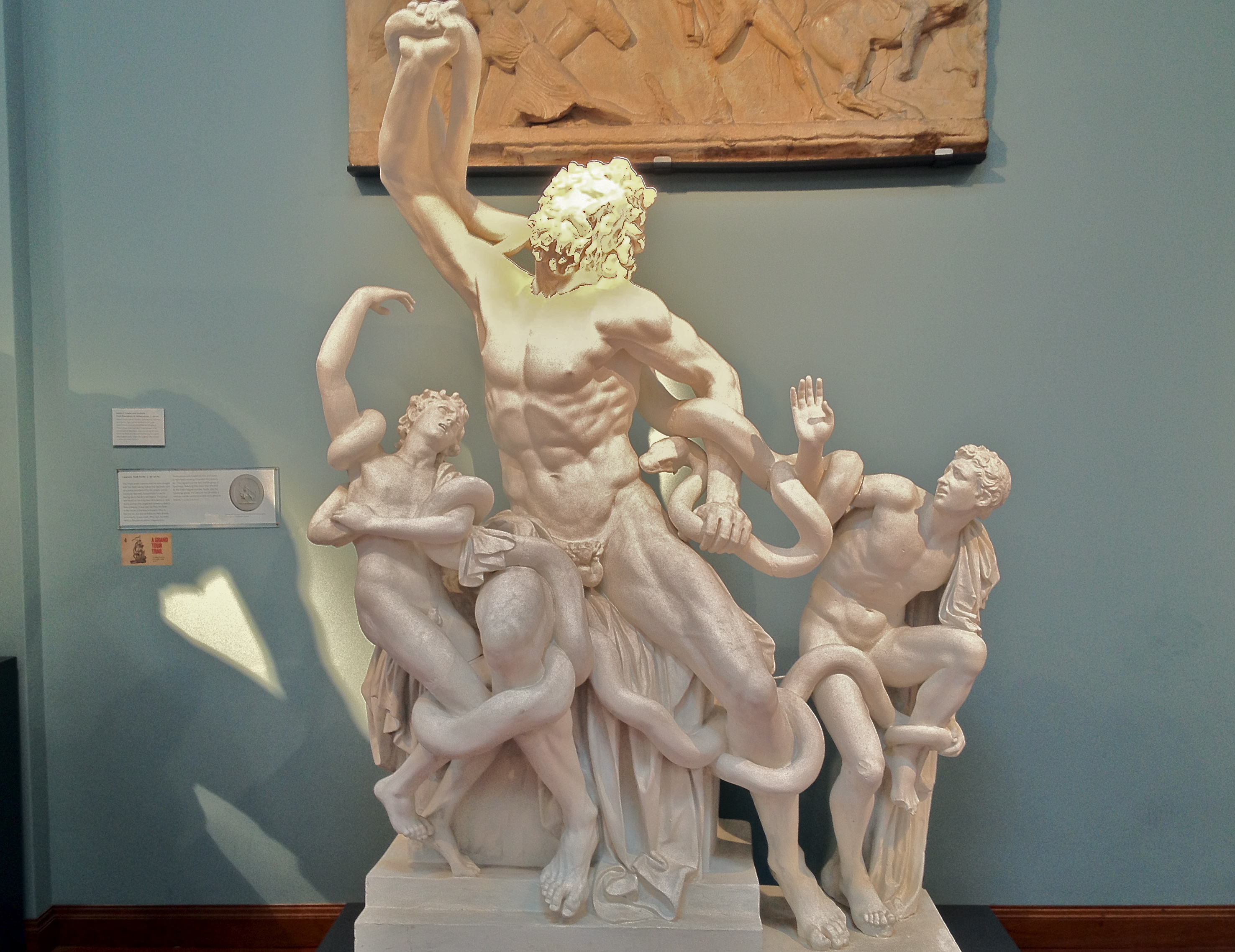
Lines Written in the Ashmolean Museum

Father and young sons
Looking at Laocoön
Museum torture

IMG_1169


Posted in Animals, Classics, Family, Oxford, Poetry | 2 Comments

Everybody Needs the Gospel and Everybody Loves Sausage

1901931_10100675630033907_814205936453584805_nSo, this past weekend, the Classical Association of the Middle West and South conference was sharing space at the Waco Convention Center with the Predator & Wild Hog Expo and the Modern Sporting Arms Expo. It made for an unlikely but interesting combination of conventioneers. After listening to a panel on the nuances of Roman love elegy, I made my way over to the exhibition floor.

This was truly the most amazing collection of weaponry I have ever seen. Guns of every variety were available–really big scary ones–as were nets, camping equipment, elaborate camo get-ups, portable stands, etc., etc.  I counted at least three helicopters on the expo floor, props to promote “Heli-hunting” safaris where you track boar and shoot them from the air.  I took a few discreet pictures with my iPhone, but these do not do justice to the sheer extent of items dedicated to apricide.  I bought a T-shirt from a boar decoy provider, who also gave me a free beer koozie though they declined my challenge of saying “boar decoy beer koozie” ten times fast.

In front of one of the helicopters was a stand set up for something called “Hogs For A Cause.” A sign to pique the curiosity, to say the least.  I stood before it until there appeared a gentle soul in a ten-gallon hat named Don, who read my mind.  “So, you’re trying to figure out what we do?”  Turns out HFAC (whose website is here) is an evangelical ministry connected with a boar-hunting operation.  As their mission statement reads,

Hogs for a Cause has been given stewardship /access to property that is overrun with hogs. We provide guided hunts at no cost to anyone interested in hunting. These hunts reduce the feral hog population and the meat eases the financial burden of local families. Each hunt is accompanied with a short gospel presentation.

“So, is this like Hunters for the Hungry?” I asked. HFTH is a program organized through the Tennessee Wildlife Federation that joins hunters up with local processors for distributing free venison to the needy.  “No,” he replied. “We give our meat out to everyone. Mostly it’s sausage we make.  The other day we gave a bunch to some guys I found out later were millionaires. Look, everybody needs the Gospel–and everybody loves sausage.”

Hard to argue with that.  Well, I suppose I could argue, if I really wanted to. “And the swine, because it divideth the hoof, yet cheweth not the cud, it is unclean unto you: ye shall not eat of their flesh, nor touch their dead carcase” (Deut. 14:8; cf. Lev. 11:7) et cetera. And the whole “bloodsport for Jesus” thing verges on self-parody.  But Christ himself once killed a bunch of pigs, so I guess there’s good precedent for his followers in central Texas.

For he said unto him, Come out of the man, thou unclean spirit. And he asked him, What is thy name? And he answered, saying, My name is Legion: for we are many. And he besought him much that he would not send them away out of the country. Now there was there nigh unto the mountains a great herd of swine feeding. And all the devils besought him, saying, Send us into the swine, that we may enter into them. And forthwith Jesus gave them leave. And the unclean spirits went out, and entered into the swine: and the herd ran violently down a steep place into the sea, (they were about two thousand;) and were choked in the sea. (Mark 5:8-13)

Posted in Animals, Bible, Classics, Poetry, Rome, Sports & Games, Tennessee | 2 Comments

Introduction for Charles Martin

Introduction to the Stacy Allen Haines Memorial Lecture
Convocation Hall, University of the South
Sewanee, Tennessee
April 9, 2014

Perhaps it is true, as Auden says in memory of Yeats, that “poetry makes nothing happen,” but all I know is that today the sun has been shining in Sewanee and Charles Martin is here. Winter has released us from its clammy grip, the swallows return to their old familiar haunts, and the song of the Martin is heard again on the mountain. Many of you will already know of Charles’ frequent appearances at the Sewanee Writers’ Conference, or of his long-standing connection to the Sewanee School of Letters, where he has been teaching poetry now on and off for a decade. So, for these reasons, I always associate Charles with the summertime, with good weather and good humor. Just last year he and I were talking, over gin and tonics as I recall, about his new translation (with Gavin Flood) of The Bhagavad Gita from Norton. It’s not a work you might associate with banter over cocktails, but I had to laugh when he responded to my questions about working on it. “Well, I had help from a slender volume called Teach Yourself Sanskrit,” he said. “It’s the most hopeful title on my bookshelf.”

Charles is a professional translator, you will know, and many of you I hope will come out to see David Landon and company’s staging from Charles’ version of The Medea in the Gailor Auditorium tomorrow at 4:30. I can see quite a few students here who are using Charles’ translation of Ovid’s Metamorphoses that Norton also published—in 2003, a year that also saw versions by David Raeburn and Michael Simpson. In an omnibus review of these various Metamorphoses, the Sewanee Review noted, “Utilizing a flexible blank verse that sometimes resembles Shakespeare and elsewhere veers toward rap, Martin’s is the most successful of these new translations, best suited to “speak now of forms changed / into new bodies,” as we find in the proem. Having parsed through the passions of Catullus, Martin is perhaps in the best position to render Ovid, whose spirit this translation seems to have deeply imbibed.” As you may know, the Metamorphoses is awash in Latin puns, and often Charles substituted a joke of his own in a different place, as for instance, when Jupiter reveals himself to a “[quote] cowed Europa on the isle of Crete [endquote].” Unforgiveable, isn’t it? And precisely what Ovid would have done, had he written in English instead of Latin. It’s an excellent translation, I think, and unless you think the American Academy of Poets gives out the Harold Landon Prize for no good reason, you’re bound to agree with me.

But I must confess that I first came to know Charles rather as a critic than as a translator, when twenty years ago, his marvelous study of Catullus was issued under the Hermes imprint by Yale. Now this book came out not a minute too soon, as far as I was concerned as a graduate student preparing for my oral exams at Chapel Hill. There are few ancient poets as naughty and vital as Catullus, and even that late in my graduate career I was having trouble getting beyond a sort of adolescent appreciation of his work. But here was a bona fide close reading of Catullus, with brilliant analysis after brilliant analysis of this darkly bright Roman poet. What I recall with particular pleasure was that moment in the oral when one of my examiners fixed me a cold stare and asked me to explicate the relationship of Catullus’ longer poems to one another. This was a scary proposition, or would have been, but rather than faltering and failing, I trotted out the entirely convincing theory about their unity “from a new book by Charles Martin,” I proclaimed loudly. And let me tell you, to cite Charles Martin under those conditions was truly to know the feeling of having one’s bacon saved.

Now it’s interesting to me that, in preparing for this introduction, I went to look for my copy of Charles’ study of Catullus, and realized I had lent it sometime ago to a student who now is teaching in Nashville, who herself uses it with her students at MBA. I happened to see her in Texas at conference this weekend, and she told me she wasn’t going to give it back because it was too valuable to her, and so I will have to buy another and get Charles to sign it for me later. But when I was flying to Dallas, I brought Starting From Sleep with me to read on the plane, Charles’ collection of New and Selected Poems from 2002. And even though we were flying over stormy weather, still I felt at peace. So much of the vitality I associate with Catullus is present in Charles’ poetry, though perhaps not the naughtiness—unless you count calling the Eucharist “Wonder Bread” in Getting the Miracle Wrong or the opening of Victoria’s Secret, which reads—

Victorian mothers instructed their daughters, ahem,
That whenever their husbands were getting it off on them,
The only thing for it was just to lie perfectly flat
And try to imagine themselves out buying a new hat.

Now there’s more like this, and I could go on, but I won’t, because the person you came to hear read this delightful poetry is not me but the winner of the Poetry Foundation’s Beth Hokin Prize, as well as a Pushcart Prize, the American Academy of Arts and Letters’ Award for Literature, and the aforementioned Academy of American Poets translation prize; the winner of fellowships from the Ingram Merrill Foundation and the National Endowment for the Arts; a beloved and inspiring teacher at Queensborough Community College, John Hopkins, and here at the University of the South, a great wit and a great friend, and today’s lecturer in the Stacy Allen Haines Memorial Series, Charles Martin.

Charles_Martin


Posted in Birds, Classics, Italy, Poetry, Sewanee, Uncategorized | Leave a comment

Corporal Punishment in Franklin County Schools

The following note was sent to my Franklin County School Board colleagues.

Dear Colleagues,

I want to make sure that, in connection with our annual review of Section Six Policies in April, we pull Policy 6.31o4, on corporal punishment, out for specific discussion on Monday, April 7th. To be clear, I oppose this policy and would like to see it deleted.

As I say, I think we need to have a conversation about this particular policy. I have had a few constituents express concern to me about paddling. While some are aware that they have the right to opt out of the policy individually for their own children, the issue is larger than individual preferences.

My position has nothing to do with the way people privately discipline their children. What people do in their own homes raising their own children is not the county’s business, within reason. Some people approve of spanking, others do not. But once children are in the schools, in a public place, they should be treated as they would be in any other public place. As a county, we do not want people hitting other people–that is just not the sort of place we want to live in.

In my opinion, the schools –as the first public place most children enter– should model safe and respectful public interaction. Policy 6.3104, which allows adults to paddle children who are not their own, is counter to that spirit. While it once made sense for the schools to act in loco parentis, in the place of parents, concerning discipline, it is now time to re-think the policy in terms of children’s personal safety and future behavior as citizens.

I look forward to talking more about this with you on April 7th.

Yours,
Chris McDonough
Representative, 5th District (Sewanee, Sherwood, Keith Springs)

Policy 6.3104 Corporal Punishment

Any principal, assistant principal or teacher may use corporal punishment in a reasonable manner against any student for good cause in order to maintain discipline and order within the public schools1 in accordance with the following guidelines:

1. Corporal punishment shall be administered only after other less stringent measures have failed, or if the conduct of a student is of such nature that corporal punishment is the only reasonable form of punishment under the circumstances;

2. The instrument to be used in administering corporal punishment shall be approved by the principal;

3. Corporal punishment shall be reasonable;

4. Corporal punishment shall be administered in the presence of another professional employee, preferably the principal or assistant principal. Corporal punishment shall be appropriately administered in the office area;

5. The nature of the punishment will be such that it is in proportion to the gravity of the offense, the apparent motive and disposition of the offender, and the influence of the offender’s example and conduct on others; and

6. In determining the use and degree of corporal punishment, consideration will be given to the age, sex, size, physical and emotional condition of the child.

A disciplinary record shall be maintained by the classroom teacher and/or administrator and shall contain the name of the student, the type of misconduct, the type of corporal punishment administered, the name of the person administering the punishment, the name of the witness present and the date and time of punishment.

Disciplinary records shall be filed in the school office and made available to parents or students, whichever is appropriate.

Posted in Education, Sewanee, Tennessee | 1 Comment

Protected: Hand, Hand, Fingers, Thumb

This content is password-protected. To view it, please enter the password below.

Posted in Bible, Classics, Emblems, England, Italy, Military, Poetry, Rome, Statues & Monuments, Time | Enter your password to view comments.

Protected: Skyhook

This content is password-protected. To view it, please enter the password below.

Posted in Astronomical, Boston, Classics, Language & Etymology, Mythology, Sports & Games | Enter your password to view comments.