Precious Moldering Pleasures

A precious—mouldering pleasure—’tis—
To meet an Antique Book—
In just the Dress his Century wore—
A privilege—I think—

His venerable Hand to take—
And warming in our own—
A passage back—or two—to make—
To Times when he—was young—

His quaint opinions—to inspect—
His thought to ascertain
On Themes concern our mutual mind—
The Literature of Man—

What interested Scholars—most—
What Competitions ran—
When Plato—was a Certainty—
And Sophocles—a Man—

When Sappho—was a living Girl—
And Beatrice wore
The Gown that Dante—deified—
Facts Centuries before

He traverses—familiar—
As One should come to Town—
And tell you all your Dreams—were true—
He lived—where Dreams were born—

His presence is Enchantment—
You beg him not to go—
Old Volumes shake their Vellum Heads
And tantalize—just so—

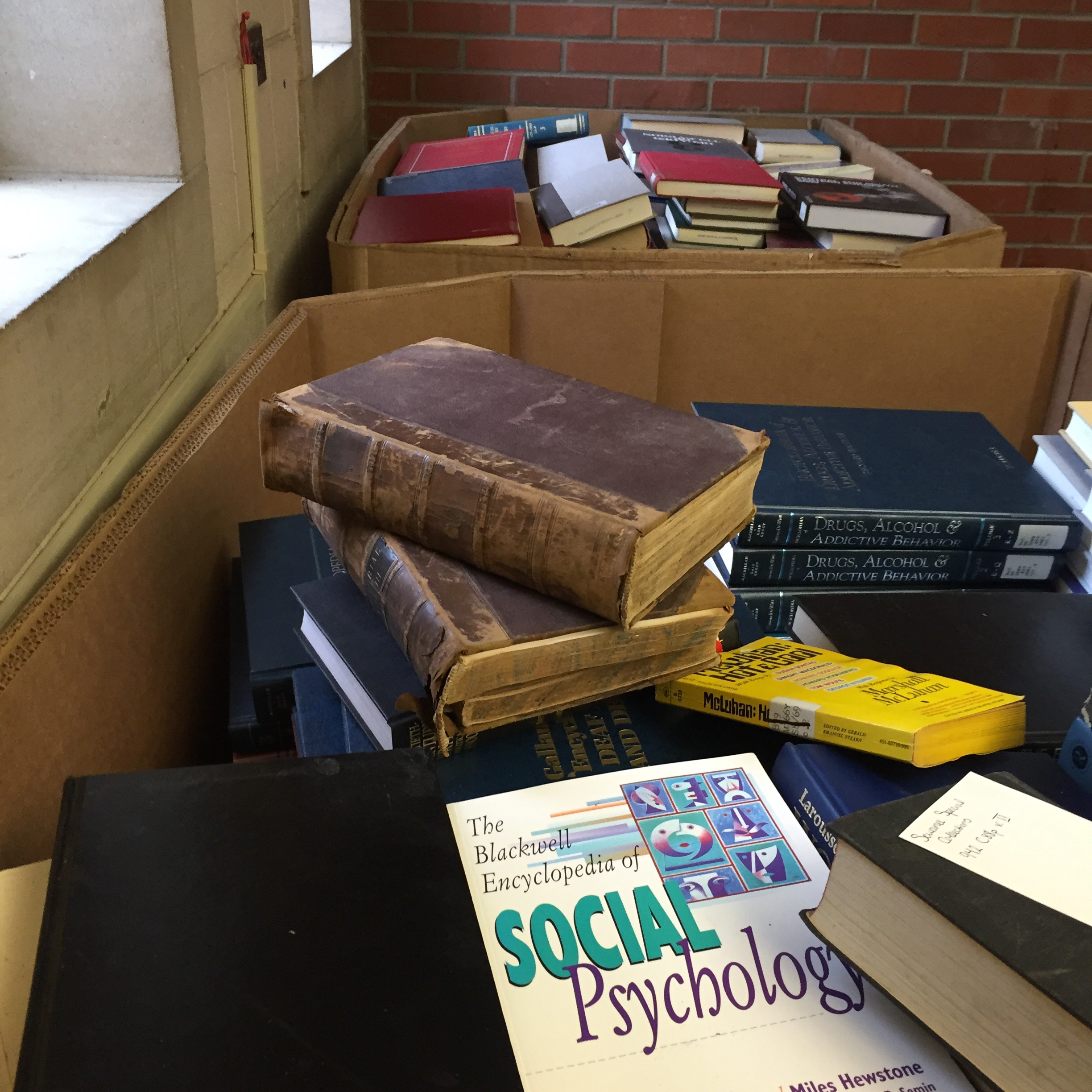
So Emily Dickinson, right as always. I thought of these lines as I snuck into duPont Library by the back door this afternoon. On the left-hand side were two very large boxes full of books to be discarded. The shelves need to cleared, we’ve been told, to make room for newer books. The old ones will what? be sold, given away, pulped? There they sit, awaiting their fate.

Against my better judgement, I begin to flip through them. Many don’t interest me–Principles of Behavior from the 60s, mid-century prayer books (though the inscription “For Sister Carlotta” gives me a twinge), economics manuals. But of course, there’s always something in a random collection of books you want to look through.


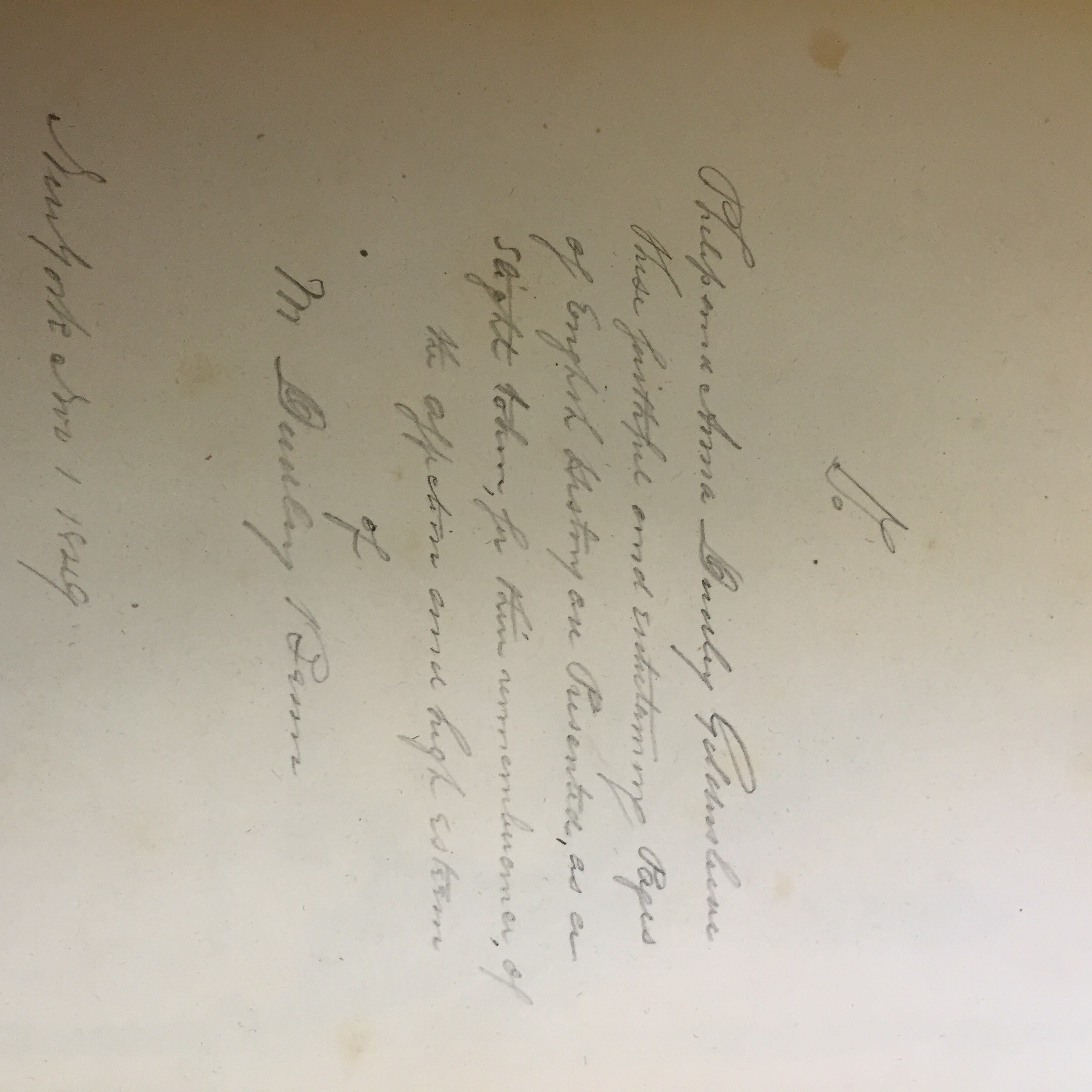
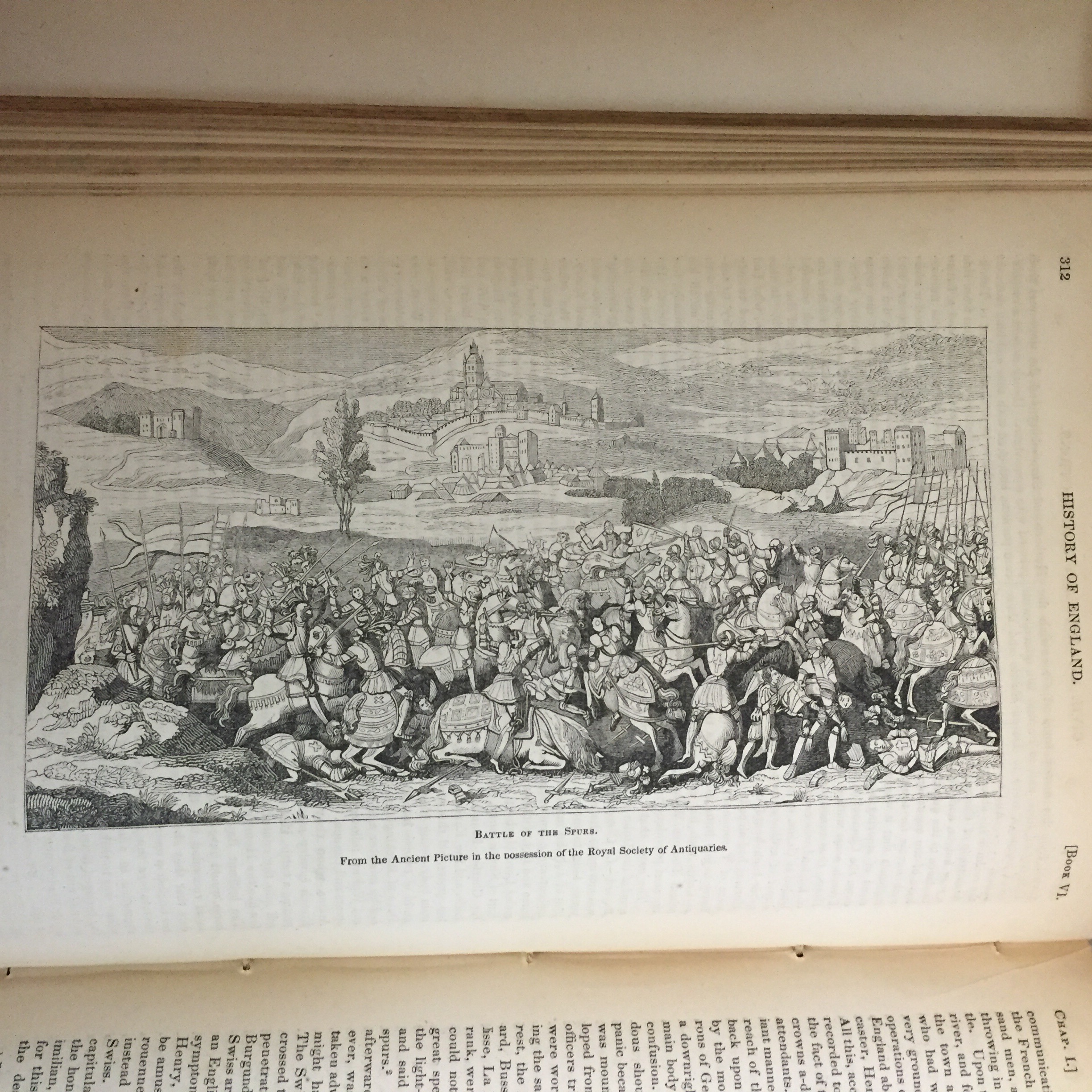
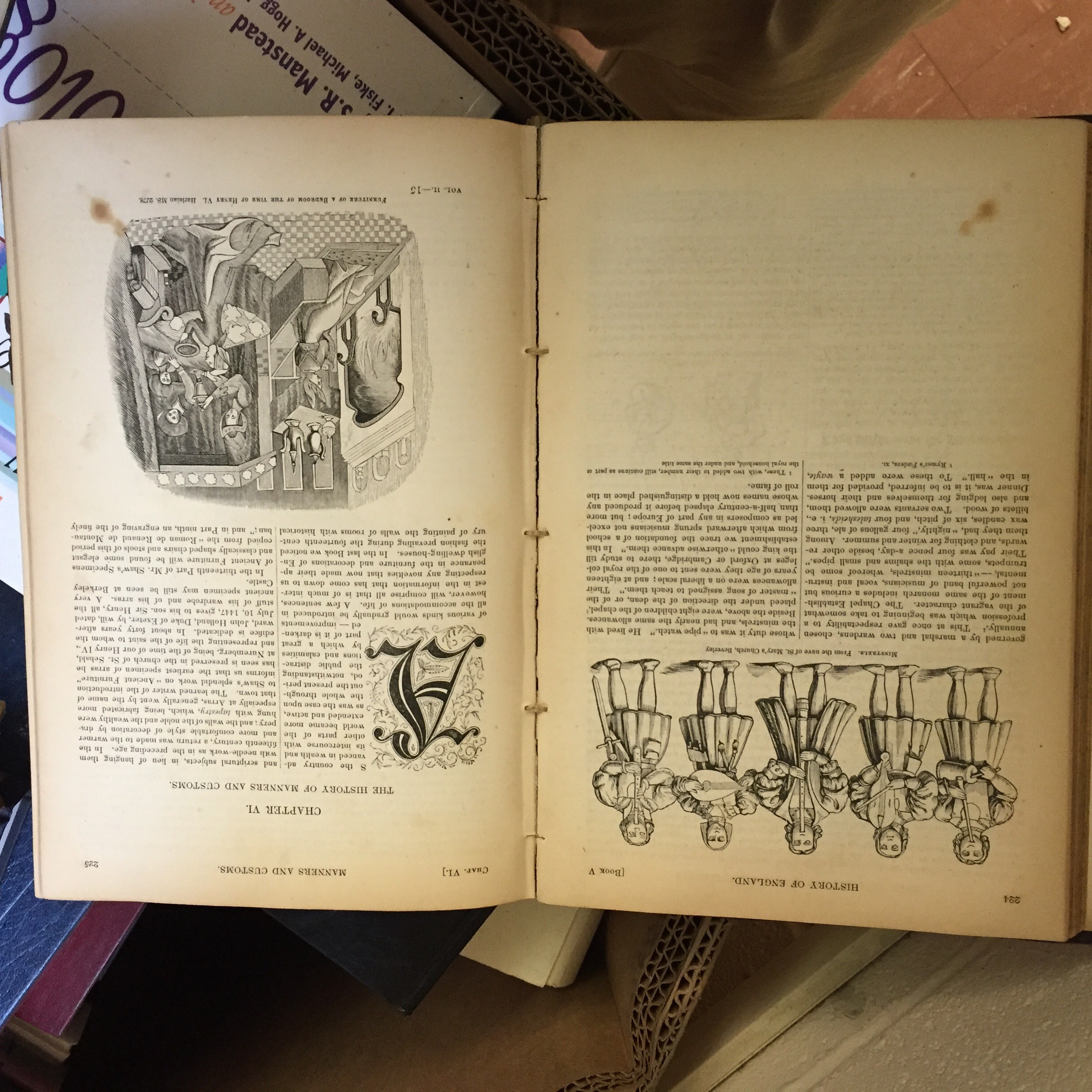
I will admit to leafing through the paperback with responses to Marshall McLuhan for a few minutes, especially Walter Ong’s essay and Susan Sontag’s, too. But it’s The Pictorial Hstory of England that really arrests me. With Several Hundred Woodcuts, reads the subtitle. Who could resist? Both volumes contain heartfelt handwritten inscriptions.

I thumb through the book. Good God, it’s just so charming. And it’s so old, and so out-of-date, and so musty, and so moldering. Should I stick it in my bag? Nobody will notice, or care. But will I ever look at it again? If I bring it home and put it on the shelf, am I not just consigning the question of what to do with this old book to my children some decades hence?

So off I go, leaving the Pictorial History to its destiny, and hate myself for it. All around me are the signs of an age that’s passing– old books being remaindered, older colleagues retiring, institutional memory passing into oblivion. Into the bin with all of you, over to the side by the library backdoor.

Posted in Cartoons, England, Poetry, Sewanee, Time, Uncategorized | Leave a comment

The Abbo’s Alley Labyrinth

Screen Shot 2016-05-18 at 1.25.15 PM

There’s a fine piece in Smithsonian today about labyrinths, which put me in mind of Sewanee’s own version of the mystic maze (about which more below). As Jennifer Billock, the author of the Smithsonian piece, writes about the spiritual engagement with this unique classic structure:

Historically, walking a labyrinth is associated with religious and magical experiences. Their many ins and outs are often associated with mythical figures, and in the past they were walked as devotional activities, mini-pilgrimages or atonements for some sin. Nordic pagans coursed the paths as a way to overcome difficulty, reinforce protection and bring good fortune. These days, walkers choose labyrinths for a meditative experience of repetition and slight concentration contained in a small circular package. The journey is a personal one—everyone gets something different out of the winding walk.

She quotes David Gallagher, director of The Labyrinth Society, who says, “I can’t tell you what a specific individual should expect to experience. Ask anyone who’s interested in labyrinths and you’ll get different answers.” The Society’s elaborate webpage–it’s actually well-organized, so I’ll avoid comparing it to a maze–notes that May 6, 2016 was World Labyrinth Day, which, in all the hubbub about Sewanee’s graduation, I seem to have missed; I’ll try to catch it next year, I guess. I note too that the society maintains a labyrinth locator that does not contain the one in Abbo’s Alley (or the other one I know of in the area, at St. Mary’s*).

I’m quite fond of our local labyrinth, and have often incorporated it into lectures about Theseus and the Minotaur. You can see one of my sons, when he was very young, playing in it above. A few years ago, I wanted to know more about this labyrinth and wrote to the person who knows the most about the Alley, Louis Rice, to find out more. He responded,

Trink Beasley’s son, Battle, a priest in Nashville ,collected the bricks and also laid out the design.Several volunteers put the bricks down and the Alley crew cut the brush and cleared the trees from atop the stone out-cropping. This was all done about 2000/01. You will note the area below is named “Trinks Terrace” in her honor.


I wrote to Father Beasley, who is rector at St. Mark’s in Antioch, TN — there is in fact another labyrinth there , one which can be found in the Labyrinth Society’s locator. Battle’s gracious response to my inquiry:

So glad to hear someone uses and enjoys it. Actually it was my mother Trink Beasley who wanted a labyrinth in the alley and asked me to put it there. I became interested in labyrinths around 1995. The one here at st. mark’s I didn’t put in but can claim to be the inspiration for the previous rector who I introduced to labyrinths.i too find them wonderful places for reflection and prayer. Thanks so much for sharing with me. Peace battle

According to the St. Mark’s website, Battle leads a labyrinth walk on the second Saturday of every month.  I’ve copied his thoughtful reflections, which might be of use to you as you walk the mystic path in Abbo’s Alley.

There are three stages of the walk:

Purgation (Releasing) ~ A releasing, a letting go of the details of your life. This is the act of shedding thoughts and distractions. A time to open the heart and quiet the mind.

Illumination (Receiving) ~ When you reach the center, stay there as long as you like. It is a place of meditation and prayer. Receive what is there for you to receive.

Union (Returning) ~ As you leave, following the same path out of the center as you came in, you enter the third stage, which is joining God, your Higher Power, or the healing forces at work in the world. Each time you walk the labyrinth you become more empowered to find and do the work you feel your soul reaching for.

Guidelines for the walk: Quiet your mind and become aware of your breath. Allow yourself to find the pace your body wants to go. The path is two ways. Those going in will meet those coming out. You may “pass” people or let others step around you. Do what feels natural.

*Postscript. My understanding is that Battle Beasley made the St. Mary’s labyrinth, too! Also, my friend and former student (and former babysitter!), Emily Senefeld, tells me that there’s also a labyrinth in the Crump Pavilion at the Dubose Conference Center!

Posted in Classics, Family, Mythology, Sewanee, Uncategorized | 4 Comments

Crazy Salad: new and old views

Helen being chosen found life flat and dull
And later had much trouble from a fool,
While that great Queen, that rose out of the spray,
Being fatherless could have her way
Yet chose a bandy-leggèd smith for man.
It’s certain that fine women eat
A crazy salad with their meat
Whereby the Horn of Plenty is undone.

The fourth stanza os Yeats’ “A Prayer for My Daughter” (1919) is one I share with my students when teaching myths of Aphrodite. The great Queen has numerous affairs (Anchises, Hermes, Adonis, and most notably, Ares), but she is married to Hephaestus, whose limp and personal ugliness make him a caricacture of a god. Yeats is not the only poet to address the topic (I’m fond of e.e. cummings’ “in heavenly relams of hellas dwelt,” with its final couplet, “my tragic tale concludes herewith: / soldier, beware of mrs smith”), and artists have long enjoyed the contrast of the unattractive old man together with his glamorous young wife: capping this tradition must be the scene from the Pythonesque movie The Adventures of Baron Munchhausen (1988), in which a crusty Vulcan played by Oliver Reed greets Uma Thurman, arriving as Venus on the half-shell:

At any rate, I’m thinking of this after reading an article in yesterday’s Washington Post about “assortative mating.” The piece is based on a study called “Leveling the PLaying Field” done last year about why couples generally are at the same level of physical attractiveness (although who adjudicates these aesthetic matters is unclear), those that are not –where one mate is decidedly “better-looking” than the other–could be explained by the way in which the couple has gotten together. According to the study abstract:

As predicted, couples revealed stronger evidence of assortative mating to the extent that they knew each other for a short time and were not friends before initiating a romantic relationship.

The research seems to show that shorter courtships are based on exterior matters, while longer ones see past the surface. I’m not sure Yeats sees it this way, and while I still would love to know what the hell he means by “crazy salad” (the title of Nora Ephron’s collection of essays about gender relations in the mid-70s), I don’t think the Olympian gods did either. The Greeks, of course, invented the concept of irony. And it is worth noting that couples that are made up of two very attractive people sometimes are lackig in other areas. To my mind, the ultimate American example is Marilyn Monroe and Joe DiMaggio, who were divorced after a few months.  Sure, sure, “None but the brave deserve the fair!” (as Dryden says), but our twentieth-century Venus seems to have been happier with Arthur Miller, the wordsmith.


Posted in Classics, Drama, England, Ireland, Mythology, Poetry, Sports & Games, Uncategorized | Leave a comment

252 Years of Sewanee

13062086_820416641758_9064344328675451021_n.jpg

April 28, 2016. Resolutions of appreciation for the retirements of Profs. Croom, Delcamp, Rupert, Landon, Perry, and Smith. “That,” says the Dean, gesturing, “is 252 years of Sewanee.” A stunned silence followed by sustained applause, and then handshakes and hugs. “Wow,” Robbe Delcamp tells me. “It went by so fast.”

Posted in Sewanee, Time, Uncategorized | Leave a comment

Protected: What hidden scorn you must have for yourself

This content is password-protected. To view it, please enter the password below.

Posted in Bible, Classics, Drama, Military, Nautical, Rome, Sewanee, Slavery, Uncategorized | Enter your password to view comments.

Protected: Circumspice: Reflections in the Wren Chapel

This content is password-protected. To view it, please enter the password below.

Posted in Bible, Boston, Classics, Education, Emblems, England, Tennessee, The South | Enter your password to view comments.

Protected: Julius Caesar, the Hulk, and other Illeists

This content is password-protected. To view it, please enter the password below.

Posted in Cartoons, Classics, Drama, Language & Etymology, Poetry, Uncategorized | Enter your password to view comments.

Catching Up With Brother Benedict

Postscript, October 30, 2016. “The Basilica of St. Benedict is destroyed, flattened by most recent earthquake.” From the Twitter account of the monks of Norcia. A tragic day.

Postscript, August 24, 2016. The 6.2 earthquake in central Italy last night has devastated the town of Amatrice (home of the famous amatriciana sauce) has rattled but not ravaged Norcia, according to a post from a blogger who is there.

The Benedictine monks of Norcia have been much in the news of late, at least for monks. Their album of chant has been highly praised, as has their beer.  Way back in 2003, I visited them at the ancestral seat of St. Benedict’s home, because a former Sewanee student, Jeremy Nivikoff, had joined the order and taken the name Benedict. A PDF of the story I wrote about the experience for Sewanee Magazine is attached– I may transcribe it at some point. Now transcribed below.

Catching Up With Brother Benedict

Two Sewanee Professors get a taste of the contemplative life with a Sewanee Alumnus

Story and Photos by Christopher McDonough

The Summer of 2003, you may recall, was one of the hottest summers on record for Europe. Thousands suffered in Paris from heat-related causes, and the Eternal city was virtual inferno. Professor Leslie Richardson and I were there in July, doing preliminary research for a Sewanee summer program entitled “Sacred Spaces in and around Rome,” slated to be offered in May 2005. At the end of our first week in Rome, we were eager to get out of the heat.

But instead of joining the tourist hordes under the Tuscan Sun, we headed to the east, hoping to find serenity in the shade in l’ombra dell’Umbria, the shade of Umbria. Our destination in particular was not Perugia, with its art treasures, nor Spoleto, with its famous music festival, but rather the small and relatively obscure medieval hill-town of Norcia, to meet up with a young American monk living in the Benedictine monastery there.

I had heard about Brother Benedict from Leslie other Sewanee faculty who had known him, before he had taken his monastic vows, as Jeremy Nivakoff, C’01. As an undergraduate Jeremy seemed to have been a ball of energy: a medieval studies major, member of the Phi Gamma Delta fraternity, and president of Sewanee’s Right-to-Life movement, student worker in the development office, and devoted denizen of the Blue Chair café. Leslie recalled how Jeremy would take over her elementary Italian class by habitually bringing a coffee-maker and serving his classmates before the lesson could begin. I heard similar stories of his ebullient personality from various other Sewanee quarters. So, as we traveled into the rural hillside, you could say my curiosity was piqued.

In the medieval component of Sewanee’s Humanities Program, I have several times taught the Rule of St. Benedict, which stresses the need for silence, humility, and discipline, and which students often describe as “extreme” and “hardcore” in its insistence on withdrawal from the world. So, besides being eager to meet an honest-to-God Benedictine monk, I wanted to see how one our students, who until recently had lived by a typically overbooked undergraduate schedule, was in the life of quiet contemplation.

Driving dominus nobiscum-style

When we arrived at Norcia, we were confronted by a real medieval city, ringed by a wall meant to withstand siege engines and accessible only through protected gates. Winding our way through its narrow streets, we finally reached the abbey where we would be staying, only to find Brother Benedict helping unload the groceries of the nuns who lived there. The monks themselves live in the monastery on the other side of town, but often help out the sisters here, who are generally much older.

AS you can imagine, there’s something pleasingly ironic in the picture of the brother in his medieval black robe carrying bags from a supermarket. The scene was one of great good cheer, and it was clear that the elderly sisters dote on the young monk, teasing him as only Italian ladies can about how skinny he is.

One heard similar things from other older women in town: Mrs. Ivanovi, the superintendent of the local archaeological museum, told me how she once saw Benedict trip over his robes in the piazza.

“You’ve fallen,” she said, “from Heaven!”

“If only,” he replied, and ever after she has called him Brother If Only.

During the customary rounds of introduction, we were a little surprised to meet a fellow weekend guest, Brother Ephraim from Switzerland, who was studying advanced Italian with Benedict in Perugia in preparation for seminary studies in Rome.

After the bags were put away, Benedict whisked me, Leslie, and Ephraim off into the monastery’s car for a drive throough the surrounding mountains to give the lay of the land. “Don’t go to the mountain peak,” the nuns warned him. “It’s so windy, you’ll blow away.”

Up, up, up the winding road we sped. Monk though he be, Brother Benedict drove like a demon. “Driving of this sort,” intoned Brother Ephraim, “is what we sometimes call dominus nobiscum.” That translates as ‘The Lord is with is’ – in other words, God is my co-pilot. I prayed it was true.

From the mountaintop, the Umbrian countryside unfolded before us, a vast panorama of hilltops and hamlets amid motley shades of green, not unlike one of Sewanee’s bluff views. The nuns were right – it was windy up there, downright chilly in fact, and we temporarily forgot that this was Europe’s worst heat wave in decades. A further drive took us to a view of the Grande Piano, the limitless azure fields where Europe’s finest lentils are grown, big bags of which Leslie and I purchased at a special discount rate for friends of the monks. But almost immediately we had to rush back to Norcia, so that Benedict and Ephraim could participate in the Compline service, to which we had been graciously invited by the abbot.

The brothers hurried into the church to prepare, and Leslie and I used the time to stroll around the piazza. Norcia’s primary exports are black truffles and mountain boar, we learned, and nearly every storefront sported at least one boar’s head, and some several. Well, I know what I’ll be having for dinner, I thought to myself as, coming into the church at sunset, we were quickly ushered into the crypt.

Listening to the exquisite Latin service, sung entirely in Gregorian chant, I felt a deep sense of calm entirely at odds with the rest of our bustling day. Seated just yards from the archaeological ruins of St. Benedict’s birthplace, hearing the church’s ancient tongue, one got an over-whelming feeling of eternity. I could only imagine how transcendently peaceful even our busy friend’s life must be, structured as it was around the Divine Service.

Famished from the day’s activites, that evening Leslie and I feasted on pasta with boar meat at a fine restaurant run by Mrs. Bianconi, and were eventually joined by Clay Gilkerson, C’02, whom Benedict had cajoled into working for a year as the abbey’s porter and gift-shop manager. A little later Benedict showed up, but as is monastic custom, he ate nothing.

He had to leave soon, in any case, to pick up yet another Sewanee student, Andrew Doak, C’05, who was to spend July assisting Clay. Andew was due to arrive on late train to Spoleto, 50 kilometers away. “I can make it in 15 minutes,” Benedict assured us. Sure enough, they were in half an hour, just as we were ordering dessert.

It was close to midnight when we all left. Benedict was off to bed (he had to be up at 4 a.m. for Matins), but the rest of us joined the town in the traditional Saturday night promenade.

There’s just no saying “no”

Sunday, the day of rest, proved to be just as frenetically busy. Leslie and I met Clay, Andrew, and Benedict in the piazza for coffee early in the morning. Early for us, I should say; Benedict had been up for hours.

As the town square came to life, Leslie likened the scene to the opening of an opera; The shopkeepers opened their doors, sweeping the threshold and dusting off boars’ heads, while children kicked a ball past a pair of befuddled tourists. By the stairs of the church stood Brother Ephraim, arms crossed, a forbidding figure in his long black robe, as much a part of the scene as he was a spectator. All that was missing was Maestro cueing the music.

Benedict then took us on another speedy drive in to the country, so that he could show us a ramshackle villa he can convince Sewanee to renovate as a conference center and retreat house for the monks. He wants to call it Villa degli Angeli, alluding to the Sewanee angels. We hurried back, this time for Mass – in Italian class, alas, since the bishop has put his foot down on too much Latin – and then, after a trip to the museum and another splendid meal, we our way to wake the nun from her siesta so we could pay for our room.

It was late now late afternoon, and we all had to be on our way. Leslie and I had dinner plans in Orvieto, and the monks had to be back for language study in Perugia on Monday morning. Somehow – I’m still not sure how this transpired – we were convinced to take Benedict to Perugia, although it was quite out of our way while behind us would follow Brother Ephraim with carload of Swiss monks who had arrived sometime last night. (Sometimes it seemed like all the world was coming to Norcia!)

As we drove, Leslie asked Brother Benedict what he missed about America. Among other things, he said that sometimes longed to hear country music. With some wheedling, we got him to sing us his favorite song, in which, as you might guess, Jesus featured prominently. It wa yet another pleasing irony to hear a monk, who chants the Divine Office seven times a day, emit a bit of Country and Western twang.

About an hour into the drive, however, it began to dawn on Benedict what an inconvenience he’d put us to. “Let’s pull over at that coffee bar, “ he said. “ I’ll hop in with Ephraim and you can be on your way.” We parked just in time to see the Swiss monkmobile fly by, evidently not noticing us by the side of the road.

Into the bar we went to mull over our options and down a quick cappuccino. Like so many such establishments in rural locations, this bar was the center of the region’s social life, and young and old were gathered here, noisily idling away their Sunday afternoon. Let me tell you, though, that when one enters such an establishment with a monk in a black robe, there is a palpable change in the atmosphere. Ties got straightened, nursed drinks got drunk and hidden away, the teenagers around the pool table giggled a little nervously. One fellow recognized Brother Benedict from some obscure connection and, eager to look good before the crowd and maybe even God, made a display of paying for our coffee.

After a phone call or two, we decided it would be best to take Benedict to the train station in Spoleto – the one he had whizzed off to just the night before – where we said our goodbyes in the idling car. After grabbing his bag from the back seat, Benedict gave us his blessing and dashed off to catch the train.

It wasn’t until hours later, when we got to Orvieto, that Leslie and I noticed that his ticket had been left on the car floor. Neither of us had any fear, of course, that he had been stranded. In fact, we were sure he rode first class to Perugia without any ticket. Forty-eight hours in his company was enough to know that there’s just no saying “no” to Brother If Only.

Christopher McDonough is an assistant professor and interim director of classical languages.

Posted in Bible, Italy, Sewanee, Uncategorized | Leave a comment

Ave atque Vale, Michael

I often went over to watch election returns with Michael Hurst. He was a Republican, and I a Democrat; he a devoted Southerner, and I a “Massachusetts-American,” as he said. We disagreed on almost everything about national politics and agreed on almost everything local. These election nights were special to me, because it was a great opportunity to argue with Michael. Believe me, there’s nothing two Irish Catholics can possibly enjoy more than arguing about politics. A favorite trophy of mine was a bottle of Maker’s Mark I won off him in a sucker bet over Christine O’Donnell. After the results would come in and the fun and games were over, we’d sit up late and talk about the things that really mattered–our families, our lives, the state of our souls. “We’re really quite alike,” he told me on one of those evenings. It was among the best compliments I have ever gotten. You are gone now, Michael, and I will miss you, and every election night I will think of you. Ave atque vale, frater. With any luck, when the final results come in, I will see you again on the other side.

Screen Shot 2016-02-15 at 2.29.20 PM

They told me, Heraclitus, they told me you were dead;
They brought me bitter news to hear and bitter tears to shed;
I wept, as I remembered, how often you and I
Had tired the sun with talking, and sent him down the sky.

And now that thou art lying, my dear Kentucky guest,
A handful of grey ashes, long, long ago at rest,
Still are thy pleasant voices, thy nightingales, awake;
For Death, he taketh all away, but them he cannot take.

Posted in Birds, Boston, Cemeteries & Funerals, Classics, Ireland, Poetry, Sewanee, The South, Time | Leave a comment

Belly Laugh, Belated

It’s good to know that something I once wrote about Ovid to be amusing can provoke a chuckle two decades later:

Posted in Uncategorized | Leave a comment