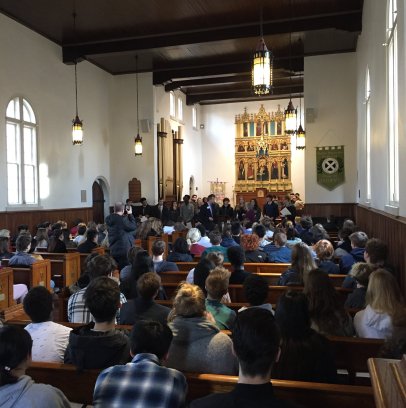
Below are remarks I gave for a forum organized by Prof. Woody Register and the Sewanee Project on Slavery, Race, and Reconciliation on about Art, Commemoration, and Sewanee’s Campus, held at Otey Parish on February 19, 2017. Also on the panel was Prof. Shelley Maclaren, whose discussion of the University History windows in the All Saints’ Chapel narthex was brilliant and thought-provoking. I would guess that there were maybe 100 folks in attendance. Write-ups in the Sewanee Purple and the Mountain Messenger appeared later in the week.
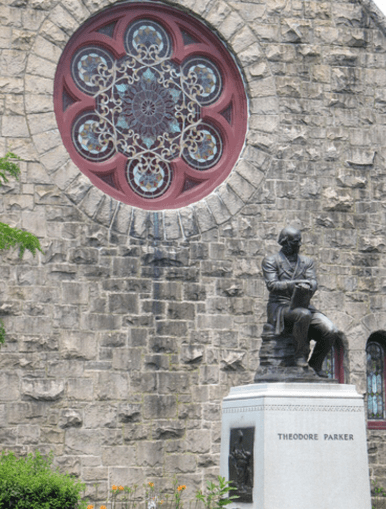 In preparing for today’s panel on “Art, Commemoration, and Sewanee’s Campus,” I thought it might make sense for me to reflect on my own experience of monuments, the earliest of which comes from the time when I was growing up in West Roxbury, a neighborhood in Boston. Outside the Unitarian Church on Centre Street was a statue completely covered in verdigris of a seated man on a high pedestal. I know now he was Theodore Parker, the renowned preacher and fiery abolitionist who aided John Brown at Harper’s Ferry, went into exile shortly thereafter and died in Florence where no less than Frederick Douglass would commission and pay for his tombstone. But to all of us neighborhood kids in the 1960s and 70s, he was a mystery: this was a church none of us had ever been in–everybody I knew was Irish, Italian, Jewish, or Greek–and besides weren’t churches only supposed to have statues of Jesus or Mary? I can remember that a friend of mine once told me confidently that the statue was really George Washington and that he himself was buried in the pedestal, even though THEODORE PARKER was very legibly spelled out in the green copper letters underneath. This friend was not an especially reliable source in other respects, I will admit, but it’s a good indication of how little good spelling out the meaning of a monument can do for many observers. But in any event: famous abolitionist, theological reformer, preacher and phrase-maker? Parker was all of these things, but to us street urchins at the time his statue was just a marker by the bus stop near the Dip-N-Sip, which was the best place in town to buy donuts. In the 90s, the Parker statue was rehabilitated, the verdigris stripped off, the copper treated so it looked like new, and a plaque erected to explain who Parker was and why he mattered. I suspect, though, that most of the kids in West Roxbury didn’t really care and still don’t.
I mention all of this as a way of pointing out that there is a natural life cycle to a monument. Few of them experience the long enthusiasm of, say, the Statue of Liberty or the Lincoln Memorial, which are almost always thronged with school-groups and selfie-taking tourists. Some end their days ignobly, like the colossal statue of Tiberius’ henchman Sejanus that a Roman satirist says was toppled by ropes and melted down into jugs, frying pans, and chamber pots (Juvenal, Satire 10.56-70), a fate Lenin and Stalin have also enjoyed, as well as the Confederate Statue in front of the courthouse in Durham, North Carolina. For most monuments, the highpoint of their life cycles is at the very beginning, that moment when the ribbons are cut, the dignitaries gathered, speeches made, family members tearing up in pride, children and pets running around, and the spirit of celebration at its peak–a scene such as is depicted at the laying of the Sewanee cornerstone. After the unveiling, it is a long slow slide into oblivion. Some monument-makers are aware of this fact, and try to forestall it by kneading the ephemeral hoopla of the moment into the thing itself. The Arch of Titus, for instance, depicts in its interior the triumphal parade of which it is itself the commemoration. Augustus’ Altar of Peace likewise depicts the imperial entourage marching to the altar’s own inauguration. (We see something like this in the final narthex window in All Saints, the procession of Vice-Chancellor McCrady and other notables in front of the chapel, still under construction.) The move here is to avoid the future disregard by remaining eternally in an unfolding celebratory present.
It is the fate of most monuments, however, once unveiled, to sit like immoveable stones while the current of history flows around and past them. Occasionally, a well-meaning history buff will take pains to try to re-inject some significance into the thing, or a dedicated group decides to scrapes off the verdigris and erect a new, inevitably to-be-ignored plaque. But mostly the monument is forgotten or subject to critical reinterpretation, as the ideological basis on which it was made comes under scrutiny. The statue of Christopher Columbus in New York’s Columbus Circle, for instance, erected by proud Italian-Americans in the 1890s, once symbolized the successful integration of immigrants into American society; the statue is now the locus of protests against imperialism and genocide, which it also encodes.
In its time, own Kirby-Smith Memorial has certainly traced this same trajectory. As Tanner Potts told us all a few months ago, it was set up in the late 30s by the United Daughters of the Confederacy to honor a university founder, an impulse in itself inoffensive. As a Jim Crow monument, though, it also helped to designate public space as white space, and is intimately connected with the university’s segregationist history. In 2016, as some of you will know, I exchanged correspondence in the Sewanee Purple with the head of the local UDC chapter about the memorial. As I said,
I think the University ought to hire an artist to make an installation that would sit in front of it [the monument], and draw attention to it [to answer] the question of what does it memorialize and what does it remember,” he said. “And that doesn’t have to be a rejection—it can be a sort of open question about, ‘What is it that we remember about the Civil War? What does it mean to us?’
It had been my idea, when suggested that an installation be put in front of the Kirby-Smith memorial, that we might reinvigorate the space as a sort of reflection garden, a place to go where the artworks could serve as a jumping off point to ponder what we are doing with our own lives and how it will look sub specie aeternitatis, in view of eternity. I still think that would have been the best way to proceed–to leave the UDC memorial in place but to give artistic voice to another point of view about the ideology it enshrined–but in the wake of the deadly Charlottesville protests of the next year, the Vice-Chancellor removed the medallion and name from University Avenue and relocated them to the cemetery. I wish the chance to debate that decision as a community had not been precluded, but that is the VC’s prerogative and so there’s no point to revisiting the matter.
 So where does this leave us now? In a famous essay he wrote for the Nation in 1985, the philosopher of art Arthur Danto outlined the critical distinction that “we erect monuments so that we shall always remember, and build memorials so that we shall never forget.” Defenders of Confederate monument sometimes elide this distinction–claiming to want to never forget the horrors of the Civil War when in fact they often want to always remember the Confederacy as a noble endeavor. The Romans had a similar practice, the damnatio memoriae, which seems to split the difference by commanding us to Always Forget an individual fallen from grace. I invoked this idea in a blogpost last fall about the now empty plinth of the Kirby-Smith last fall. Some people really liked this idea, and some were very upset and pained by it. I think, insofar as the project whose auspices we are gathered under is named the “Project on Slavery, Race, and Reconciliation,” my idea about damnatio memoriae is not an especially useful one.
But larger than that, far larger, I think is the issue of the “Always/Never” dynamic that Danto points out in his essay. An inherent problem of all monuments and memorials, it seems, is their totalizing nature, their insistence on being taken to have a single, indivisible meaning which we must either accept or reject entirely (Something like this seems to be at work with honorary degrees, I have to say, though I won’t say anything more about that … right now). As an educational institution, we don’t accept the idea of a single monolithic meaning in other works of art of literature, nor do we believe that history or politics are ever simple matters. It may be that, in this age of polarized politics and weaponized nostalgia, we all could use a lot less all-or-nothing certitude and a little more hesitancy in the middle ground.
And so, in this respect, I am very attracted to the Cité Mémoire project in Montreal that Shelley Maclaren has introduced me to, in which images from the past are projected into various locales that do not confirm or negate strongly-established principles but instead unsettle us a little about what we think we already know. I like the temporary nature of the images, their connection to the visual culture we occupy now–screens–and not one that is associated with boring old History–statues. The idea of an exhibit that can be curated, questioned, re-curated, and re-questioned. If I had to select a few images for such an outdoor exhibit on Slavery, Race and Reconciliation at Sewanee, here are some of them:
 The autographed picture of Louis Armstrong dedicated to English professor Charles Harrison, now in the Ralston Listening Room. When Armstrong played at Sewanee in the early 60s, it was Harrison’s home he stayed at because, as a black man, he was excluded from the old Sewanee Inn. As Richard Tillinghast notes in Sewanee Poems, “Coming down the morning of the gig he is greeted / With the question: “How would you like your eggs, Mr. Armstrong?” /Armstrong comes back at him /In that melodious throaty bass of his: / “However you’re having yours, Daddyo.” There’s much to reflect upon in this story–the private accommodations that had to be made in the face of Jim Crow, the place of music in the process of reconciliation , and the nature of hospitality that culminates in the wonderful anecdote Armstrong gave Harrison as a gift.
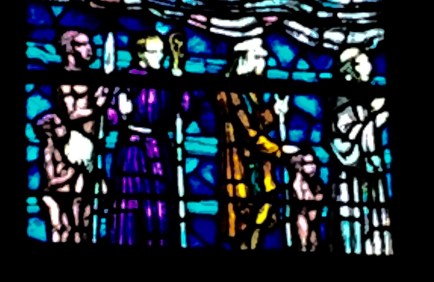 This image of a procession of “natives” which makes up part of the base of one of the windows behind the high altar in All Saints. This I would throw up outside of the chapel, on the McClurg side where it would be seen by many, as a way of forcing us to confront at eye-level what this kind of iconography means. Why is this offensive, racialized image in the church windows? What does it say about those who made it and installed it, that the Jesus they approach is himself white, indeed Anglo?
One last image below would be Allan Crite’s amazing engravings of the Stations of the Cross, with Christ suffering at the School of Theology Dean’s house (now the Spanish House) behind the old Seminary, crucified and then risen in front of St. Luke’s Chapel. The originals of these are small, and sit in a frame over in Hamilton Hall–enlarged, and projected onto St. Luke’s, they could be quite powerful. Crite, an African-American artist and devout Episcopalian, visited Sewanee in the early 1950s, and made this engravings on-site. The images, very much of but also far ahead of their time, were intended to encourage people in the seminary here to see the sufferings of black people in light of their avowed Christian faith. “As a visual artist,” Mr. Crite said in a 1998 interview with the Harvard Extension School Alumni Bulletin, “I am . . . a storyteller of the drama of man. This is my small contribution – to tell the African-American experience – in a local sense, of the neighborhood, and, in a larger sense, of its part in the total human experience.”

There are other images I can think of, but I have no doubt the people in this room have fuller and more interesting ideas of their own. I welcome your response to this proposal, and would be more than happy to gather a database of possible images to project and suggested places to show them. Many thanks, and good evening.
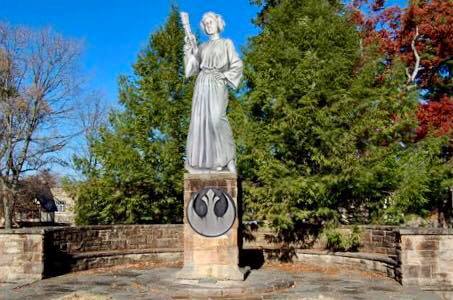
Postscript. During the Q&A the followed the panel, someone asked me what I would put in place of the Kirby-Smith monument if it were up to me. I said that it, in keeping with the spirit of the gift from the UDC, we should make. a point of honoring another rebel general and suggested we put up a statue of Princess Leia. My friend Yuliya sent me this image the next day.



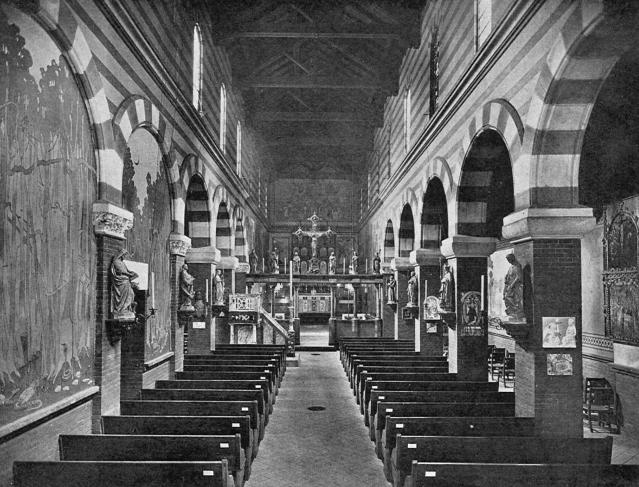

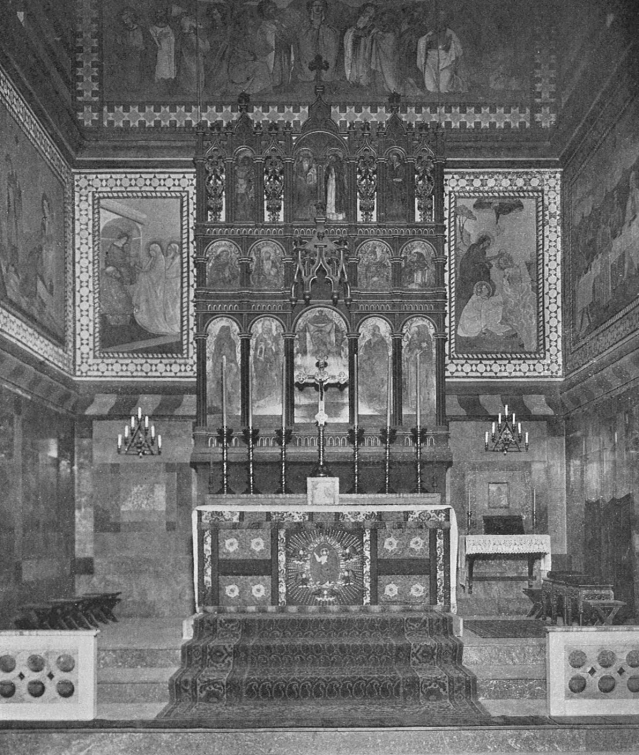
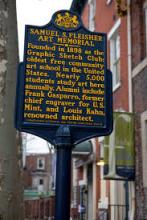 At any rate, Percival became ill in the 1890s, and the Oxford Movement/ Victorian medievalism he espoused fell out of favor in the decades following. The chapel at St. Andrews in Sewanee opened in 1914, as Fr. Wade notes, probably with the reredos now removed from its failing home in Philadelphia. The Church of the Evangelists has had a colorful afterlife: converted into an art gallery in 1922 associated with the Graphic Sketch Club, it became part of the Samuel S. Fleisher Art Memorial. “The mission of the Fleisher Art Memorial,” as stated on their website, “is to make art accessible to everyone, regardless of economic means, background, or artistic experience.” The space is used for exhibits and occasionally weddings (as can be seen in the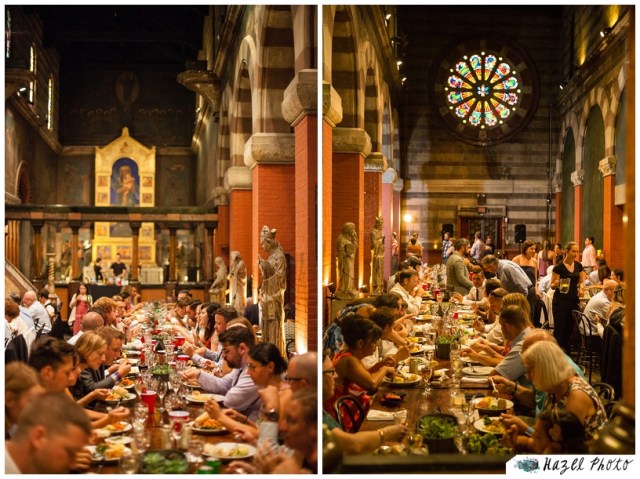
 “It is very happily and kindly provided,” writes Dr. Johnson, “that in every life there are certain pauses and interruptions, which force consideration upon the careless, and seriousness upon the light; points of time where one course of action ends and another begins; and by vicissitude of fortune, or alteration of employment, by change of place, or loss of friendship, we are forced to say of something, this is the last.”


 uncomelyandbroken