
-
Recent Posts
Recent Comments
Archives
- March 2026
- November 2025
- December 2024
- April 2024
- October 2021
- February 2021
- September 2020
- July 2020
- June 2020
- May 2020
- April 2020
- March 2020
- January 2020
- August 2019
- July 2019
- June 2019
- May 2019
- April 2019
- March 2019
- February 2019
- January 2019
- December 2018
- November 2018
- October 2018
- July 2018
- June 2018
- May 2018
- April 2018
- March 2018
- February 2018
- November 2017
- October 2017
- September 2017
- August 2017
- April 2017
- February 2017
- October 2016
- September 2016
- May 2016
- April 2016
- March 2016
- February 2016
- January 2016
- November 2015
- October 2015
- September 2015
- August 2015
- July 2015
- June 2015
- April 2015
- March 2015
- February 2015
- January 2015
- December 2014
- November 2014
- October 2014
- September 2014
- August 2014
- July 2014
- June 2014
- May 2014
- April 2014
- March 2014
- February 2014
- January 2014
- December 2013
- November 2013
- October 2013
- September 2013
- August 2013
- July 2013
- June 2013
- April 2013
- March 2013
- February 2013
- January 2013
- December 2012
- November 2012
- October 2012
- September 2012
- August 2012
- July 2012
- June 2012
- May 2012
- April 2012
- March 2012
- February 2012
- January 2012
Categories
- AI
- Animals
- Astronomical
- Bible
- Birds
- Books
- Boston
- Cartoons
- Cemeteries & Funerals
- Classics
- Coal
- Dogs
- Drama
- Education
- Emblems
- England
- Family
- Film
- Florence
- Ireland
- Italy
- Language & Etymology
- Military
- Music
- Mythology
- Nautical
- New England
- Numismatics
- Oxford
- Poetry
- Pontius Pilate
- Race
- Rivers
- Rome
- Saints
- Scotland
- Sewanee
- Slavery
- Sports & Games
- Statues & Monuments
- Tennessee
- The South
- Time
- Trees & Flowers
- Uncategorized
Meta
Protected: Quelle Heure Est-Il?
Posted in Boston, Family, Sewanee, Time, Uncategorized
Enter your password to view comments.
The Unmoved Mover
About two decades fifteen years ago, my wife had given a brilliant talk on Henry V and, as a result, been offered a job at Sewanee. One perk was that they would pay our moving expenses, and so it came to pass one June day that I was in our apartment watching a few professional movers packing all of our stuff–our heavy, heavy stuff–into boxes and putting them onto a truck. This was an especially agreeable occasion, because it was very hot, and our apartment was very un-air conditioned, and it was they who were packing and moving all of these heavy, heavy things, and not I. And as they packed and moved, I sat and pondered.
I wondered, to whom did I owe this very real pleasure of not moving these heavy things that I had been moving around to and fro in a variety of locations now for several years, as most 20- and 30-somethings are wont? It seemed to me that my very first debt of gratitude was to my wife, of course. If she weren’t a brilliant exponent of Shakespeare, well, I’d be loading the boxes. And naturally, Sewanee deserves thanks for being willing to foot the bill for the moving expenses. So those were the most immediate debts of gratitude, it seemed to me.
But what about more remotely? I began to think even harder on the matter, as the moving guys grunted and sweated with my stuff. Perhaps I can even thank Shakespeare himself, I thought, that here I am, comfortably seated and not lifting a finger to help out. After all, had he not written Henry V, then my wife would not have lectured on it and so impressed the Sewanee faculty. The lines about the baggage boys at Agincourt came floating into my mind, and the histrionics of Kenneth Branagh reacting to them (Henry V, Act 4, scene 7):
Kill the poys and the luggage! ’tis expressly
against the law of arms: ’tis as arrant a piece of
knavery, mark you, as can be offer’t.
The poor boys, I reflected, simply doing their job. Not so different from the men putting my luggage and such into their truck. And then it occurred to me that perhaps I owed a still deeper debt to King Henry himself, who defeated the French at Agincourt, since Shakespeare would not have written the play had the battle not been won, and then my wife would not have lectured on it, and I would be sweating and swearing as I loaded the van.
But of course, it was not me loading the van at that moment, and for this Shakespeare and Henry V were in some part responsible, as might also be invention of the longbow and the tennis balls sent by the Dauphin. Still further back, perhaps I might even credit the longstanding enmity between England and France, the rivalry of nation with nation, or the simple mean-spirited propensity of humankind to compete and kill. Who could say?
Perhaps, in the end, my comfort on that humid June afternoon was ultimately an unintended and distant ramification of the malice lurking in the human heart. And what was it that had put this long line of contingent events into motion, that had set all these things along their way, but that First Cause whom Aristotle identifies at the center of all Creation, the Unmoved Mover? O thou eternal Mover of the heavens, cries out King Henry’s son in a later play. Look with a gentle eye upon this wretch! O movers, had I asked you that afternoon, what might you have said about all this?
Dedicated to a True friend, who suggested the title, and seems to like my moving tales.
Posted in Classics, England, Family, Sewanee, Uncategorized
4 Comments
Nubibus Atris
 Nubibus atris
condita nullum
fundere possunt
sidera lumen.
So run the first four lines of the final poem in Boethius’ Consolation of Philosophy, Book 1. These eight words, so skillfully arranged, convey with precision a primary theme of the Consolatio‘s opening book. In an earlier poem, Boethius had already powerfully connected the stars, in their regular orbit, with the idea of a cosmic order that ought to apply to human affairs. Here, Boethius draws another astral analogy. The stars, he claims, are sources of light in the night sky, if only the clouds do not obtrude. This is a critical Boethian theme, the idea that the capacity to see what is real (as represented by the light-giving, order-confirming stars) requires a commitment to genuine philosophical inquiry. In other words, the mind and soul must be trained to see past the distractions of Fortune in order to make out Truth.
The meter of this short stanza is great (it’s an adonic, a dactyl followed by a trochee, “TUM ti ti TUM ti”), but even more significant is the arrangement of the words. Latin allows a long separation between noun and adjective, and Boethius has cleverly segregated the adjectives in line 2 from their corresponding nouns in line 4. The effect is to sift out in the verses the negative from the positive as an analogy for refining one’s vision. It is a poetic representation of the philosophical quest to look beyond the ephemeral darkness to the eternal light.
When hid by clouds, the stars at night
Cannot pour forth their brilliant light.
Due to a lack of talent, I can’t replicate Boethius’ sturdy meter, but I hope my rendition at least can get across some idea of the word order, with the second half of each line undercutting the negative first half. Perhaps nobody will mind if, as a way of suggesting what I think Boethius’ eight words are saying here, I allude to Van Gogh’s famous stars swirling in the violent Mistral winds, an image painted through the barred windows of his asylum in Saint Remy, only few hundred miles west of the prison where, centuries before, the poet-philosopher had also looked for answers into the night sky.

Posted in Astronomical, Classics, Poetry
3 Comments
O Stelliferi Conditor Orbis
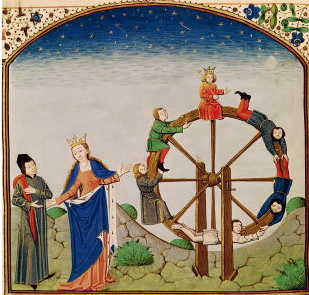 In the Medieval Latin class I’m teaching this term, we’re now reading Boethius’ Consolation of Philosophy. (If you’ve not read it before, stop wasting time on-line and read it now.) The Consolatio is partially written in prose, partially in verse, and offers a genuinely comforting framework within which to view adversity. It was written when Boethius, who had been at the very highest realms of influence, was unjustly imprisoned; not long after he would be mercilessly killed. I’ve asked my students to try to turn the verse portions into English poetry, and one of them demanded that I do the same. Talk about a reversal of fortune! My laughable effort is below, with the original Latin following. It’s not the entirety of the poem, only the first part, and it gets a little free at the end, but I think the Boethian idea of Fortuna’s fickleness comes through.
Boethius, Consolation of Philosophy
Book 1, Poem 5, “O Stelliferi Conditor Orbis”
Complaint in Verse to the Universe’s Capricious Ruler
O Ruler of the astral sphere
at rest on your eternal throne—
To spin the skies and master stars
in motion is your work alone.As now the Moon, illumined full,
Returns her brother’s sunny beam
And dims the constellations ‘round
Her head, and then herself grows dim.As Venus who, at evening,
has in the west made cold ascent,
will change her course and, paler now,
arise to meet the sun again.Another star, at winter’s start,
which looks upon the scattered leaves,
now brings constriction of the light
that lengthens then in summer’s breeze.You rule the ever-turning year,
arrange for Zephyr to return
the leafy boughs the North Wind stole.
You bloom in spring what summer burns.Exemption from such firm control
Is granted nothing, not a thing
Escapes its proper placement, in
your government of everythingSo why, in all this vast array,
this interwoven universe,
do lives of people like myself
alone not turn back from the worse?
The original Latin (which is given in full here):
O stelliferi conditor orbis,
qui perpetuo nixus solio
rapido caelum turbine uersas
legemque pati sidera cogis,
ut nunc pleno lucida cornu
totis fratris obuia flammis
condat stellas luna minores,
nunc obscuro pallida cornu
Phoebo propior lumina perdat
et qui primae tempore noctis
agit algentes Hesperos ortus
solitas iterum mutet habenas
Phoebi pallens Lucifer ortu.
Tu frondifluae frigore brumae
stringis lucem breuiore mora,
tu cum feruida uenerit aestas
agiles nocti diuidis horas.
Tua uis uarium temperat annum,
ut quas Boreae spiritus aufert
reuehat mites Zephyrus frondes,
quaeque Arcturus semina uidit
Sirius altas urat segetes:
nihil antiqua lege solutum
linquit propriae stationis opus.
Omnia certo fine gubernans
hominum solos respuis actus
merito rector cohibere modo.
…
Posted in Astronomical, Classics, Poetry
5 Comments
Doggerel and Dogs in the Snow
In the back of one of my college notebooks, I once wrote a piece of doggerel that a friend of mine found and would recite when the spirit moved him.
It does my asthma little good
To go cavorting through the wood.
A few decades later, I guess my attitude’s changed some. There are woods behind my house and I spend a lot of time there, not cavorting but walking the dogs, occasionally thinking up doggerel.


A snowflake pattern
from the bottom of a boot
pressed into the snow.

Posted in Dogs, Poetry, Sewanee, Trees & Flowers
7 Comments
Protected: Constellations in the Cupboard
Posted in Astronomical, Boston, Emblems, Family, Language & Etymology, Mythology, Sewanee, The South
Enter your password to view comments.
Protected: Father Time and the Baby
Posted in Cartoons, Classics, Emblems, Language & Etymology, Mythology
Enter your password to view comments.


 uncomelyandbroken