Remembering My Late Great Friend and Mentor, Bob Kupka

This is a piece my brother Jamie wrote about Bob Kupka, a former teacher of his at West Roxbury High who became a great friend. Bob passed away in January 2016, and his obituary is below. Jamie sent me this essay he’d written last week, and I decided to retype it and put it up here. 

Before I start this essay, I do want to say a few things about Bob Kupka. Bob was a caring man with a big heart who had an interest in the kids as a teacher. He was loved by the students, his colleagues, his friends, people he knew from sporting events, parents. And what can I say? Just a lovable guy.

And I want to start this essay on what good friends he and I were. When I first met Bob, I did not know how to take him. He would kid with me when I would be in front of the potato chip selling table talking to my friend Scott Brothers. I couldn’t take kidding at the time but he liked me and I didn’t know it. He called me Mac. That would stick with me for as long as we were friends. Then the next year he called me Jimmy Mac. That stayed with me too, which everybody called me, students and teachers.

When the next school year came, he and I became real good friends in lots of ways. We cared about each other and he and I took a liking in a lot of ways. And to top it off, we shared an interested in the old rock n roll that took our friendship off in a big way.

And I also saw what a decent guy he really was. Not only that, I helped him out with the hockey team. I helped him with the potato chip sales which he also was in charge of. And I can remember when I was home sick, he called my house to see if I could go to the hockey game. My mother answered the phone and told him I was sick. And my mother thought he was very kind. And that same year of school, he gave me a Celtics calendar.

And when the next school year came where I was a senior, he did something very nice. I had very bad marks which I was down about. And he called my house from Billerica where was was living at the time and talked to my mother about it, and me as well, and another teacher called too. And it got straightened out.

That same year I was going to be the only manager of the hockey team. To tell you the truth, I never showed up for any of the hockey game but at the sports banquet, he gave me a nice hockey sweater, which was a very kind thing he did. And to tell you more about our friendship that year, he gave me a picture of Elvis Presley which I really liked. We would lend each other oldies cassette tapes. And to top it off, I was kind of screwing up by cutting one of my classes. He brought me up to my teacher and said I’ll be back from now on and I did go back to not cutting my class.

But another thing to top off our friendship even more, I wasn’t going to get a diploma. I was going to get something called a certificate of attendance and he was very much involved with me coming back another school year to get my diploma with the principal and some other teachers. Then I came back and got my diploma. And also that year I did start to go to hockey games and the first game I went to he said to the person at the ticket desk, Let him in, he’s the manager.

That year, I graduated and after that we remained friends. And also as I can remember, that year and the year before, liking the old rock n roll as he and I both did. We had fun times asking each other about trivia questions about the oldies. And it was funny one time when we’re doing it, the school police officer said, Do you guys play this all the time? And my last year of high school, I can also recall the first day Bob came to me and asked if I saw Year of the Dragon, a Mickey Rourke movie. We were also Mickey Rourke fans. It was good being with him my last year.

And another thing I remember was the first time I met Joan, who was Bob’s girlfriend who would become his second wife, and not only that, my friend as well as Bob, and how meeting her occurred. I was over the house where Bob was living along with his buddy, Billy Mahoney. And another former student of his was there named Sam. We were having an oldies contest, Sam and I. Bob was keeping score. Then Joan came over. Bob introduced her to me and she was very impressed how I knew the oldies. And not only that she told me she knew all about me. Bob told her everything about me. I do have to say it was a fun night. I had a really good time meeting Sam and Joan. Then Joan drove me home. Sam came for the ride.

And even after graduation, I also remember I would go over to the house to visit Bob for the next year. Many times, Joan would be over seeing him too and it was all some great visits. And not only that, Bob and Joan were glad I got out of bagging groceries and got a job with the Boston Police Department as a custodian.

Then shortly after after that happened, Bob moved out of Billy’s house and got his own condo in West Roxbury, which I was very happy about because I lived there too.  And let me tell you how great it was going over his condo living near by my house and him being my friend in ways. I would go over there and we would have some great talks on the oldies and not jus that, other things too. I would make him and Joan cassette tapes from my stereo. I would bring my VHS’s on the oldies. Bob and I would watch it on his VCR.

And also in the summer time, Bob, Joan, and myself would go out to the pool at his condo complex and swim. We had some real great times together, and also some of my other teachers would come over his house and we had some great talks as well. And some of Joan’s friends would come over and I would have more great talks with them also. And I’ll never forget meeting Bob’s parents, nice older people, and Bob really wanted me to meet them, and I really appreciated that. It meant a lot to me.

And at Christmas time, we would always exchange presents. And I remember one Christmas time, he and Joan were hosting a party. I was invited and I met some nice people. And another thing about our friendship, we could kid around with each other. That shows really good friendship.

And Bob also had his good ways about caring about me. I remember when I was involved with the wrong girl and going to move in an apartment with her, he called me over to his house and advised me not to do it. And in other ways too. I was in the hospital there times he came to visit me. And when my mother dies he came to the wake. And also when my grandmother died, he also came to her wake. And he also many times would advise me to try to find friends my own age because I was always hanging around older people. But he always said he and I would always be friends and looking back, I think he had a point there.

And also he told me to get my teeth fixed, because at the time my two front teeth were chipped and that made me look bad. Like a lot of people told me to do, and eventually I did it. And in a lot of way he cared about me.

Then as time went on, I would see Bob and Joan every once in a while. Then I would see them more and more occasionally, mostly around Christmas tim. Then Bob and Joan got married and eventually retired from their jobs. And sadly, Joan got sick with MS. And I remember I called them a lot to see how Joan was, which they appreciated and to show their appreciation, they called me up to say thank you which I thought was awfully nice. Me and Bob had a great talk after the thank you. Then not long after that they sold their condo and moved to New Hampshire. Even after they moved, I stayed in touch with them and what can I say? We remained friends.

Then, as I remember, my father died in the hospital and I called Bob and told him, but he could not make it to the wake because he had to take care of Joan, but he called his colleagues also and his friends and had them come to the wake, which was another nice thing that he did for me. I was very touched by that. And the year after my dad passed away, I got my own condo and Bob and I would send Christmas cards to each other every year. And not only that, I called Bob every chance I could. Then sadly, a year or two later, Joan passed away. Then I did something nice. I sent Bob a mass card remembering Joan. He very much appreciated that.

And around the time Joan was sick and before she died, Bob developed some health issues of his own. One of them was cancer. But Bob was no coward. He told me not to feel sorry for himself, that he was gonna beat it. He went through some chemotherapy for it. Plenty of times. And he had a lot of people who were concerned about him, his family and friends and me. I called every chance I could to see how he was. And guess what? He beat it. And time went on and he was doing well. And I called him every week. And about three of four years later, he developed cancer again but he still took it like a man, which I have to give him credit for.

And as I recall, the last Christmas card he sent me on it said, Thank you for the prayers. Then a month later, sadly, we lost Bob. And I and a lot of other people, especially his family, were devastated by it. I took it kind of hard but I can remember about Bob Kupka. He was a great guy, a fantastic teacher, a man who thought of other people . Someone I knew well and loved. Someone I shared an interest with. Just a totally good person, who is truly missed by a lot of people and will always be remembered.

My dear friend, Bob Kupka.

Screen Shot 2017-10-07 at 11.09.43 AM.png

Obituary for Robert J. Kupka

Hampton, NH – Robert J. Kupka, 70, of Hampton, died peacefully Thursday, January 21, 2016 at Exeter Hospital.

He was born October 24, 1945 in Springfield, MA the son of the late Joseph and Gertrude (Murphy) Kupka.

Raised in Springfield, he graduated in 1963 from Springfield Cathedral High School, where he excelled on the school hockey team and was inducted into the Springfield Cathedral Hall of Fame. Following graduation he went on to play hockey at Boston College and graduated with the Class of 1967. 

Mr. Kupka was a teacher at West Roxbury High School for 30 years, retiring in 2002. During this time he was the school hockey coach and soccer coach as well as a well-respected and well-known referee for NCAA Division I Hockey, 

Robert enjoyed reading, walking and spending time at Hampton Beach, where he could always be seen sitting at his favorite bench. His greatest joy was spending time with family, especially his grandchildren.

He shared 10 years of marriage with his late wife Joan B. (Allman) Kupka who predeceased him in 2010.


IMG_6687.JPG

Posted in Boston, Cemeteries & Funerals, Education, Family, Music, Sports & Games, Uncategorized | Leave a comment

Protected: But Let Judgment Run Down As Waters

This content is password-protected. To view it, please enter the password below.

Posted in Animals, Bible, Classics, Family, Mythology, Sewanee, Time | Enter your password to view comments.

Protected: Ubi, Ubi Tu, Scooby Doo?

This content is password-protected. To view it, please enter the password below.

Posted in Uncategorized | Enter your password to view comments.

Introduction to the revised edition of “Latin and Greek As Used at Sewanee”

From a Sewanee Features piece last year, some of you will know that I am planning on publishing (at some point in the near but as yet undetermined future) a revised edition of the little pamphlet, Latin and Greek as Used at Sewanee by Forrest Dillon from 1972. When I reached out to him, Forrest was good enough to write the following preface for the new edition–it’s too good to keep to myself until the book is done, so here it is. –CMcD

It was a pleasant surprise last year when I received an email from Classical Languages Professor Chris McDonough, letting me know that he and some of his students were about to prepare a revised edition of “Latin and Greek As Used at Sewanee”.

Professor McDonough referred me to his Sewanee Features article, “Veni, Vidi, Scripsi”, in which he explains the impetus for the project, and summarizes some examples of Latin and Greek texts that can be found around the campus. He asked me to write an introduction to the new edition, and suggested I include some of the background story of the original pamphlet.

Going back 46 years into my memory bank would be challenging! But I was intrigued that there seems to be an interest in the Sewanee community for a recondite subject, and the more I communicated with Chris, the more interested I became.

“Latin and Greek As Used at Sewanee” was originally a term paper for Professor Bayly Turlington’s “Latin 412 – Linguistics” class, and was finished on April 29, 1970.

I found this paper in my files, entitled “Some Latin at Sewanee”. It is hand-written in black ink, and includes Dr. Turlington’s comments in red ink. I’ve sent it to Chris McDonough for the archives.

(I should mention here that Bayly Turlington (Dr. T, to me and my classmates), his wife Anne, son Fielding, and daughter Bowman became a kind of second family to me in my four years on the Mountain. I was from New Jersey, and usually couldn’t travel home for vacations; I often enjoyed kind hospitality at the Turlingtons’. I maintained contact with Bayly and his family for several years after graduating, until his untimely death in 1977. It was quite poignant for me to see, in Chris’ Sewanee Features article, the photo of Bayly’s memorial plaque in All Saints Chapel, with a very appropriate Greek inscription.)

Dr. T had suggested, shortly before I graduated in June of 1970, that I expand the term paper into a pamphlet for publication by Sewanee, and that I include whatever Greek writing I could find on campus. The result was eventually produced by the Office of Information Services in 1972.

I’m not sure when, in the period between graduation in 1970 and publication in 1972, I converted the term paper into the pamphlet.

In those years the war in Viet Nam was winding down, but our military was still heavily involved. My draft number was 11, and I had no chance of deferment; so in August of 1970 I reported for duty at the Naval Officer Candidate School in Newport, RI, and spent the next two years on two different destroyers, the second of which spent time in the Tonkin Gulf, on the gun line. (My first ship, the USS Barry, is now a museum in Washington DC. I was an Intelligence Officer, and the Navy in its infinite wisdom put me, a Latin major, whose only bad grade at Sewanee was in Physics 103, in charge of all the electronics on the ship.)

I must have worked on the paper in the summer of 1970 and somehow in off-hours in the Navy. I do remember going over proofs which reached me in the South China Sea, and being aware of the contrast between the subject…ancient texts in leafy, tranquil Sewanee….and my immediate surroundings.

In any case, somehow before graduating I must have collected whatever Greek inscriptions I could find. The order of items in the paper was re-arranged, and some of the more abstruse grammatical notes were cut. On the “Acknowledgments” page in the pamphlet are listed the many people who helped, and no doubt Dr. T. was an essential editor.

I’ve learned from Chris the very good news that the classics department at Sewanee is thriving. It’s also gratifying that my little pamphlet will be updated, including the additions since 1970 of Latin and Greek items, and most importantly the correction of a serious lacuna: the Sewanee diploma! Herewith my apologies, long overdue, for this lack.

Many thanks and best wishes to Professor Chris McDonough and his students for undertaking this project. 

Forrest Dillon
September 2016
Brunswick, Maine

Posted in Classics, Education, Nautical, Sewanee, Tennessee, Time | 1 Comment

Protected: Electra and Orestes on a White-Ground Lekythos?

This content is password-protected. To view it, please enter the password below.

Posted in Classics, Mythology | Enter your password to view comments.

To Hear About a Martyr and a Hero

I had been prepared yesterday to talk about kings and prophets, but instead got to hear about a martyr and a hero.
screen-shot-2014-10-10-at-10-29-00-pm

Friday was the day before Fall Break here in Sewanee, and my last class of the week was the introductory Humanities class. We had been reading 1 & 2 Samuel, a fascinating set of texts about rulers at any time but especially during the tumultous month before the Trump-Clinton presidential election. The class had had lively discussions about Saul and David, and how we should be reading the sources about controversial leaders; we thought about the difficulties in the story of Bathsheba and Nathan’s upbraiding of David; we thought about Psalm 51, listened to Gregorio Allegri’s haunting Miserere, as well as Bill Clinton’s reworking of the psalm in his remarks to the National Prayer Breakfast in 1998; for some of us, Donald Trump’s apology was in the background of the conversation, too. In addition, we had also forced ourselves to look at the unresolved issues of justice and vengeance in the story of Tamar’s rape, and read a contemporary essay on it. On Wednesday, my colleague Eric Thurman had given a brilliant lecture on Amos and the prophetic tradition. “Prophets speak, but they also act in symbolic ways, deliberately to make us uncomfortable,” he noted, pointing to Jeremiah carrying an ox-yoke. He then asked us to think about Colin Kaepernick’s taking a knee during the National Anthem. “Is Colin Kaepernick among the prophets?” he asked, to much squirming.

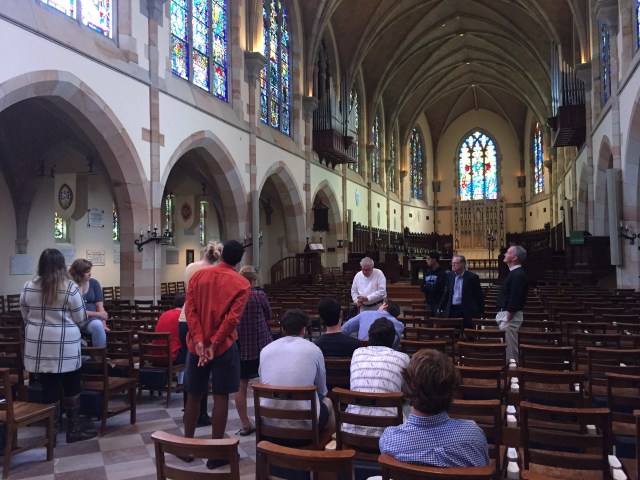
It might make sense , I thought, to go over to All Saints’ Chapel to look at the stained glass windows in which David’s story is told and the prophets are portrayed. I thought it would be worthwhile to talk about the Bible in the church, and see how different that might be from discussions around a seminar table. Two older gentleman and a young man came though the chapel just as I was beginning to point out the program of the windows to the students, how Old Testament stories are found in the Southern clerestory, and illustrations of Church history are in the North. I had not gotten very far when Tom Macfie, the University chaplain and and old friend appeared with the three guys who’d come in earlier. “Chris, can you come here?” he asked. “Bring your students.” Uh oh, I thought, I’m in trouble for not letting him know we were going to be in here.

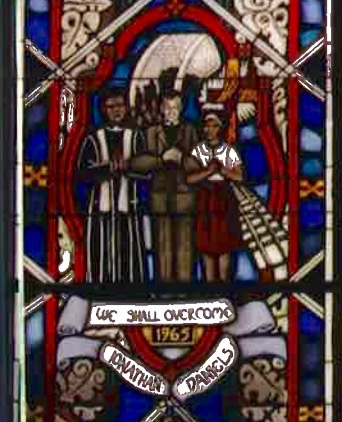
We were under one of the Northern windows which depicts significant scenes in the history of the Episcopal church. In one medallion, a bishop from the Confederate states is holding a Rebel flag and shaking hands with a bishop under an American flag; it’s labelled Reconciliation. Corresponding to it is an image of Civil Rights marchers, Tom pointed out to us. You see three people with linked arms on what I take to be the Edmund Pettus Bridge. The young woman on the right, an African-American teenager, is Ruby Sales. Beside her, Tom continued, is a young white man. Underneath you see the words We Shall Overcome, and the man’s name, Jonathan Daniels, 1965. 

Jonathan Myrick Daniels (March 20, 1939 – August 20, 1965) was an Episcopal seminarian and civil rights activist. In 1965 he was assassinated by a shotgun-wielding construction worker, Tom Coleman, who was a special county deputy, in Hayneville, Alabama while in the act of shielding 17-year-old Ruby Sales. He saved the life of the young black civil rights activist. They both were working in the Civil Rights Movement in Lowndes County to integrate public places and register black voters after passage of the Voting Rights Act that summer. Daniels’ death generated further support for the Civil Rights Movement. In 1991 Daniels was designated as a martyr in the Episcopal church, and is recognized annually in its calendar

“This man is Richard Morrisroe,” Tom told us, putting his hand on one of the older men’s shoulders. “He was there as well.” In a calm voice, Richard began to tell us his story. That day in 1965, Jonathan and Richard (at that time a Roman Catholic priest) had been in the Lowndes County jail with several African-American civil rights protesters. Unexpectedly released in the middle of the hot day, four of them–Jonathan, Richard, Ruby, and another young back woman named  went across the street to get a Coke, and were greeted by a man with shotgun in the doorway whose name was Tom Coleman, a county deputy. What happened next is quite awful, and rather then recount poorly Richards story, let me quote Ruby Sales herself from an interview in 2005:

And it is a face that we have never seen before. And we have gone to that little store over and over. And of course, we’ve just gotten out of jail, and even if we hadn’t been in jail we had no weapons. And he said something like, “Bitch, I’ll blow your brains out,” and this man moved with rapid fire.

Next thing I knew I was being pulled back and tripped and fell. I didn’t know that Jonathan was shot. I just knew the shotgun blast had happened. It happened so fast I can’t describe to you, — I didn’t associate the body flying up in the air to Jonathan. I mean, my mind, it was happening so fast that I couldn’t even process it.

When I began to process it and come back to some consciousness, — I’m on the ground and I’m saying “This is dead. This is what it feels like to be dead.” I think in my head that I’m dead. But I realize that I’m not dead because the other shotgun blast happens. I hear Father Morrisroe moaning for water, “Water, water, water.”

Morrisroe was running with Joyce Bailey in his hands, — he’s holding her hand and he’s not letting it go for nothing. And he’s running with her, and he did not let go of her hands until he was shot in the back, and she kept running and he fell.

She runs around, — you know how in the south, — always there were these cars and so she ran behind one of these cars. This is the jail, she runs over, she runs out and then she circles around and goes around on the side of the jail very close to where I had fallen. And to her credit she did not leave until she could determine who was alive and who was dead. So she started calling my name, “Ruby, Ruby, Ruby, Ruby, Ruby.”

And I don’t know how, but I managed to crawl on my knees. Because you have to understand that this man’s rage was not depleted. Tom Coleman literally walks over to [Morrisroe], he is over Morrisroe’s body, standing guard over this body, because [Morrisroe] is calling for water and he’ll be damned if he’s gonna let anybody give him water. Jimmy Rogers comes over and tries to give Father Morrisroe water, and the man threatens to blow his brains out. So he is not finished. He is on a rampage.

Joyce and I get up, I crawl over to her and we run across the street to the other group. And by now you can imagine there is bedlam. I mean people are frightened, because we don’t know if this is a klan conspiracy and people are all in the bushes. We just don’t know what is going to happen.

But what we do know is that Father Morrisroe is still calling for water. So, I go back over, and the crazy thing about it is that this man didn’t even realize that I was a person that he tried to kill. I sometimes wonder, — [I was] really crazy to go back over there, but I did that.

[Coleman] was threatening to kill everybody.

Daniels was killed instantly, and Morrisroe seemed very close to death. Indeed, a hearse came to pick up Daniels’ body, and Morrisroe was put on top of him and transported to the hospital, where he was in fact given his last rites. After much pleading, a doctor agreed to operate on Richard and saved his life after an 11-hour operation. After two years of physical therapy, Richard recounted, he learned to walk again, and to deal with what he came to realize was Post-Traumatic Stress Disorder. Probably you can guess that Coleman was acquitted by an all-white jury, and died peacefully at home in 1997.
img_4041

The other older man, as I come to learn, is an Episcopal priest named Francis X. Walter, himself a figure from the Civil Rights movement, and he has opinions about some of the Confederate fetishism that Sewanee has at times engaged in. The conversation strays to stories of the Mace, of Leonidas Polk, and other things.All this while, the younger man who had come in with Richard sits in quiet attention. He is Richard’s grandson, a student at the University of Buffalo, the same age as my Humanities students, who have been listening intently to this story of martyrdom and heroism–they are aware what a remarkable moment this is.

The hour is almost up, and as we gather our things to leave, Francis encourages us to look at a book  by Charles Eagles called Outside Agitator (University of North Carolina, 1993), about Jon Daniels as well as Tom Coleman. I look it up later, and in fact find Francis’ own review of the book, itself well worth reading. As he writes,

One of the knots that Eagles entices the reader to untangle is: what should be the role of prudence when one steps out in faith to realize one’s self and the best in one’s culture? Was Jon heedless, did he not know his behavior could get him killed? Eagles has many examples of Jon acting and speaking with blacks and whites as if racism did not exist, as if a reign of peace and justice actually existed in Selma and Lowndes County in 1965. If he knew the danger (and he did) what was his obligation to himself, God, and his Church to exercise caution? Just how much Kingdom should a person in extreme circumstances live in order to offer his due to God and humanity? The reader is urged to decide this in the case of Jon Daniels. It is to be earnestly hoped the reader will consider his or her own case. It is good to be prepared should such a time of decision come to us.

Jon led an examined life. Tom led an unexamined life. Jon wanted to explore agape. Tom wanted to keep everything the same, to protect the little he had. Tom protected a bunch of lies to keep an easy life. Jon explored the truth and was racked with sorrow that it hurt people for him to do so. Jon had vision. Tom could not visualize Lowndes County without an order such as his father provided. He got up from his courthouse domino game and killed to keep the only order he could imagine. Tom had a sense of place, local, un-nuanced. He loved the land of Lowndes County. Jon lived a lot of his life in the Spirit, and tried to love the oikoumene—the whole inhabited earth.

What can I say? We never did get to talk about Amos on Friday, but I suppose we will long remember this accidental meeting that illustrated more than any class discussion could the prophet’s most famous lines, But let judgment run down as waters, and righteousness as a mighty stream.

img_4044

Richard Morrisroe, Francis Walter, Richard’ grandson, and Tom Macfie

fullsizerender


11398100-large

Prayer on the Feast Day (August 14th) of Jonathan Myrick Daniels, Martyr.

O God of justice and compassion, who dost put down the proud And the mighty from their place, and dost lift up the poor and afflicted: We give thee thanks for thy faithful witness Jonathan Myrick Daniels, who, in the midst of injustice and violence, risked and gave his life for another; and we pray that we, following his example, may make no peace with oppression; through Jesus Christ the just one: who with thee and the Holy Spirit liveth and reigneth, one God, for ever and ever.

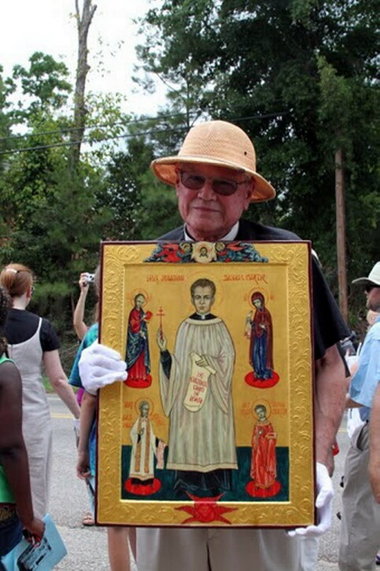
Image to the right, from AL.com. The Rev. Francis Walter, a retired Episcopal priest in Alabama, carries the icon of Jonathan Daniels during the 2010 pilgrimage. Walter, who helped raise their bond money, had visited Daniels and the others jailed in Hayneville in the week before Daniels’ murder. After Daniels’s death, Father Walter was sent by the Selma Interreligious Project to continue a ministry of presence in Selma and the surrounding counties. (Courtesy of Dave Drachlis)

Postscript. It would be remiss me of me not to link to Annie Blanks’ very fine story on Her Campus about Ruby Sales’ visit to Sewanee in 2014. As her piece concludes, “Behold how good it was when Jonathan Daniels made the ultimate sacrifice so that Ruby Sales could live, fighting for a cause hoping that one day brothers and sisters of all colors could truly dwell together in unity.”

Posted in Bible, Education, Music, Poetry, Race, Saints, Sewanee, Statues & Monuments, The South | Leave a comment

Shadowboxing at the DNC, or Bill’s Apology

I was really struck this summer, when listening to Bill Clinton’s speech on behalf of Hillary at the DNC, with a parallel to Plato’s Apology about Socrates’ trial in 399 BC. After listing his wife’s many accomplishments, Bill says the following:

CLINTON: Now, how does this square? How did this square with the things that you heard at the Republican convention? What’s the difference in what I told you and what they said? How do you square it? You can’t. One is real, the other is made up.
You just have to decide. You just have to decide which is which, my fellow Americans.
The real one had done more positive change-making before she was 30 than many public officials do in a lifetime in office.
(APPLAUSE)
The real one, if you saw her friend Betsy Ebeling vote for Illinois today…
(APPLAUSE)
…has friends from childhood through Arkansas, where she has not lived in more than 20 years, who have gone all across America at their own expense to fight for the person they know.
(APPLAUSE)
The real one has earned the loyalty, the respect and the fervent support of people who have worked with her in every stage of her life, including leaders around the world who know her to be able, straightforward and completely trustworthy.
The real one calls you when you’re sick, when your kid’s in trouble or when there’s a death in the family.
The real one repeatedly drew praise from prominent Republicans when she was a senator and secretary of state.
(APPLAUSE)
So what’s up with it? Well, if you win elections on the theory that government is always bad and will mess up a two-car parade…
(LAUGHTER)
…a real change-maker represents a real threat.
(APPLAUSE)
So your only option is to create a cartoon, a cartoon alternative, then run against the cartoon. Cartoons are two- dimensional, they’re easy to absorb. Life in the real world is complicated and real change is hard. And a lot of people even think it’s boring.
(APPLAUSE)
Good for you, because earlier today you nominated the real one.
What reminded me of Plato’s Apology  here was the passage below, where Socrates speaks about the “trial by media” to which he had already been subjected (he speaks particularly of the “Socrates” who is the subject of Aristophanes’ comedy, The Clouds). 
For I have had many accusers who accused me of old, and their false charges have continued during many years; and I am more afraid of them than of Anytus and his associates, who are dangerous, too, in their own way. But far more dangerous are these, who began when you were children, and took possession of your minds with their falsehoods, telling of one Socrates, a wise man, who speculated about the heaven above, and searched into the earth beneath, and made the worse appear the better cause. These are the accusers whom I dread; for they are the circulators of this rumor, and their hearers are too apt to fancy that speculators of this sort do not believe in the gods. And they are many, and their charges against me are of ancient date, and they made them in days when you were impressible – in childhood, or perhaps in youth – and the cause when heard went by default, for there was none to answer. And, hardest of all, their names I do not know and cannot tell; unless in the chance of a comic poet. But the main body of these slanderers who from envy and malice have wrought upon you – and there are some of them who are convinced themselves, and impart their convictions to others – all these, I say, are most difficult to deal with; for I cannot have them up here, and examine them, and therefore I must simply fight with shadows in my own defence, and examine when there is no one who answers.
Posted in Uncategorized | Leave a comment

Protected: At Zora’s Grave

This content is password-protected. To view it, please enter the password below.

Posted in Animals, Bible, Cemeteries & Funerals, Race, The South, Trees & Flowers, Uncategorized | Enter your password to view comments.

Precious Moldering Pleasures

A precious—mouldering pleasure—’tis—
To meet an Antique Book—
In just the Dress his Century wore—
A privilege—I think—

His venerable Hand to take—
And warming in our own—
A passage back—or two—to make—
To Times when he—was young—

His quaint opinions—to inspect—
His thought to ascertain
On Themes concern our mutual mind—
The Literature of Man—

What interested Scholars—most—
What Competitions ran—
When Plato—was a Certainty—
And Sophocles—a Man—

When Sappho—was a living Girl—
And Beatrice wore
The Gown that Dante—deified—
Facts Centuries before

He traverses—familiar—
As One should come to Town—
And tell you all your Dreams—were true—
He lived—where Dreams were born—

His presence is Enchantment—
You beg him not to go—
Old Volumes shake their Vellum Heads
And tantalize—just so—

So Emily Dickinson, right as always. I thought of these lines as I snuck into duPont Library by the back door this afternoon. On the left-hand side were two very large boxes full of books to be discarded. The shelves need to cleared, we’ve been told, to make room for newer books. The old ones will what? be sold, given away, pulped? There they sit, awaiting their fate.

Against my better judgement, I begin to flip through them. Many don’t interest me–Principles of Behavior from the 60s, mid-century prayer books (though the inscription “For Sister Carlotta” gives me a twinge), economics manuals. But of course, there’s always something in a random collection of books you want to look through.


I will admit to leafing through the paperback with responses to Marshall McLuhan for a few minutes, especially Walter Ong’s essay and Susan Sontag’s, too. But it’s The Pictorial Hstory of England that really arrests me. With Several Hundred Woodcuts, reads the subtitle. Who could resist? Both volumes contain heartfelt handwritten inscriptions.

I thumb through the book. Good God, it’s just so charming. And it’s so old, and so out-of-date, and so musty, and so moldering. Should I stick it in my bag? Nobody will notice, or care. But will I ever look at it again? If I bring it home and put it on the shelf, am I not just consigning the question of what to do with this old book to my children some decades hence?

So off I go, leaving the Pictorial History to its destiny, and hate myself for it. All around me are the signs of an age that’s passing– old books being remaindered, older colleagues retiring, institutional memory passing into oblivion. Into the bin with all of you, over to the side by the library backdoor.

Posted in Cartoons, England, Poetry, Sewanee, Time, Uncategorized | Leave a comment

The Abbo’s Alley Labyrinth

Screen Shot 2016-05-18 at 1.25.15 PM

There’s a fine piece in Smithsonian today about labyrinths, which put me in mind of Sewanee’s own version of the mystic maze (about which more below). As Jennifer Billock, the author of the Smithsonian piece, writes about the spiritual engagement with this unique classic structure:

Historically, walking a labyrinth is associated with religious and magical experiences. Their many ins and outs are often associated with mythical figures, and in the past they were walked as devotional activities, mini-pilgrimages or atonements for some sin. Nordic pagans coursed the paths as a way to overcome difficulty, reinforce protection and bring good fortune. These days, walkers choose labyrinths for a meditative experience of repetition and slight concentration contained in a small circular package. The journey is a personal one—everyone gets something different out of the winding walk.

She quotes David Gallagher, director of The Labyrinth Society, who says, “I can’t tell you what a specific individual should expect to experience. Ask anyone who’s interested in labyrinths and you’ll get different answers.” The Society’s elaborate webpage–it’s actually well-organized, so I’ll avoid comparing it to a maze–notes that May 6, 2016 was World Labyrinth Day, which, in all the hubbub about Sewanee’s graduation, I seem to have missed; I’ll try to catch it next year, I guess. I note too that the society maintains a labyrinth locator that does not contain the one in Abbo’s Alley (or the other one I know of in the area, at St. Mary’s*).

I’m quite fond of our local labyrinth, and have often incorporated it into lectures about Theseus and the Minotaur. You can see one of my sons, when he was very young, playing in it above. A few years ago, I wanted to know more about this labyrinth and wrote to the person who knows the most about the Alley, Louis Rice, to find out more. He responded,

Trink Beasley’s son, Battle, a priest in Nashville ,collected the bricks and also laid out the design.Several volunteers put the bricks down and the Alley crew cut the brush and cleared the trees from atop the stone out-cropping. This was all done about 2000/01. You will note the area below is named “Trinks Terrace” in her honor.


I wrote to Father Beasley, who is rector at St. Mark’s in Antioch, TN — there is in fact another labyrinth there , one which can be found in the Labyrinth Society’s locator. Battle’s gracious response to my inquiry:

So glad to hear someone uses and enjoys it. Actually it was my mother Trink Beasley who wanted a labyrinth in the alley and asked me to put it there. I became interested in labyrinths around 1995. The one here at st. mark’s I didn’t put in but can claim to be the inspiration for the previous rector who I introduced to labyrinths.i too find them wonderful places for reflection and prayer. Thanks so much for sharing with me. Peace battle

According to the St. Mark’s website, Battle leads a labyrinth walk on the second Saturday of every month.  I’ve copied his thoughtful reflections, which might be of use to you as you walk the mystic path in Abbo’s Alley.

There are three stages of the walk:

Purgation (Releasing) ~ A releasing, a letting go of the details of your life. This is the act of shedding thoughts and distractions. A time to open the heart and quiet the mind.

Illumination (Receiving) ~ When you reach the center, stay there as long as you like. It is a place of meditation and prayer. Receive what is there for you to receive.

Union (Returning) ~ As you leave, following the same path out of the center as you came in, you enter the third stage, which is joining God, your Higher Power, or the healing forces at work in the world. Each time you walk the labyrinth you become more empowered to find and do the work you feel your soul reaching for.

Guidelines for the walk: Quiet your mind and become aware of your breath. Allow yourself to find the pace your body wants to go. The path is two ways. Those going in will meet those coming out. You may “pass” people or let others step around you. Do what feels natural.

*Postscript. My understanding is that Battle Beasley made the St. Mary’s labyrinth, too! Also, my friend and former student (and former babysitter!), Emily Senefeld, tells me that there’s also a labyrinth in the Crump Pavilion at the Dubose Conference Center!

Posted in Classics, Family, Mythology, Sewanee, Uncategorized | 4 Comments