
In my Classical Reception class at Sewanee recently, I was teaching Beth Piatote’s Antíkoni, a brilliant Native American re-imagining of Sophocles’ Antigone which deals with the collections of human remains in institutions like the Smithsonian and the desire to see them repatriated. The political issues surrounding this matter are complex, and I was happy to have my colleague from Anthropology, Emily Sharp, come to class to teach us. Her experience with NAGPRA (the North American Grave Protection and Repatriation Act) was highly relevant to our conversation.
Antigone works well for this conversation about the proper treatment of bodies, of course, as it does for other political situations. As George Steiner writes in his book Antigones: How the Antigone Legend Has Endured in Western Literature, Art, and Thought, “The myth precipitates and purifies the agitated, opaque elements of the immediate situation.” While Pietatote is writing this play as a sort of palimpsest under which we can feel the Greek original (the characters names are Antikoni, Kreon, Haimon, Ismene, etc.), she has more freely innovated in other places. We see these innovations in the choruses especially, where instead of alluding to Danae, as Sophocles does, there are invocations of Native American figures like Coyote, Pissing Boy, and Grizzly Bear.
At one point, when Antikoni and Kreon are debating the role of museums in the preservation/ desecration of Native American culture, the figure of Ishi is invoked. I assumed that my students would not know about Ishi (as indeed I did not), who was the sole survivor of the destruction of his native Yahi people. Apprehended in 1911, he ended up living in the University of California anthropological museum, where he was a janitor and “living exhibit,” until his death in 1916. It’s a bracing story that has been subject of much powerful consideration in recent years. To situate students, I made the following slide:
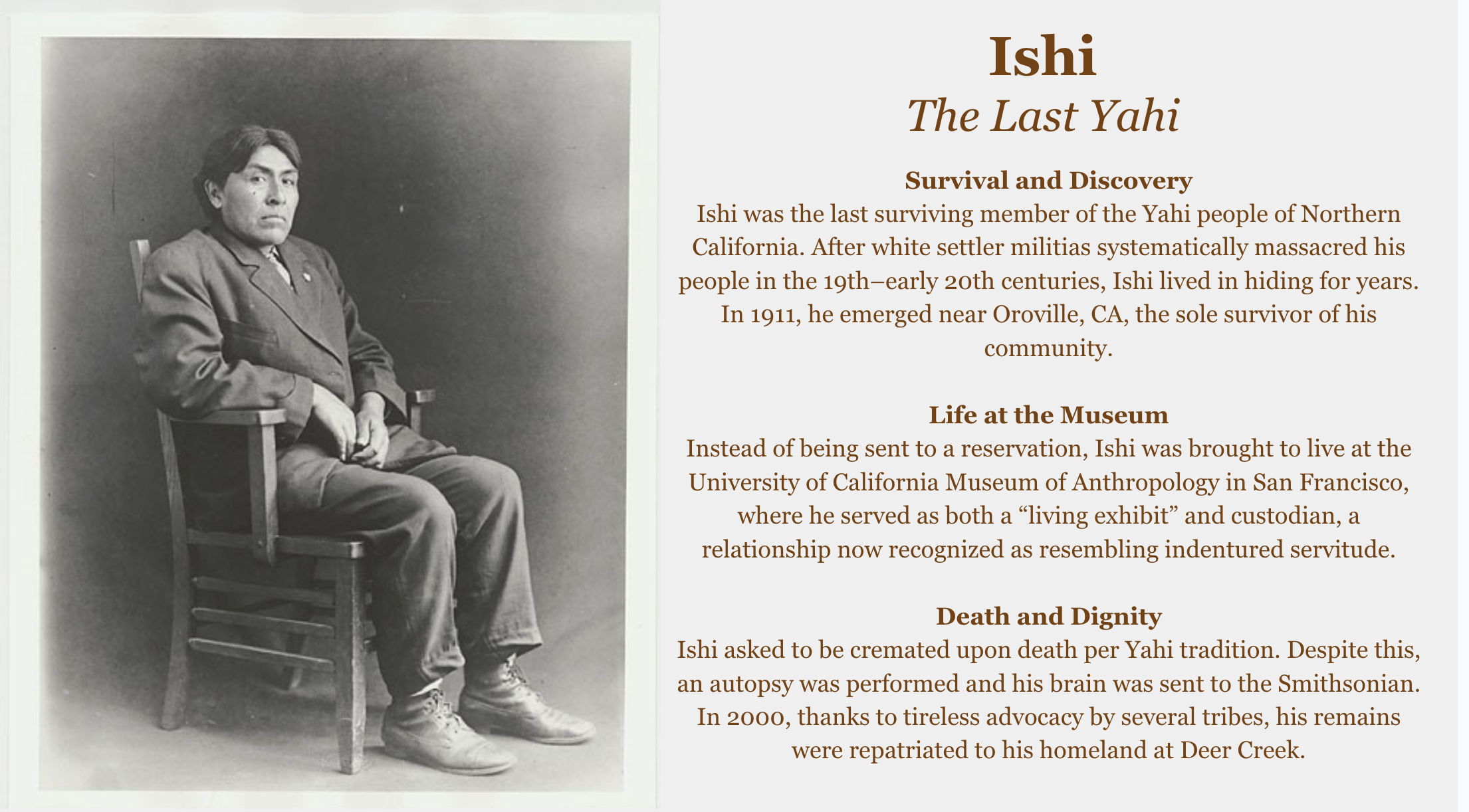
My text here is modified from what is found on the Hearst Museum’s website. The image, which shows Ishi in Western-style clothing and seated in a chair looking at the camera, was likewise taken from the Hearst.
So, as I say this slide was in my slideshow, but when I was reviewing for class, a notice from Google popped up asking if I wanted to “Beautify this slide.” This appears to be a new feature, so I thought, well, OK, and hit the button. Here’s what came up:
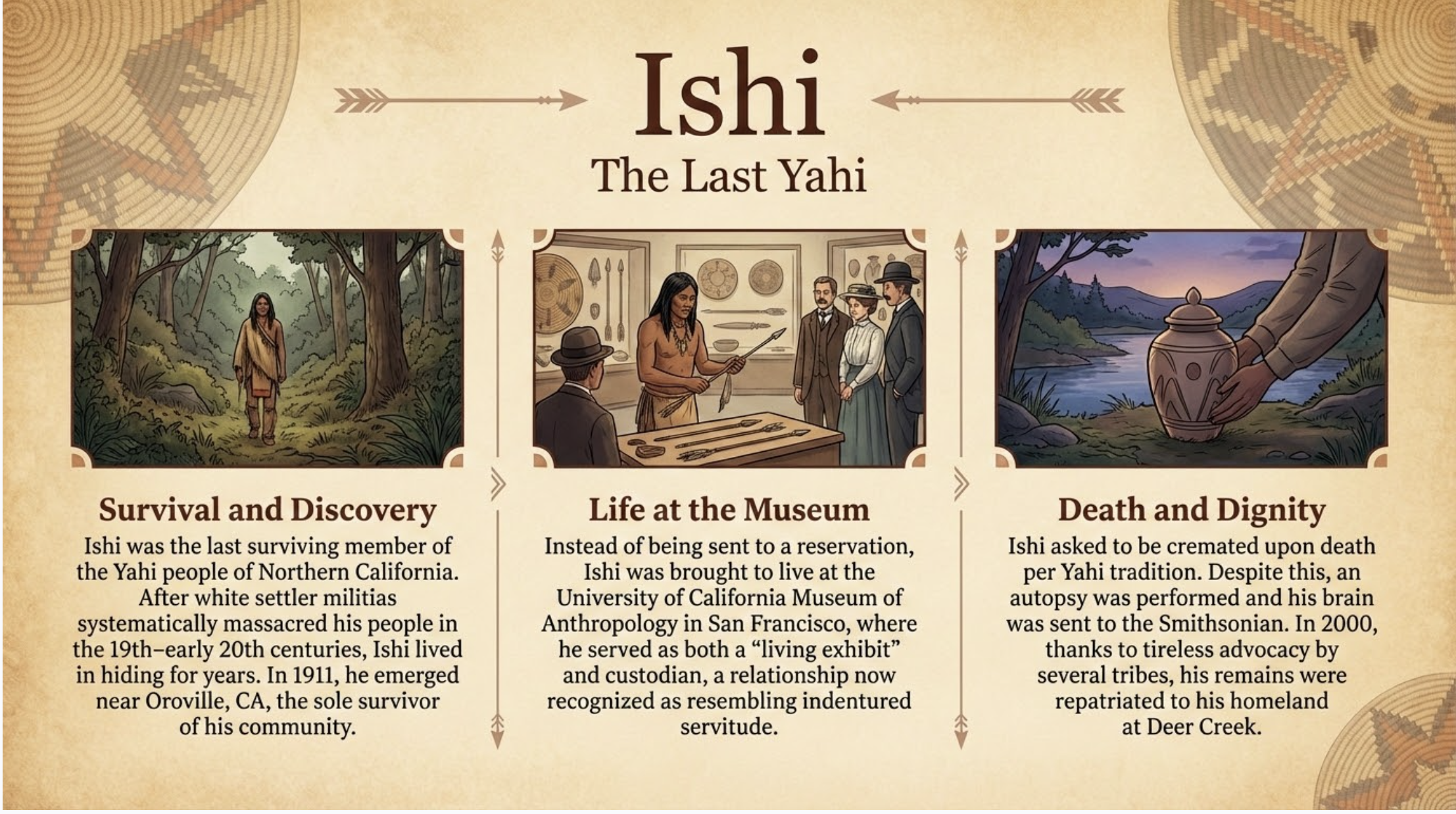
I was sort of stunned by this. The text is the same (and perhaps more easily presented, I’ll grant), but I was dumbfounded by the background imagery of Indian basketry and arrows. Even more astounding was the central image which shows Ishi NOT as depicted in the contemporary photo (seated, clothed, looking at the viewer) but instead standing, shirtless, and being looked at.
After debating it for a while with myself, I decided to bring this image into class to get the students’ reaction, which largely mirrored my own. As we discussed, the slide was created by Google’s AI, which is culling from a vast amount of data. So, really, what was being produced here was the distillation of the written and visual record about Native Americans available in the LLM.
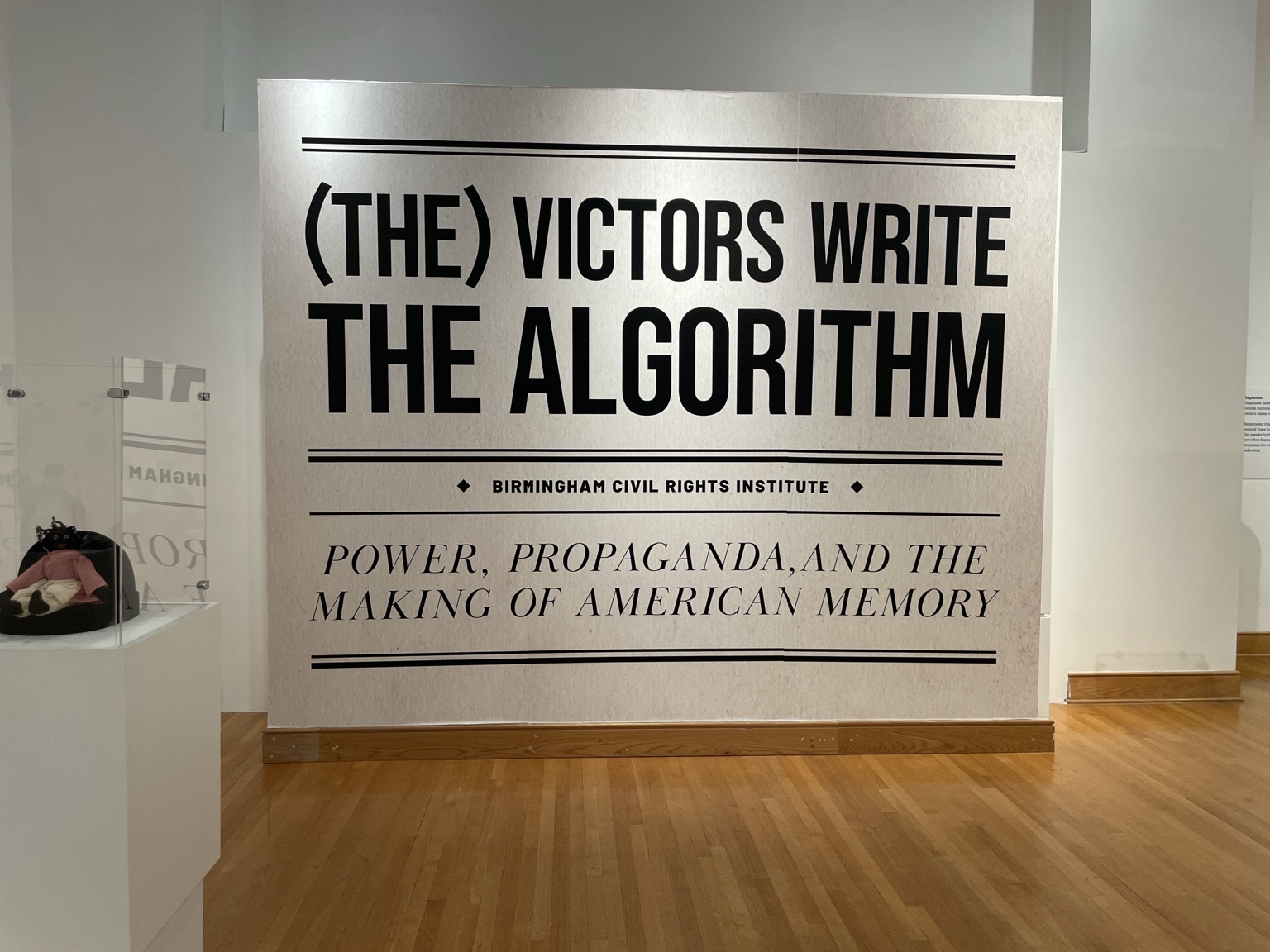
As luck would have it, there is a really great exhibit up right now about this very topic called “(The) Victors Write the Algorithm” at the Birmingham Civil Rights Institute, which I visited this week. While this exhibit deals with harmful stereotypes about African-Americans, the point of the exihibit might just as easily applied to depictions of Native American culture: From propaganda and biased news coverage, to the digital platforms and algorithms that determine what we see and share, we should examine how narratives are constructed and disseminated as “truth”.
The difference between the imagery on the “beautifed” slide of Ishi versus what I had originally is easy enough to make out, and helps to surface the issues of racism and representation encoded therein. But I wonder how many other AI-generated images and texts contain less immediately discernible offensive elements? I happened to be able to see this example clearly but there are without doubt many others to which I am simply blind.


 uncomelyandbroken
Enjoyed your post! I read the Theodora Kroeber book Ishi in Two Worlds many years ago. There has been much revision of the legacy of anthropologist A.L. Kroeber and his spouse Theodora in the years since, including efforts to rename buildings associated with their name. You may know the Kroebers were the parents of novelist Ursula LeGuin.
You may have found this site in your searches – I thought it was an interesting account of the friendship between Kroeber and Ishi, as well as the story of Ishi’s death, autopsy, and finally the return and cremation of his remains:
https://cypresslawnheritagefoundation.org/blog/the-truthful-facts-of-ishi-and-alfred-l-kroebers-friendship/
Best,
Dennis Davenport (father of Lily)
Hi Dennis, Yes, Ishi is a fascinating story. I am sure Lily–as an Ursula K. Le Guin expert–has some opinions here! The relationship of Kroeber and Ishi is a complicated one, to be sure. What I find bewildering is how the AI generated images here reduced it to its more cliched, stereotypical form.