
 I have written before about Major Archibald Butt, a notable alumnus of Sewanee who died heroically aboard the Titanic. That’s him to the right, together with President Taft, from a stained glass window in All Saints’ Chapel which commemorates the presidential visit to Sewanee a year before Butt’s death. His traveling companion on that fateful voyage was the artist, Francis Davis Millet, who shared a house with Butt in Washington where they hosted large social gatherings. As it happens, the Butt-Millet Memorial Fountain erected by their powerful and well-connected friends was only few blocks from the hotel I was stayed at last weekend in our nation’s capitol, so I took a morning to go over and visit.
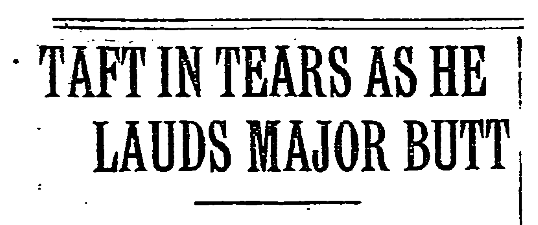 The fountain could not be have been more prestigiously located, as befits two men so well-loved in their day. “Taft In Tears As He Lauds Major Butt,” reads the headline of the New York Times (May 6, 1912, p. 4). It only makes sense that the memorial to a man whom the President loved as a son would be placed close to the White House, close to the very top of the Ellipse. And I suppose it only makes sense that, as the years pass–indeed over a hundred of them–the depth of such feelings for a brave and noble man would subside into oblivion. Today, the monument is hard to find, hidden behind the iron fencing and Jersey barriers that ring the White House. One has to pass by the monument to Butt and Millet, but given all the visual noise along the Ellipse Road and E Street, as well as the yelling Capitol police, it’s easy to overlook the eight foot stone fountain.
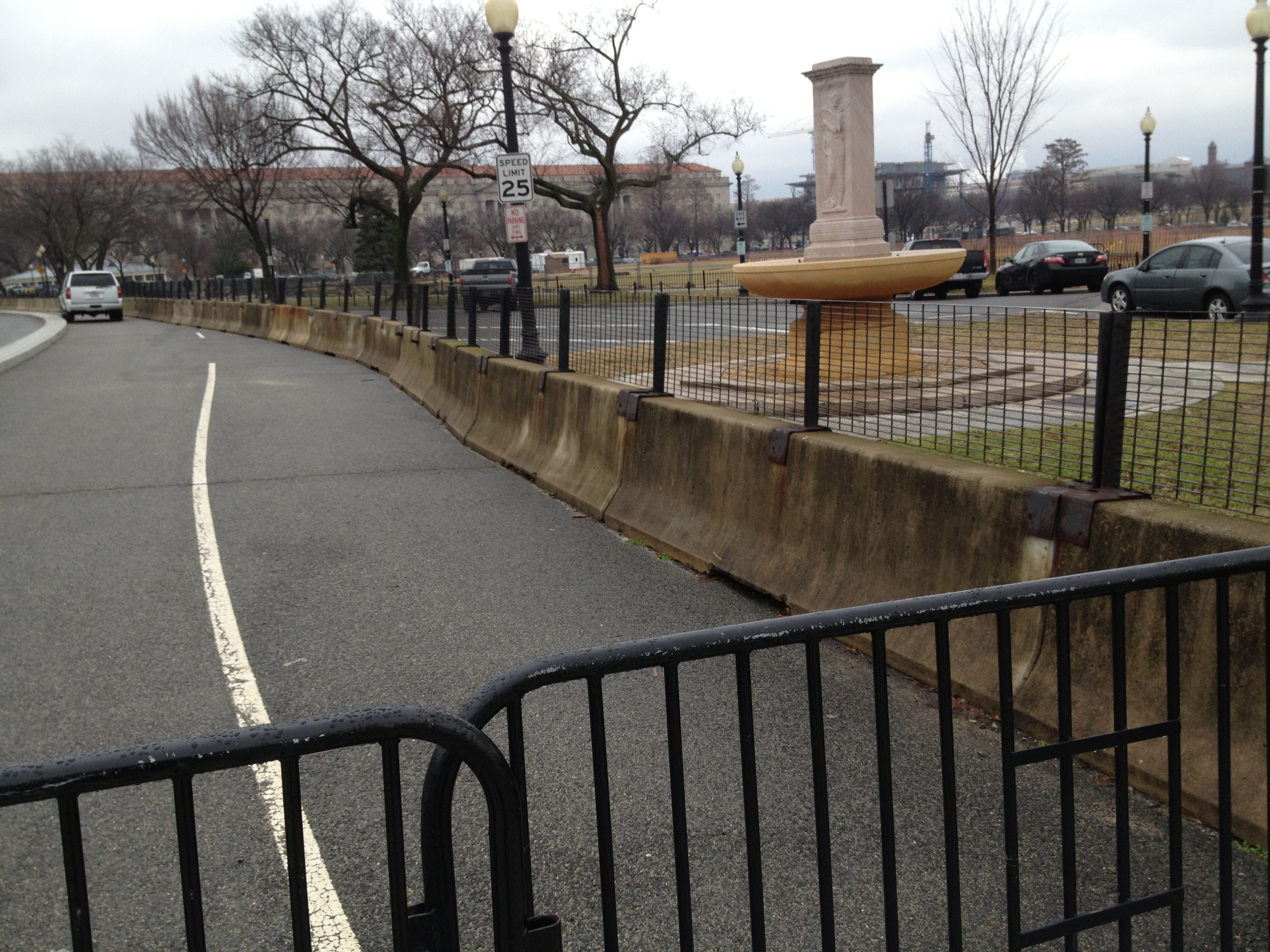
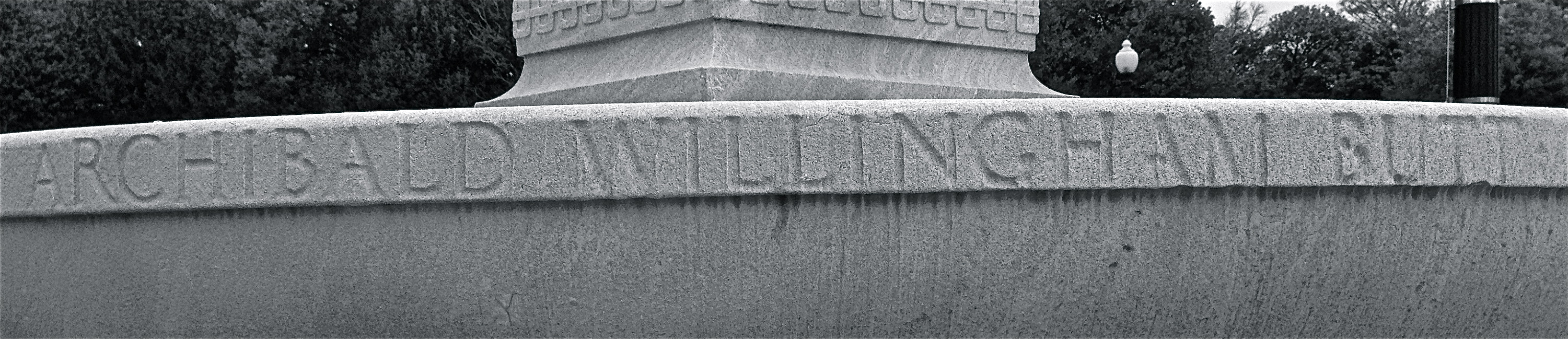
The fountain base is made of Tennessee marble, appropriate for Butt, whose connection to the South was a fundamental part of his identity. Above the base on the granite slab is, n one side, a symbolic representation of Valor, fitting for Butt as a military man. Just behind the trees is the White House.

On the other side one sees a representation in Millet’s honor of the Arts. In the distance you can see the Washington Monument.

It has been reasonably suggested Butt and Millet were lovers and if so, there is something poignant about the fact that this memorial stands in so prominent location, a place where tourist go by in droves and droves, and yet somehow seems to go unseen, to be somehow hidden in plain sight.


 uncomelyandbroken
According to a September 1912 newspaper report (https://news.google.com/newspapers?id=OeMrAAAAIBAJ&sjid=hEYEAAAAIBAJ&pg=4839%2C4847452) a plaque was unveiled in All Saints Chapel at the University. I couldn’t find anything else out about it, does it still exist, is anything known of it?
Hi Richard–Yes, the plaque for Major Butt is on the North wall of the Chapel. I could send you a picture if you’re interested.
Thank you for your comments about the Major Butt. I’ve learned more about him today and I’ve known all my life. I’ve shared both articles with my brother and we are in your debt.
My introduction to him was through an old book on the Titanic and a bumper sticker that said “Save the Butt Bridge” referring of course to the bridge in Augusta Georgia.
To learn that there are several references and memorials to the major is a delightful addition to our knowledge.
spending time in Washington DC as a young submariner and not seeing my kinsman’s other notations is somewhat painful at this late day.
But should I have the ability to visit the town again I will extend my efforts and try to find these memorials.
any source of information is greatly appreciated and the picture you offered to the other notation below your article would be appreciated as well.
Once again thank you for your efforts.
Many thanks for your note, Dennis. I am glad I as able to contribute to your knowledge about your ancestor. When I am next on campus, I will send you a photo of the plaque to the major erected by his fraternity brothers, as I recall.
Do you happen to know a book by Ely Green called Ely: An Autobiography? It is quite a memoir, written by a mixed-race man who grew up in Sewanee (a longer version of this memoir is called Too Black Too White). The shorter version focuses on his life in Sewanee in the 1890s through the 1910s or so. He talks about his interactions with Major Butt a few times.
In fact, I just decided to post copies of the pages from Ely as an entry; https://uncomelyandbroken.com/2024/04/15/ely-green-on-archibald-butt/
Pingback: Ely Green on Archibald Butt | uncomelyandbroken