
-
Recent Posts
Recent Comments
Archives
- March 2026
- November 2025
- December 2024
- April 2024
- October 2021
- February 2021
- September 2020
- July 2020
- June 2020
- May 2020
- April 2020
- March 2020
- January 2020
- August 2019
- July 2019
- June 2019
- May 2019
- April 2019
- March 2019
- February 2019
- January 2019
- December 2018
- November 2018
- October 2018
- July 2018
- June 2018
- May 2018
- April 2018
- March 2018
- February 2018
- November 2017
- October 2017
- September 2017
- August 2017
- April 2017
- February 2017
- October 2016
- September 2016
- May 2016
- April 2016
- March 2016
- February 2016
- January 2016
- November 2015
- October 2015
- September 2015
- August 2015
- July 2015
- June 2015
- April 2015
- March 2015
- February 2015
- January 2015
- December 2014
- November 2014
- October 2014
- September 2014
- August 2014
- July 2014
- June 2014
- May 2014
- April 2014
- March 2014
- February 2014
- January 2014
- December 2013
- November 2013
- October 2013
- September 2013
- August 2013
- July 2013
- June 2013
- April 2013
- March 2013
- February 2013
- January 2013
- December 2012
- November 2012
- October 2012
- September 2012
- August 2012
- July 2012
- June 2012
- May 2012
- April 2012
- March 2012
- February 2012
- January 2012
Categories
- AI
- Animals
- Astronomical
- Bible
- Birds
- Books
- Boston
- Cartoons
- Cemeteries & Funerals
- Classics
- Coal
- Dogs
- Drama
- Education
- Emblems
- England
- Family
- Film
- Florence
- Ireland
- Italy
- Language & Etymology
- Military
- Music
- Mythology
- Nautical
- New England
- Numismatics
- Oxford
- Poetry
- Pontius Pilate
- Race
- Rivers
- Rome
- Saints
- Scotland
- Sewanee
- Slavery
- Sports & Games
- Statues & Monuments
- Tennessee
- The South
- Time
- Trees & Flowers
- Uncategorized
Meta
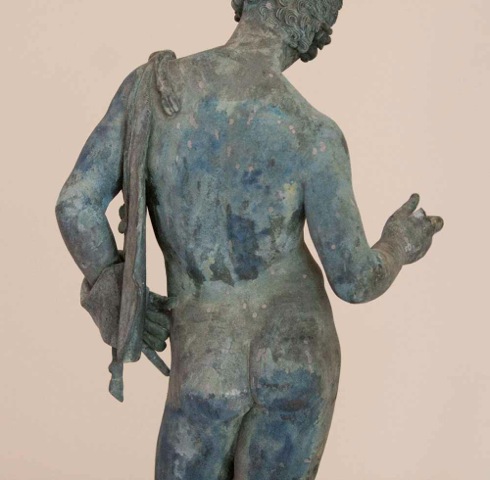
Rear-View
Dr. Christopher M. McDonough,
At the request of the PROVINCETOWN ARTS magazine I have been asked to write a review of the recent biography of Tennessee Williams by John Lahr, TENNESSEE WILLIAMS, Mad Pilgrimage of the Flesh,
For this review, I ask your permission to reproduce a rear- view photo of Williams copper statue, “Testa dell’Efebo” [attached]
PROVINCETOWN ARTS IS A NONPROFIT PRESS FOR ARTISTS AND POETS,
Provincetown MA 02657
Respectfully,
Leona Rust Egan, Theater historian
author, PROVINCETOWN AS A STAGE
Postscript. In fact, the article in Provincetown Arts Journal is now out! A PDF of ” Tennessee Williams: His Long Farewell” by Leona Egan is here.
Posted in Boston, Classics, Sewanee, Statues & Monuments, Tennessee
2 Comments
At Armfield’s Grave
This morning I went to the Beersheba Springs Assembly for the Posse Retreat, which had as its focus “Crime and Punishment.” This was a great event, with many good conversations, impressive facilitating, lots to laugh and think about. After lunch, I made my way home (though vowing that next year I’d attend the entire weekend ), but first stopped off at the Armfield Cemetery, just down the road from Assembly.

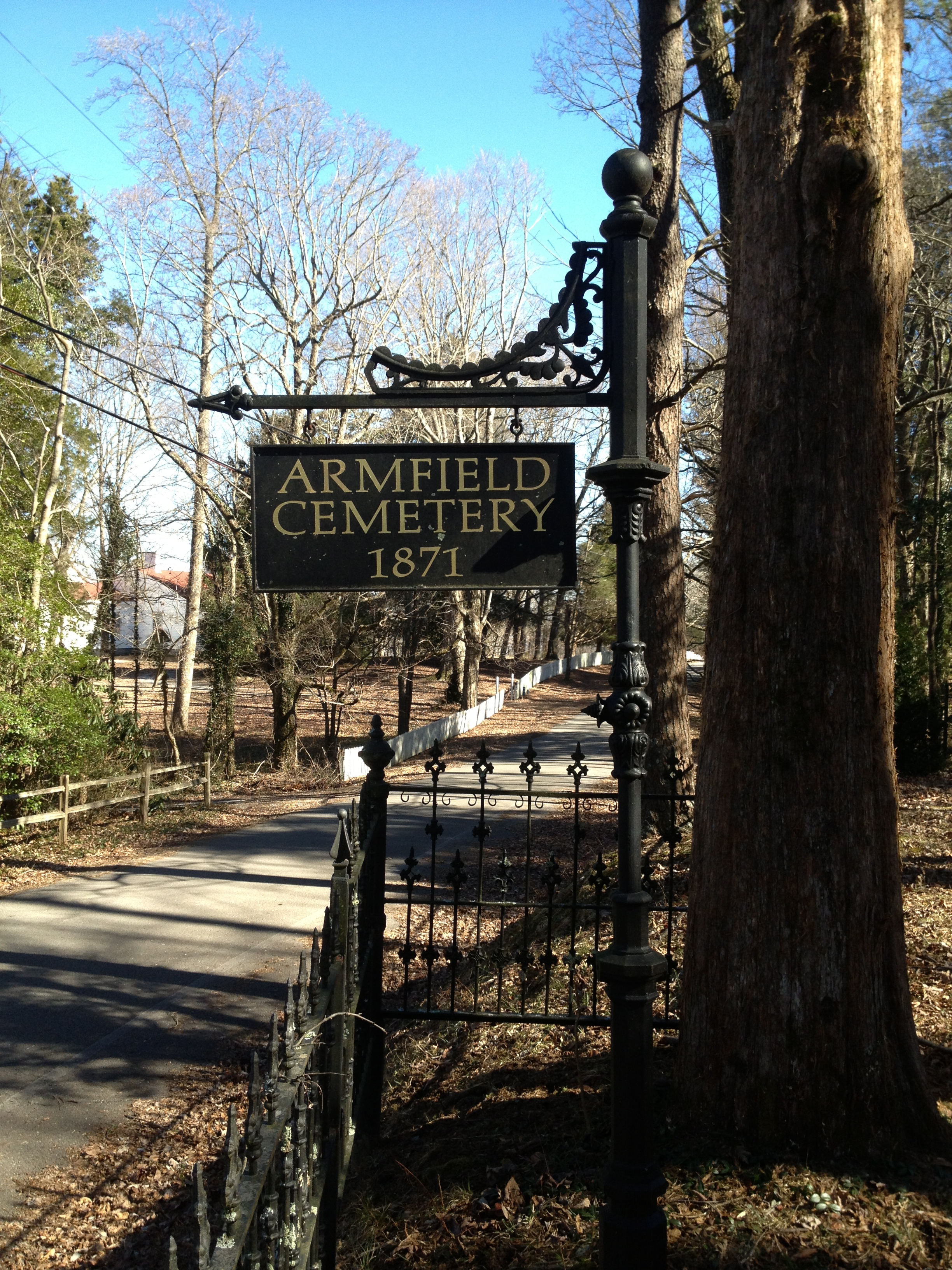

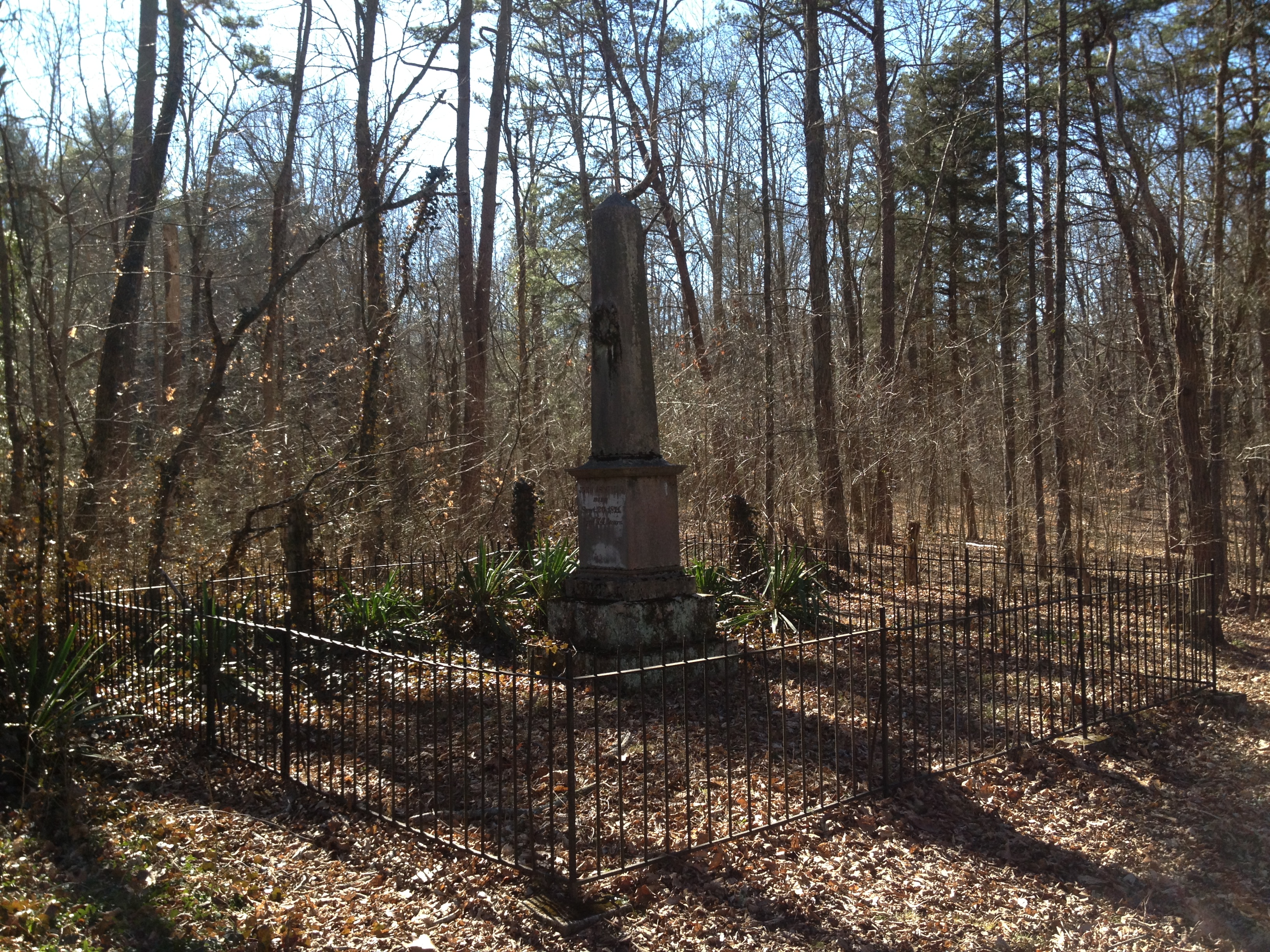
The graveyard dates to 1871 and, on a sunny February afternoon, the old trees, leaf litter, and ironwork gates give the place a certain Victorian Gothic charm. Across the street are modest, old-fashioned homes which, being built on the bluff, have a commanding view off the plateau into the Savage Gulf State Park. The most prominent monument in the cemetery is that for John Armfield, below.
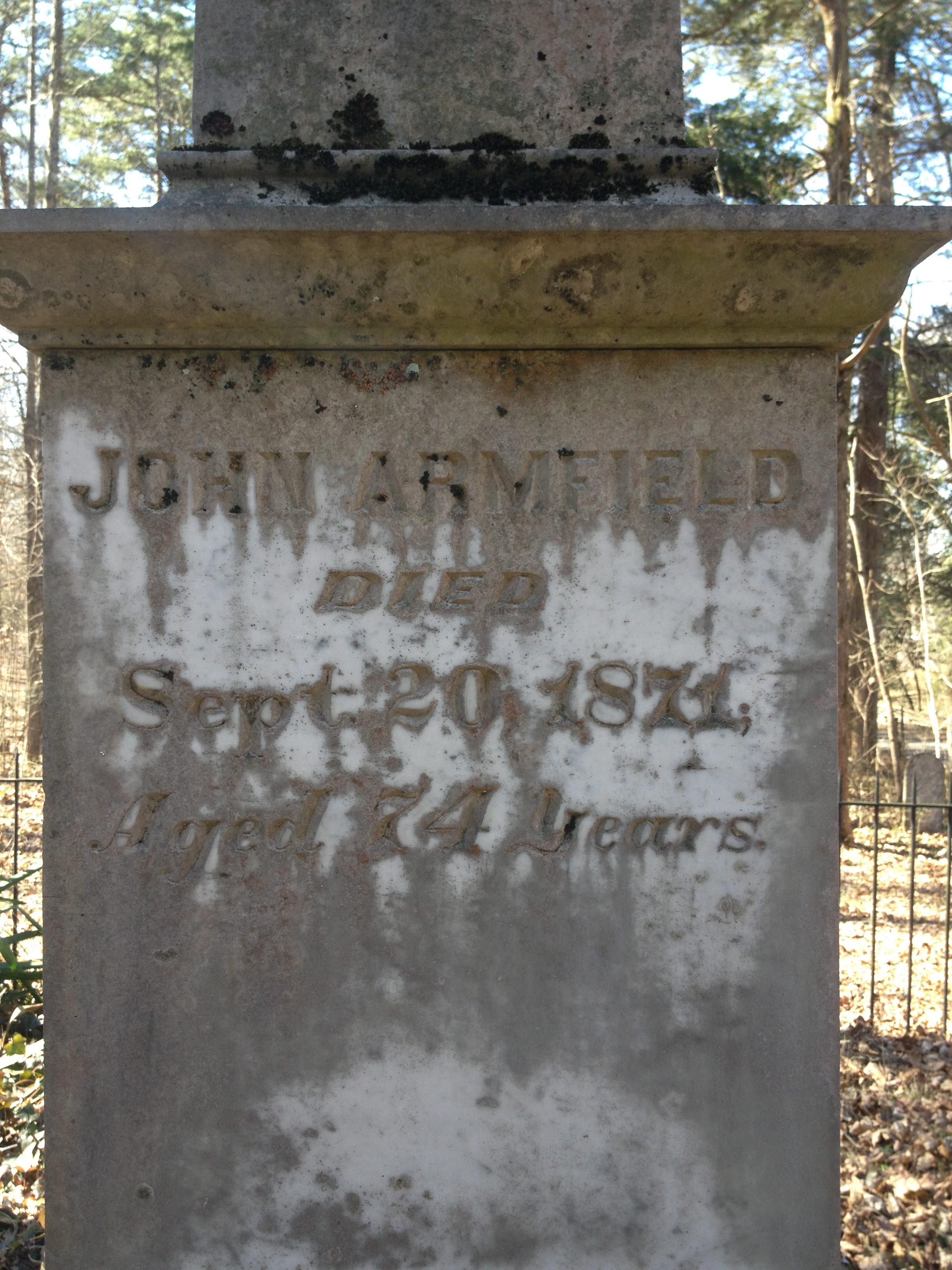 I have a profound antipathy for Armfield who, with Isaac Franklin, ran a successful slave-trading operation. “With headquarters in Alexandria, Virginia, Franklin and Armfield conducted gangs of chained and shackled slaves down the Natchez Trace and sold them in the slave pen on the edge of that Mississippi town,” writes Herschel Gower in the Tennessee Encyclopedia of History and Culture. “The arduous journey took seven or eight weeks, but wealthy cotton planters paid Franklin and Armfield well for their traffic in African flesh. Armfield’s biographer, Isabel Howell, estimated that the pair averaged sales of twelve hundred slaves per year for every year from 1828 to 1835.”
 In the 1850s, Armfield– now rich from slave-trading and enjoying his retirement– began buying up property in Beersheba Springs. Many of the cottages he built at that time are still to be seen in the town. He was close with Bishops Otey and Polk, who owned summer homes in Beersheba, and helped to convince them to build the University of the South on the Cumberland Plateau.
 In this same period, as James L. Nicholson writes in his Tennessee County History Series: Grundy County, “to show his endorsement and in a typical display of his munificence, [Armfield] pledged $25,000 a year during his lifetime to the university.” As Tanner Potts has discovered in his well-researched slideshow on this topic for Sewanee’s Roberson Project, Armfield’s gift to the University was not exactly $25K:
On January 4, 1859, John Armfield pledged 25 installments of $1,000 per year for the construction and upkeep of the first buildings of the University of the South. Armfield’s subscription, pictured below, stipulates that the college must be built near Beersheba Springs and must be of the “first class institutions of learning in the United States.” Armfield’s gift was erroneously reported by the Republican Banner and Nashville Whig as $25,000 per year for the duration of his life. While the actual gift fell short of its myth, the pledge launched the construction of the university shortly after its incorporation.
Whatever the cash value of his support, his name survives on the University’s Domain today as Armfield Bluff.
At lunchtime at the retreat, I had spoken with one of my former students, Gabby, who knows all about the biography of Armfield and Beersheba’s early history. It’s ironic, we agreed, that the retreat, where so much great work is done to confront ingrained issues of institutional racism, should be held here. “But it makes sense, too,” she said. “It’s a sort of re-claiming.”
She’s right, of course, though I wonder if it’s entirely true. As I drove back to Sewanee, it happened that I was listening to a podcast from Radio Diaries on George Wallace’s famous segregation speech (re-broadcast from 2012 in connection with the release of “Selma”). In later years, Wallace would be deeply regretful of his position, and he even went on an “apology tour” of Alabama. Among the people he apologized to was John Lewis, one of the Selma marchers who is now a well-known Congressman from Georgia:
“And I remember the occasion so well,” Lewis says. “It was like someone confessing to their priest or to a minister. He wanted people to forgive him. He said to me, ‘I never hated anybody; I never hated any black people.’
“He said, ‘Mr. Lewis, I’m sorry.’ And I said, ‘Well, governor, I accept your apology.’ ” . . .
“Does it hurt me? No,” Lewis says. “In the end, I think George Wallace was one of the signs on this long journey towards the creation of a better America, toward the creation of a more perfect union. It was just one of the stumbling blocks along the way.”
Postscript, Feb. 7. My friend, David Haskell, sends along a link to a blog called “US Slave” which has images of Franklin and Armfield’s slave-trading business:
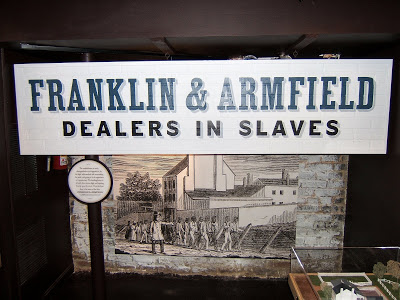
Posted in Cemeteries & Funerals, Education, Sewanee, Slavery, Statues & Monuments, The South
1 Comment
An Ancient Source for the Winking Pizza Chef
According to a piece on pizza box art on the CBS News website today, “The caricature of a smiling mustachioed chef has been a popular feature of pizza boxes for decades. Sources say it dates back to the 1950s, to a hand-painted sign on the roof of Schaller’s Drive-In in Rochester, N.Y., though some claim it dates back even before World War II.” CBS calls this image “The Winking Chef” although, in the example they give online, both of the chef’s eyes are open so that he is not actually winking.
In fact, the gesture he is employing is an ancient Italian one. There is a famous description of the extremely beautiful Psyche found in Apuleius’ Golden Ass, from second-century AD which bears a striking resemblance to what the Winking Chef is doing. As Apuleius writes, “Many of the citizens and plenty of visitors whom the rumor of an outstanding spectacle had gathered with crowded curiosity, would be stupefied in admiration of her unapproachable beauty. Moving a right hand to their mouths with the forefinger resting on an outstretched thumb, they revered her as though she were Venus herself in religious adoration.” Multi denique civium et advenae copiosi, quos eximii spectaculi rumor studiosa celebritate congregabat, inaccessae formositatis admiratione stupidi et admoventes oribus suis dexteram primore digito in erectum pollicem residente ut ipsam prorsus deam Venerem religiosis <venerabantur> adorationibus. (Golden Ass, 4.28)
It doesn’t go so well for Psyche, being compared to Venus. The goddess sets her son Cupid on the beautiful by hapless girl, but he ends up falling in love with her. Adventures ensue, jealous sister are involved, an obligatory trip to the Underworld. It all works out in the end for Cupid and Psyche. I have to think that, with his knowing look, Winking Chef understands it all.
Posted in Cartoons, Classics, Italy
Leave a comment
The Butt-Millet Fountain, A Memorial Hidden in Plain Sight
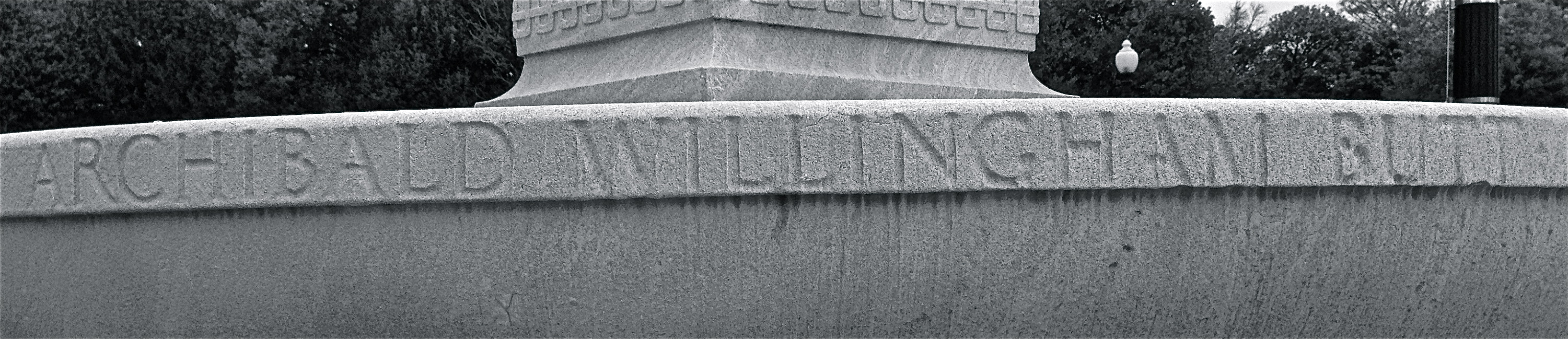
 I have written before about Major Archibald Butt, a notable alumnus of Sewanee who died heroically aboard the Titanic. That’s him to the right, together with President Taft, from a stained glass window in All Saints’ Chapel which commemorates the presidential visit to Sewanee a year before Butt’s death. His traveling companion on that fateful voyage was the artist, Francis Davis Millet, who shared a house with Butt in Washington where they hosted large social gatherings. As it happens, the Butt-Millet Memorial Fountain erected by their powerful and well-connected friends was only few blocks from the hotel I was stayed at last weekend in our nation’s capitol, so I took a morning to go over and visit.
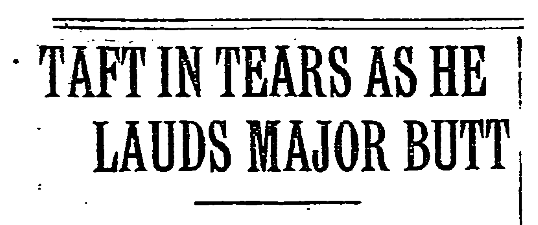 The fountain could not be have been more prestigiously located, as befits two men so well-loved in their day. “Taft In Tears As He Lauds Major Butt,” reads the headline of the New York Times (May 6, 1912, p. 4). It only makes sense that the memorial to a man whom the President loved as a son would be placed close to the White House, close to the very top of the Ellipse. And I suppose it only makes sense that, as the years pass–indeed over a hundred of them–the depth of such feelings for a brave and noble man would subside into oblivion. Today, the monument is hard to find, hidden behind the iron fencing and Jersey barriers that ring the White House. One has to pass by the monument to Butt and Millet, but given all the visual noise along the Ellipse Road and E Street, as well as the yelling Capitol police, it’s easy to overlook the eight foot stone fountain.

The fountain base is made of Tennessee marble, appropriate for Butt, whose connection to the South was a fundamental part of his identity. Above the base on the granite slab is, n one side, a symbolic representation of Valor, fitting for Butt as a military man. Just behind the trees is the White House.

On the other side one sees a representation in Millet’s honor of the Arts. In the distance you can see the Washington Monument.

It has been reasonably suggested Butt and Millet were lovers and if so, there is something poignant about the fact that this memorial stands in so prominent location, a place where tourist go by in droves and droves, and yet somehow seems to go unseen, to be somehow hidden in plain sight.
Posted in Cemeteries & Funerals, Military, Nautical, Sewanee, Statues & Monuments, Tennessee
6 Comments
Protected: Ave atque Vale, Treebeard
Posted in Oxford, Poetry, Sewanee, Trees & Flowers
Enter your password to view comments.
Orwell against mistreatment of prisoners
My last post concernted St. George as an avenger for justice, and in this month, as we process the Senate’s release of the Torture Report, another English George with similar convictions comes to mind. From an unpublished letter of George Orwell to The Times, October 12, 1942:
By chaining up German prisoners in response to similar action by the Germans, we descend, at any rate in the eyes of the ordinary observer, to the level of our enemies. It is unquestionable when one thinks of the history of the past ten years that there is a deep moral difference between democracy and Fascism, but if we go on the principle of an eye for an eye and a tooth for a tooth we simply cause that difference to be forgotten. …
It seems to me that the civilized answer to the German action would be something like this: “You proclaim that you are putting thousands of British prisoners in chains because some half-dozen Germans or thereabouts were temporarily tied up during the Dieppe raid. This is disgusting hypocrisy . . . At this moment we cannot stop you maltreating our prisoners, though we shall probably remember it at the peace settlement, but don’t fear that we shall retaliate in kind. You are Nazis, we are civilized men. This latest act of yours simply demonstrates the difference.”
The whole text can be found in Volume 2 of the Collected Essays, My Country Right or Left, 1940-1943, pp. 243-44.
This is the Orwellian sentiment that has come to my mind these past few weeks, the unpublished protest against inhumane conditions rather than the grimly satirical statements from the Ministry of Truth or the all-too-realistic portrait of Room 101.
Posted in England, Military
Leave a comment
“My Friend George”
Lou Reed, I read in the Times, will be inducted into the Rock and Roll Hall of Fame next April. Various questions arise, of course, chief among which are, Isn’t he already in there? (yes, as a member of the Velvet Underground, so I guess this will be a separate entry) and Shouldn’t it be spelled Rock ‘n’ Roll with a “‘n'” rather than an “and”? (there’s actually a lively debate over this issue, but I guess when you’re naming a Hall of Fame, it won’t do to have an “‘n'” in it: the Victoria ‘n’ Albert Museum, for instance, would just sound silly and might lead people not to go in gawk at all the antique tchotchkes, and perhaps the slangy “‘n'” would turn away customers who would otherwise pay good money to gaze upon Ramones memoribilia. It’s about dignity, people! But perhaps I digress).
Anyway, I remember the first Lou Reed record I bought, actually as a cassette, back in 1984 called New Sensations. This is not one of Lou’s greatest works, though I liked it pretty well and used to listen to it on my Walkman a lot. Everybody and his brother already knew “Walk on the Wild Side” and “Sweet Jane,” but New Sensations was hailed for its brighter, boppier sound. “I Love You, Suzanne” had a happy guitar lick and not a single reference to drug addiction so far as I could tell.
The song I liked best on the album, though, was a darker one called “My Friend George”– I’ve appended the lyrics below, as well as a Youtube clip– and I am pleased to see that, in an interview with Jonathan Cott in Rolling Stone from 1989, Lou claimed that he liked it best, too. In his review of the album, Kurt Loder called the song a “lovely, loping” lament for “the hard times of a violent (and possibly psychotic) old pal,” which is sort of right– the song begins, Read in the paper ’bout a man killed with a sword/ and that made my think of my friend George / People said the man was five foot six / sounds like George with his killing stick. Lou said a little more about it in the Rolling Stone interview that’s worth noting:
That’s my favorite song on that album. I remember that when we were recording it, the engineer turned to me and said, “Do you have a friend named George?” And I said, “Of course not.” One of the nice things about being a writer is that you can have a friend named George.
As the singer indicates, George is not a real person but a symbol, a kind of heroic figure, and it was as such that I liked him so much. My favorite part of the song is when the narrator meets up with his friend at a local bar, after having heard that he’s “got this stick.” George “was wired up,” the lyrics go, and then the following occurs:
Avenge yourself he says to me
avenge yourself for humanity
Avenge yourself for the weak and the poor
stick it to these guys right through their headsWell, the fight is my music, the stick is my sword
and you know that I love you, so please don’t say a word
Can’t you hear the music playing, the anthem, it’s my call
and the last I seen of George was him
running through the door
It’s the “stick it to these guys right through their heads” that really gets me, that expression of a visceral hatred of injustice demanding immediate, violent response which breaks the rhyme and meter of the song, the audio equivalent of “him running through the door.”
The sentiments of the song sound just as fresh now– in these days of protest over the deaths of Michael Brown and Eric Garner and so many others, not to mention the simmering anger at the utter failure of any criminal proceedings to be brought against the Wall Street bankers who wrecked the economy in 2008–as they did when I first was listening to Lou on my primitive headphones back in the day.
As it happens, I was a student in London in 1984, and the sense of class resentment at the time was at a complete boil. Margaret Thatcher was utterly at war with the National Union of Miners led by Arthur Scargill in what was probably the last great labor movement of the twentieth century; the miners’ strike would last until the following spring and eventually end with the complete destruction of the union, but not before thousands lost their livelihoods and were forced onto welfare. Coal Not Dole read the buttons one saw everywhere. “We had to fight the enemy without in the Falklands,” Thatcher said at the time of the strike. “We always have to be aware of the enemy within, which is much more difficult to fight and more dangerous to liberty.” The rhetoric was more than matched by action, with police forces in riot gear battling strikers in widely-reported confrontations. The anger on the streets was palpable, not just in the run-down parts of North London but even the fashionable districts near the Victoria ‘n’ Albert Museum. At the age of twenty, it all seemed so wrong to me, and Lou’s friend George seemed so right.
 During this turbulent period, I can remember one time riding on the top floor of a double-decker bus through the affluent neighborhood of St. John’s Wood, not far from Lord’s Cricket Ground and the Abbey Road studio. The bus careened alongside the roundabout, in the center of which stood a life-size bronze statue of a mounted St. George killing a dragon on a high plinth. I’d passed by it numerous times, admiring the way the medieval legend of England’s patron saint had been re-purposed as a memorial to both world wars. On this particular morning, however, it happened that I was listening to New Sensations as we drove on by the monument. There was Charles L. Hartwell’s saint driving his lance through the monster’s neck while Lou sang, “Stick it to these guys right through their heads.” Everywhere else in St. John’s Wood, well-heeled business men and women made their way, copies of the Telegraph tucked under their arms, untroubled by the miners’ misery. I gasped at the sudden epiphany.
By some chance, could Lou be referring to St. George in this song, I wondered. Could the killing stick be the saint’s lance, could the bastards he’s fighting be any number of gold-hoarding dragons? Lou was Jewish, of course, but was more than willing to employ Christian symbolism when it suited him. When he died in 2013, in fact, Cardinal Gianfranco Ravasi tweeted,
And I suppose what I hear in “My Friend George” is a yearning after justice, and three decades later, that sound is undiminished. This coming March will mark the thirtieth anniversary of the end of the Miners’ Strike, and what it continues to mean for England remains unclear. Just a few weeks later, on April 18th, the late Lou Reed will be inducted into the Hall of Fame in Cleveland, a city now embroiled in protests over the killing of Tamir Rice. Less than a week later, on April 23, it will Saint George’s Day. Hey bro, what’s the word? Talkin’ ’bout my friend George, You talkin’ ’bout my friend George.
Read in the paper ’bout a man killed with a sword
and that made my think of my friend George
People said the man was five foot six
sounds like George with his killing stick
Hey bro, what’s the word
talkin’ ’bout my friend George
Hey bro, what’s the word
talkin’ ’bout my friend George
You talkin’ ’bout my friend George
I knew George since he’s eight
I always thought that he was great
And anything that George would do
you know that I would do it too
George liked music and George liked to fight
he worked out in a downtown gym every night
I’d spar with him when work was done
we split lips but it was all in fun
Hey bro, what’s the word
you talkin’ ’bout my friend George
Hey bro, what’s the word
talkin’ ’bout my friend George
Talkin’ ’bout my friend George
Next thing I hear George’s got this stick
he’s using it for more than kicks
I seen him down at Smalley’s bar
he was wired up, I tried to calm him down
Avenge yourself he says to me
avenge yourself for humanity
Avenge yourself for the weak and the poor
stick it to these guys right through their heads
Well, the fight is my music, the stick is my sword
and you know that I love you, so please don’t say a word
Can’t you hear the music playing, the anthem, it’s my call
and the last I seen of George was him
running through the door, I says –
Hey bro, what’s the word
talkin’ ’bout my friend George
Hey bro, what’s the word
you talkin’ ’bout my friend George
Talkin’ ’bout my friend George
Hey bro, what’s the word
you talkin’ ’bout my friend George
Hey bro, what’s the word
what me saying ’bout my friend George
Hey bro, what’s the word
hear you talkin’ ’bout my friend George
Hey bro, what’s the word
I hear talkin’ ’bout my friend George
Posted in England, Music
5 Comments
The Eroticism of the Gettysburg Address
The androgyne of Aristophanes’ speech in Plato’s Republic is a deeply comic myth on the nature of eros, one that has been put to music in Hedwig and the Angry Inch (see below). I have long wondered whether the strange male birth imagery in the Gettysburg Address ought to be understood as a Platonic ideas about eros, and now am glad to see this idea in a scholarly book. (By the way, I have no opinion on suggestions about Lincoln’s own sexuality!)
From Kerry T. Burch, Democratic Transformations: Eight Conflicts in the Negotiation of American Identity (Bloomsbury Publishing 2012) p. 20:
Eros, the ancient Greek term that describes a form of love, is a symbol uniquely endowed to help us grasp the deeper layers of meaning of the Gettysburg Address. While popular conceptions typically reduce eros to the realm of sexuality, let us recall that Plato wrote the Symposium to articulate the powerful educational dimensions of the concept. In his classic treatment on love, Plato has Aristophanes define eros as “the desire for wholeness,” a theme in symmetry with Lincoln’s identification of the “unfinished work” facing the nation. The life-enhancing energies of eros have long been recognized as vital to the process of self-knowledge and to the development of community. Rollo May tells us that “eros is a state of being” an ardent desire which provides the condition of possibility for an individual to be “magnetized” toward the vision of an imagined good, for oneself or for one’s larger community. One of the defining strands of eros therefore consists of a passion for changing things for the better, individually and civically.
With this broad understanding of eros in mind, it is easier to recognize how Lincoln’s consistent use of birth imagery—“brought forth,” “conceived,” “created,” and “new birth of freedom” –affirms the erotic character underlying the Gettysburg Address. Not only are these erotic signifiers woven into the fabric of the speech but they also emerge from a background of contradiction and are presented as resolutions to that contradiction.
Indeed, it is precisely a heightened awareness of this contradiction that prompts Lincoln the teacher to ask Americans to reconnect to their democratic tradition as a way out of their collective predicament. The desire to move toward and connect to something better, whether to a person, to an object of knowledge, or to a sense of national wholeness, is not only an erotic energy but is also educable. Similarly, Lincoln wanted Americans to reinvent themselves in light of what was “truly good,” holding that such goodness would be impossible to bring forth without a prior grounding in the values and principles enshrined in the Declaration. That Lincoln’s civic pedagogy has an erotic character is also evidenced by his ability to fashion Gettysburg as an aesthetic event in which the teacher, representing beautiful ideas, succeeds in stimulating a desire among citizens to reinvent the nation on the basis of a common good of equality and opportunity, that is, on the basis of a philosophical idea.


 uncomelyandbroken
